
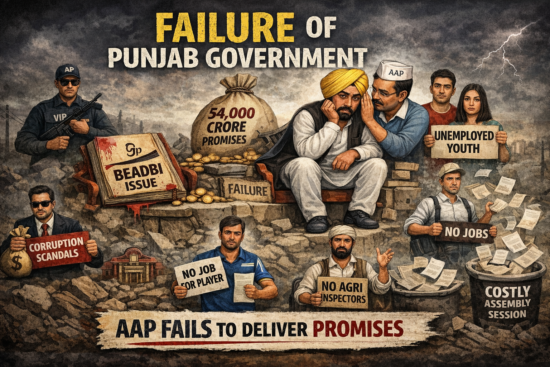
Since the formation of the Aam Aadmi Party government in Punjab in March 2022 under Bhagwant Mann, the party projected itself as a symbol of clean politics and anti-corruption governance. AAP had entered Punjab politics with promises of “badlav” and transparent administration, assuring people that corruption would not be tolerated under any circumstances. The government even launched an anti-corruption helpline and encouraged citizens to report bribery and misuse of power. However, over the last four years, several ministers, MLAs, and party leaders have faced allegations, investigations, ED raids, vigilance actions, and arrests, creating major political controversies across Punjab.
The first major shock came only a few months after AAP formed the government. In May 2022, Health Minister Vijay Singla was removed from the cabinet and arrested in a corruption case. Chief Minister Bhagwant Mann himself announced that Singla had allegedly demanded a 1% commission from officials linked to departmental contracts and tenders. The arrest became national news because it was one of the rare cases where a ruling party minister was publicly removed and arrested by his own government. AAP leaders claimed this action proved that the party was serious about fighting corruption and would not protect anyone, regardless of position. However, opposition parties argued that the incident exposed how corruption had already entered the system despite AAP’s promises.
During 2022 and 2023, Punjab Vigilance Bureau intensified anti-corruption operations across the state. Hundreds of officials, police personnel, and politically connected individuals were investigated or arrested in bribery and misuse of authority cases. At the same time, opposition leaders alleged that the government was selectively targeting rivals while trying to shield influential figures inside the ruling party. Political debates over corruption, illegal mining, municipal irregularities, and misuse of government machinery became increasingly common in Punjab’s political atmosphere.
Another major controversy emerged in 2025 involving AAP MLA Raman Arora. The Punjab Vigilance Bureau arrested him after allegations surfaced regarding corruption and extortion through bogus municipal notices. Investigators claimed that fake notices were allegedly issued to residents and builders to extract money. Raids were conducted at his residence and other linked locations. The arrest became politically embarrassing for the ruling party because Raman Arora was considered an influential urban MLA. Opposition parties immediately accused the government of failing to control corruption within its own ranks and questioned AAP’s “clean governance” image.
As pressure mounted on the ruling party, political confrontations between AAP and opposition parties intensified further during 2025 and 2026. BJP leaders repeatedly claimed that enforcement agencies were exposing large-scale corruption inside Punjab’s ruling structure. AAP, on the other hand, accused the BJP-led central government of misusing agencies like the Enforcement Directorate and CBI to target opposition governments politically. The confrontation gradually turned into a battle of narratives, with AAP calling it “political vendetta” while opponents called it “exposure of corruption.”
In March 2026, another controversy damaged the party’s image when AAP MLA Harmeet Singh Pathanmajra was arrested in a rape and criminal intimidation case after reportedly remaining absconding for months. The arrest attracted significant public attention because AAP had repeatedly claimed that it represented a new political culture different from traditional parties. Opposition leaders argued that repeated arrests involving AAP legislators were weakening public trust in the government.
During the same period, former cabinet minister Laljit Singh Bhullar was also reportedly taken into custody, adding to the growing list of controversies involving ruling party leaders. Political observers noted that these repeated incidents were beginning to create pressure on the Bhagwant Mann government, especially because AAP had built its political identity around honesty and accountability.
The biggest political storm of 2026 emerged when the Enforcement Directorate launched raids connected to alleged fake GST transactions and money laundering investigations involving Punjab minister Sanjeev Arora. The ED later arrested him in connection with an alleged ₹100 crore money laundering case. The raids triggered massive political reactions across Punjab. Chief Minister Bhagwant Mann strongly defended his minister and accused the BJP-led Centre of using central agencies to destabilize opposition governments. BJP leaders, meanwhile, claimed that the investigations had exposed deep-rooted corruption inside Punjab AAP.
Punjab AAP president Aman Arora also came under political pressure after his name surfaced during ED-linked investigations involving businessmen allegedly connected to land and commercial approval matters. Aman Arora denied all allegations and stated that his name was deliberately dragged into the controversy to politically defame him before elections. The matter further intensified the political conflict between AAP and BJP in Punjab.
These repeated allegations, raids, arrests, and investigations have significantly affected Punjab’s political environment. When AAP entered Punjab politics, it positioned itself as a cleaner alternative to Congress and Shiromani Akali Dal. Many voters supported the party believing it would bring transparent governance and reduce corruption. However, repeated controversies involving ministers and MLAs have raised serious questions among critics regarding whether the party has been able to maintain the standards it promised before elections.
At the same time, AAP supporters argue that the government has shown greater willingness to take action against its own leaders compared to previous governments. They point out that ministers and MLAs were removed, investigated, or arrested instead of being openly protected by the party leadership. According to AAP leaders, this reflects accountability rather than political failure.
The timeline of events from Vijay Singla’s arrest in 2022 to the ED action against Sanjeev Arora in 2026 highlights how Punjab politics has increasingly become dominated by corruption allegations, vigilance probes, ED raids, and political confrontation. Whether these actions represent genuine accountability or politically motivated investigations remains a deeply debated question in Punjab’s political landscape.