
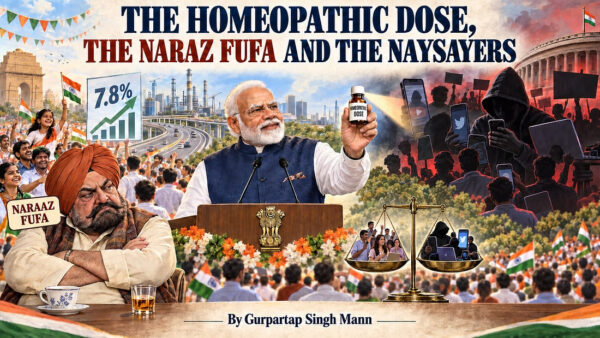
Prime Minister Narendra Modi says the “homoeopathic dose” he administered from the Red Fort has worked. The moment he mentioned “dimaagi Naxals”, they began emerging from everywhere and exposing themselves, he told students at Shri Ram College of Commerce.
Six months before Modi’s Independence Day speech, I had argued that Naxalism was not merely a .303 gun. It is also a method and an ideology. The rifle can be replaced by a smartphone, the pamphlet by a viral reel and the jungle meeting by a podcast or university platform. A gun shoots one; a manufactured digital narrative can mislead thousands.
Its objective need not be the violent overthrow of the state. It may be to spread fear, create permanent distrust, delegitimise institutions, turn every grievance into confrontation and obstruct development as a matter of habit. The gun may disappear while the method survives.
However, Capt. Amarinder Singh has raised an important question. In a recent article, he asked the Prime Minister to distinguish a “dimaagi Naxal” from a lawful dissenter. Coming from a senior BJP leader, former soldier and former chief minister who has dealt with terrorism, his caution cannot be brushed aside as Opposition noise because in this era of politicians, he is the most meaningful.
A democracy needs critics. A student protesting an examination, a farmer questioning policy, a journalist exposing wrongdoing or an Opposition leader attacking the government does not become a Naxal. Every democracy also has what Modi amusingly called the naraz fufa, the permanently offended uncle who objects even during celebrations. He may be spectacularly wrong, but he usually needs a cup of tea or, in Punjab, perhaps a Patiala peg to iron out his ego. To understand a Naraz Fufa watch this humours Punjabi film

At the same time, Amarinder Singh’s warning cannot become an excuse to deny an organised ecosystem of disruption, sometimes amplified, financed and controlled from overseas. Punjab has repeatedly seen genuine farmer concerns appropriated by groups whose politics and often their business is to remain in perpetual agitation, road blocks and dharnas. For them, every industrialist is a thief, every highway a conspiracy, every reform is sale of the nation and every police action is fascism. A state cannot live permanently at a dharna and still expect investment and jobs. There are few journalists on youtube who are the torch bearers in this campaign.
The same habit appears in the economic debate. India recorded 7.8 per cent GDP growth despite war, oil shocks and global uncertainty. In an earlier article, I placed it alongside record exports of $863.1 billion and foreign-exchange reserves of $729.33 billion. Modi rightly observed that some people found the growth number difficult to digest, probably they question the base line, the earlier years data to challenge this years data.
Questions about jobs, income distribution or statistical methodology are legitimate. I have myself argued that India is growing despite a colonial mindset of the administration, a painfully slow judiciary and almost no serious agricultural reforms since 1947. But questioning a number after studying it is criticism; declaring every favourable number fraudulent, merely because it favours India, is a different “mental ailment.”
India has seen the power of narrative before. The CAG under Vinod Rai put enormous figures into the 2G spectrum and coal-allocation debates. The 2G figure was expressly an estimate of “presumptive loss”; the coal report estimated financial gains to private parties that the government might have captured. These were audit calculations, not equivalent to cash proved stolen. Yet television studios converted estimates into verdicts, and the BJP used them relentlessly to batter Dr Manmohan Singh’s government.
This does not mean there were no irregularities: the Supreme Court cancelled most coal allocations, while the 2G acquittals remain under appeal. The BJP, having benefited from that narrative storm, is now discovering how it feels to stand in one.
The dividing line must therefore be clear. Dissent questions the government; “dimaagi Naxalism” systematically seeks to defame and delegitimise the state. Dissent demands evidence; propaganda manufactures evidence and convenient narratives. Criminal action must follow only where thought becomes conduct incitement, financing, conspiracy or deliberate assistance to violence.
Modi’s homeopathic pill has started a useful debate. The armed Naxalite may be disappearing from the jungle, but manufactured negativity, organised obstruction and ideological anarchy remain. They must be fought with facts, with reforms, communication (the GenZ way) and better ideas.