
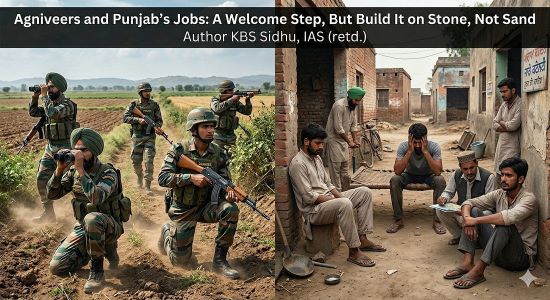
 The Punjab Government’s decision to constitute a high-powered committee to formalise job reservation for Agniveers in state government services deserves to be welcomed — warmly, but not uncritically. The committee is headed by Vikas Pratap, a distinguished 1994-batch IAS officer currently serving as Additional Chief Secretary, Technical Education and Industrial Training — a senior and experienced Punjab cadre officer of proven administrative ability. It includes Sumer Singh Gurjar, Principal Secretary, Defence Services Welfare, who brings direct departmental relevance and institutional knowledge to the exercise. The presence of Bhawna Garg, a lady IAS officer and topper of her batch, adds further intellectual heft. This is a credible team, and one is confident it will produce credible recommendations — provided the government gives those recommendations the statutory force they deserve.
The Agnipath Reality: Three Out of Four Will Return
The urgency of the matter cannot be overstated. Under the Agnipath scheme, Agniveers serve a fixed tenure of four years — six months of rigorous training followed by three and a half years of deployment. At the end of that tenure, only 25 per cent are absorbed into the permanent cadre of the armed forces. The remaining 75 per cent — three out of every four Agniveers — return to civilian life, young and trained but without pension, without permanent employment, and without a structured pathway forward. Punjab, which has historically contributed a disproportionately large share of the nation’s soldiery, will face a significant annual inflow of skilled, disciplined young persons who need to be gainfully absorbed into the state’s workforce. To ignore this reality would be not merely a policy failure but a betrayal of the families that have stood behind the uniform for generations.
A Personal Reminiscence: When the Stars Were Aligned
I write on this subject not merely as an observer. In 2002, upon my promotion to the Secretary rank, I was posted as Secretary, Defence Services Welfare, Punjab. Chief Minister Captain Amarinder Singh — himself a decorated war veteran and an enthusiastic champion of soldiers’ welfare — held the portfolio personally. The Chief Secretary, Y.S. Ratra, was also an ex-serviceman. The atmosphere was uniquely conducive to reform, and I had the rare privilege of placing my files directly before the Chief Minister at a relatively junior stage of seniority. Stars of this alignment are rare in public life, and one had to make full use of the opportunity.
The Statutory Foundation: 13 Per Cent, on Paper
The backbone of everything we attempted then — and everything this committee must build upon now — is the Punjab Recruitment of Ex-Servicemen Rules, 1982. Notified on 12 February 1982, and framed under the proviso to Article 309, read with Articles 234 and 318 of the Constitution of India, these rules reserve 13 per cent of all direct recruitment vacancies across State civil services and posts for ex-servicemen. This is among the more progressive reservations in any Indian state and reflects Punjab’s deep historical covenant with its military families.
The rules also carry a humane proviso: where an ex-serviceman with the requisite qualifications is not available, the reserved vacancy passes to the wife or one dependent child — and later, through an amendment, to lineal descendants including sons and daughters whether married, unmarried, widowed, or legally divorced. The original use of the word “dependent” had created endless litigation — was a married daughter dependent? A widowed daughter who had re-married? A daughter who held another job? During my tenure, we moved the crucial amendment replacing “dependent” with “lineal descendant,” which the rules now explicitly define to include daughters regardless of their marital status or economic independence. This single amendment opened the door for daughters to claim reserved vacancies in their own right — particularly important for specialised posts such as college lectureships and MBBS appointments where ex-servicemen themselves were rarely available in adequate numbers.
The Uncomfortable Truth: 13 Per Cent Reserved, Barely 2 Per Cent Filled
Here is where the story becomes painful. Despite the 13 per cent statutory quota, the actual absorption of ex-servicemen into state government jobs has been a fraction of what the law envisages.
Parliamentary data, as reported by The Tribune, tells a damning story. Of 60,772 ex-servicemen registered for re-employment in Punjab, only 1,150 were actually employed against reserved vacancies — a placement rate of barely 1.89 per cent. Punjab, which accounts for over 2.71 lakh ex-servicemen receiving government pensions (as per data placed before Lok Sabha), and which sees approximately 6,500 ex-servicemen retire from service every year at the young age of 35 to 45 (as per PESCO), is giving government jobs to fewer than two out of every hundred who register for one.
The reasons are systemic and well-known: vacancies are advertised without properly highlighting the ex-servicemen component; reserved posts are carried forward perfunctorily and then quietly “reverted” to the general category on the plea that no suitable candidate was found; contractual and outsourced appointments — which have proliferated enormously — are entirely outside the reservation framework; and there is no single dedicated body to track, advertise, and fill ESM vacancies across all departments. The result is that the 13 per cent reservation exists largely on paper, as a statutory aspiration rather than a living covenant.
A Proposal Whose Time Has Come Again: A Dedicated Recruitment Board
During my tenure in 2002, I placed before the Chief Minister an ambitious proposal: a dedicated Ex-Servicemen Recruitment Board, headed preferably by a retired Lieutenant General or Major General, which would handle transparent, time-bound recruitment across all non-gazetted vacancies reserved for ex-servicemen and their dependants — rather than leaving each department and each recruitment board to manage its own ex-serviceman component independently, with predictable results. Instead of fragmentation and opacity, a single-purpose board with institutional memory, a published annual recruitment calendar, and dedicated staff could have transformed the reservation from a pious declaration into a living instrument.
The proposal was sabotaged by entrenched interests who argued that it would trigger parallel demands from other reserved categories. It was, frankly, a specious objection. The ex-servicemen reservation is horizontal in nature and does not displace other reservations; a dedicated board would simply ensure that what is already due to veterans is actually delivered. I believe the time has come to revive this proposal — and the arrival of Agniveers on the scene, adding a new and numerically significant class of discharged military personnel, makes it even more imperative.
Track From Day One, Not Day Last
One further innovation must be built into the framework from the outset. From the very day an Agniveer is recruited — not after four years when he or she is discharged — the Department of Defence Services Welfare should begin building and maintaining a live database: qualifications, skills, area of specialisation during service, domicile, languages known. When the Agniveer completes tenure and returns home, the state should not need to start from scratch. The department should proactively reach out with appropriate job offers — in government service, in public sector undertakings, and in the private sector — rather than waiting for the discharged Agniveer to navigate a bewildering system alone. Proactive tracking and outreach, not passive registration, must be the model.
Statutory Rules, Not Executive Instructions
One more caution is essential. Whatever framework this committee recommends must be given the form of statutory rules framed under the proviso to Article 309 of the Constitution — not mere executive instructions issued by government circulars and office memoranda. Executive instructions are fragile. They are susceptible to legal challenge, to quiet dilution by successive governments, and to death by administrative neglect. The 1982 Rules have endured for over four decades precisely because they have statutory force. The Agniveer reservation must stand on equally firm ground.
Punjab’s Jobs for Punjab’s Soldiers: The Domicile Imperative
Finally, a point that must be settled without ambiguity. Domicile in Punjab and proficiency in Punjabi up to Class X level must be mandatory qualifications for any reservation under these rules. Punjab cannot afford a scenario where Agniveers recruited from neighbouring states — Haryana, Himachal Pradesh, Rajasthan — occupy vacancies that were designed for Punjab’s own sons and daughters. The state’s sacrifice is the justification for the reservation; that justification cannot be extended to those who have no roots in Punjab’s soil. The rules must say so clearly, and recruitment boards must enforce it without exception.
Conclusion: From Welcome Gesture to Durable Covenant
The Punjab Government’s decision is a welcome gesture. The committee it has constituted has the expertise to translate that gesture into sound policy. But gestures alone do not protect families. What is needed is a durable, robust, statutory framework — backed by a dedicated recruitment board, a proactive tracking mechanism for serving Agniveers, mandatory domicile and language conditions, and iron-clad insulation from contractual and outsourcing evasion.
Punjab has always been the sword arm of the nation. Those who unsheathe that sword must never be left without a shield when they come home.