
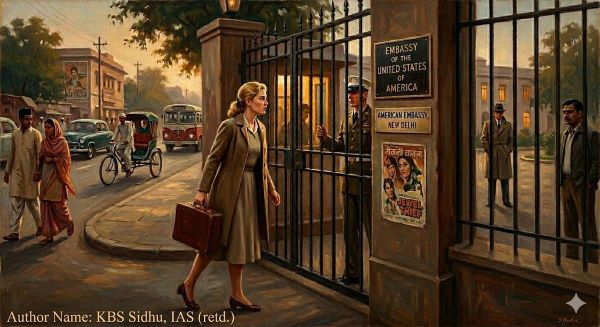
 On a warm March day in 1967, a fair‑skinned woman, barely out of her twenties, walked up to the gates of the U.S. Embassy in New Delhi with a small suitcase and a heavy secret. She calmly told the Marine guard that she was the daughter of Joseph Stalin, the Soviet supremo, and that she wanted asylum in the United States. Inside, the diplomats turned pale. They knew at once that this was no routine consular plea but a potential Cold War explosion—staged not in Berlin or Vienna, but in the Indian capital.
The woman was Svetlana Iosifovna Alliluyeva, Stalin’s only daughter and youngest child. Born into the very heart of Soviet power, she had spent her childhood within the Kremlin, witnessing both privilege and terror. Her mother, Nadezhda Alliluyeva, had died under murky circumstances when Svetlana was still young, and her relationship with her father was scarred by emotional distance and his ruthless politics. Over time, she came to resent both the man and the system he had built, even as she remained, in the eyes of the world, “Stalin’s daughter.”
An unlikely Indian route to freedom
Svetlana’s path to New Delhi began not with geopolitics but with a love story. In the early 1960s, she fell in love with an Indian communist, Brajesh Singh, who was in Moscow for medical treatment. The Soviet authorities refused to allow them to marry formally; a union between Stalin’s daughter and a foreigner, especially from the developing world, was viewed as politically awkward. Nevertheless, their relationship deepened, and when Singh’s health deteriorated, he returned to India, leaving Svetlana behind in the USSR.
In 1966, Singh died. Soviet leaders, anxious about appearances, grudgingly permitted Svetlana to travel to India to immerse his ashes in the Ganga and visit his family in Kalakankar, a village in Uttar Pradesh. It was a rare concession: Stalin’s daughter was allowed beyond the Iron Curtain, albeit under tight control. Her movements were closely monitored by the Soviet Embassy, which held her documents and expected her to return promptly once the rituals were completed.
Her visit coincided with India’s 1967 general election—the first major national contest after Jawaharlal Nehru’s death—so Delhi’s political class and media were preoccupied. Soviet and Indian officials kept her presence low‑key; there was no desire in New Delhi to attract attention to such a sensitive guest. Yet, away from Moscow and the austere discipline of the Soviet state, Svetlana breathed an unfamiliar air of freedom. In rural India and in the bustle of Delhi, she sensed possibilities that had never existed in her cloistered life in the Kremlin.
Indira Gandhi’s sympathetic distance
Indira Gandhi, then Prime Minister and barely into her second year in office, met Svetlana during this period while she was in the thick of the election campaign. Accounts suggest that Svetlana confided in her, asking—at least informally—for help in staying on longer in India. Indira is said to have responded with personal sympathy but marked political caution. India in 1967 was formally non‑aligned, but its strategic tilt toward the Soviet Union was unmistakable, especially after the 1962 war with China and Western hesitations on defense cooperation. Facilitating the prolonged stay, let alone asylum, of Stalin’s daughter against Moscow’s wishes could risk serious damage to a vital relationship.
New Delhi therefore chose not to intervene. There would be no formal asylum, no bold humanitarian gesture, no public defiance of Soviet preferences. To the Indian state, Svetlana remained a Soviet citizen on a private visit, under the ultimate care and control of her own embassy. When the Soviets indicated it was time for her to return, India did not stand in the way.
Svetlana saw it differently. To her, the refusal to grant protection or even a longer stay was a painful rejection by a country where she had felt a rare sense of emotional connection. In later accounts, she wrote bitterly that India had refused her asylum, a judgment that would resonate uneasily in New Delhi once the full consequences of what happened next became clear.
“I want asylum”: the U.S. Embassy gambles
As her scheduled departure to Moscow approached, Svetlana’s dread deepened. She did not want to go back to the Soviet Union, to its informers and constraints, to the role of “Stalin’s daughter” that she increasingly despised. On 6–9 March 1967 (sources differ by a few days), she made a desperate choice. Slipping away from her Soviet minders in New Delhi, she took a taxi to the U.S. Embassy and presented herself unannounced.
Inside the embassy, Ambassador Chester Bowles and his staff understood the stakes at once. Accepting the defection of Stalin’s daughter from Indian soil would be a propaganda triumph for Washington—but also a diplomatic minefield. The Johnson administration, wary of provoking Moscow and mindful of India’s sensitivities, was initially cautious. Bowles sent urgent messages home, asking for instructions.
What followed, however, owed as much to personalities as to policy. Bowles, a long‑time friend of India and a committed liberal, decided on moral and political grounds that the United States should not turn Svetlana away. Working closely with CIA officer Robert Rayle, he arranged for her to be given the necessary documentation and quietly booked on a commercial Qantas flight out of New Delhi. Crucially, they did this without formally involving the Government of India. The logic was blunt: if India were officially notified, it might feel compelled to consult Moscow or even detain her; better to make sure she “got on the plane on her own.”
Within hours, Svetlana had ceased to be a Soviet guest in India and had become, in effect, an American protégé. She flew to Rome, then moved on to Geneva, while Washington debated how publicly to embrace this unexpected Cold War prize.
India in the crossfire
For Moscow, the optics were humiliating. The daughter of the man who embodied Soviet might had not only repudiated communism but had done so from the territory of a friendly non‑aligned state, ending up under the protection of its capitalist rival. Soviet leaders directed much of their anger toward New Delhi. In their view, India had failed to “take proper care” of a high‑profile visitor and had allowed her to vanish into the hands of the Americans.
Indira Gandhi’s government thus found itself in an unenviable position. It had not invited this drama, had not sanctioned U.S. actions, and had not granted any asylum. Yet it could not entirely escape responsibility. The defection had occurred on Indian soil, using Indian airports, under the nose of Indian authorities. For a government already managing a fragile domestic political environment after the 1967 elections, this was an unwelcome storm.
India’s response combined damage control and denial. Publicly, the line was that this was a matter between the Soviet Union and its citizen; India had not been a party to her actions or the American decision. Privately, the government tried to calm Soviet ire while avoiding any open rift with Washington. The episode underlined the tightrope India walked: non‑aligned in theory, but deeply enmeshed in the rivalries of the superpowers.
The Jha mission and quiet de‑escalation
In an effort to demonstrate goodwill to Moscow and to show that Delhi had not colluded with Washington, Indira Gandhi dispatched her Principal Secretary, L. K. Jha, to meet Svetlana in Switzerland. His mission was to persuade her—gently but firmly—to return to the Soviet Union. According to later reports, Jha appealed to her sense of family and patriotism, mentioning her children and the political damage her defection had caused to a country she had once claimed to love.
Svetlana refused. Having taken the extraordinary step of defecting, she was not about to retrace her path back into Soviet custody. With that, the realistic options for India narrowed. It could neither compel her return nor publicly demand it. After the Jha mission failed, the Indian government allowed the matter to fade from the headlines. Over time, the controversy cooled, especially as other global crises pushed it off the front pages.
Yet within diplomatic and academic circles, the episode lingered as a case study in the hazards of Cold War neutrality. It showed how a formally non‑aligned capital like New Delhi could become, in effect, a stage for East‑West espionage and defections—a kind of “Berlin of the East,” where rival embassies eyed one another warily and individuals like Svetlana could turn local chancelleries into gateways of escape.
From New Delhi to New York
Eventually, Washington decided to accept Svetlana publicly. From Switzerland she traveled onward to the United States, arriving at John F. Kennedy Airport in April 1967. Soon after, at a carefully choreographed press conference in New York, she denounced Stalin’s crimes and declared her rejection of Soviet communism. The symbolism was powerful: Stalin’s own daughter, speaking freely in America, became a living indictment of the regime her father had built.
She had brought with her a manuscript—later published as Twenty Letters to a Friend—a memoir‑in‑letters that offered an insider’s view of life inside the Kremlin and the emotional cost of being Stalin’s child. The book became a bestseller, strengthening her status as both a witness to and a refugee from the Soviet experiment.
In the years that followed, Svetlana’s personal trajectory was restless and often unhappy. She moved between continents, changed names (taking “Lana Peters” after an American marriage), and even briefly returned to the Soviet Union before finally settling in the United States, where she died in 2011. But the most dramatic act of her life remained that moment in New Delhi when she walked, unannounced and unescorted, into the U.S. Embassy.
India’s unintended starring role
For India, the episode is a reminder of how easily a non‑aligned state could be dragged into the gravitational pull of superpower politics. By neither granting nor formally denying her asylum, New Delhi tried to remain a spectator. Yet history ensured that India was recorded as the stage on which Stalin’s daughter made her bid for freedom—and as a country that had to mollify an angry Moscow while quietly absorbing the reality that it had become a reluctant junction in the Cold War’s underground railway.
Lessons for India’s Contemporary Leadership
The Svetlana episode of 1967 has offered several lessons that remain relevant even today. It showed first how quickly India’s territory can become a theatre for other powers’ contests, even when New Delhi is not a principal, and therefore why internal coordination between political leadership, foreign office and security agencies is critical to avoid being blindsided. It also underscored the costs of ambiguity: by neither granting nor denying asylum, India tried to stay outside the frame, yet ended up carrying political responsibility in Moscow’s eyes while having little real control over the outcome.
In today’s more fluid, multipolar environment, India is no longer a formally “non-aligned” power trying to keep equidistance, but a multi-aligned state pursuing issue-based partnerships while preserving strategic autonomy. The same structural vulnerability—foreign crises playing out on Indian soil—now coexists with far greater leverage: defence and technology ties with the United States, residual linkages with Russia, energy interdependence with Iran and the Gulf, security cooperation with Israel, and intense competition-cum-economic interdependence with China. Yet this diplomatic flexibility is constrained by economic exposure, with crude prices still hovering around $100 a barrel and the rupee remaining under constant pressure, prompting Prime Minister Narendra Modi to appeal for restraint in expenditure and tighter prioritisation. Managed coherently, this web of relationships allows New Delhi to diversify risk, extract concessions from multiple partners, and resist being locked into any single camp; mismanaged, it could once again leave India carrying disproportionate costs for contests it does not control.