
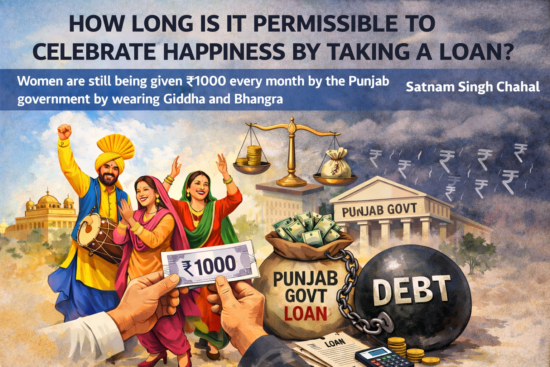
 It was February 2022. Arvind Kejriwal and Bhagwant Mann swept across every corner of Punjab selling one word — “Badlav” (Change). Free electricity up to 300 units, ₹1,000 per month for every woman, restoration of the Old Pension Scheme, and a corruption-free government — these promises touched the hearts of Punjabis so deeply that AAP won a historic 92 seats. The people believed. They voted. They waited for the change.
But today, three years later, that “badlav” is nowhere to be found. Today again, the Mann government borrowed ₹2,500 crore. Last month too, nearly ₹4,000 crore was borrowed. Punjab is not running on revenue — it is running on loans. One after another, month after month, year after year. The state that was once counted among India’s most prosperous has become a textbook case of a debt trap.
The Loan Timeline — Every Step of the Debt
When AAP came to power in March 2022, Punjab’s outstanding debt was already around ₹2.82 lakh crore. Before that, when Congress took power in 2017-18, the figure stood at ₹1.82 lakh crore, and back in 2007-08, Punjab’s debt was ₹55,982 crore. The state was already in a hole. AAP chose to dig it deeper. PTC News
In the very first year of AAP rule, 2022-23, the state took loans worth ₹32,500 crore. This was also the year when the government was scrambling to implement its free electricity promise. In the first two years of AAP’s rule alone, Punjab borrowed as much as ₹47,000 crore, straining finances where a good part of tax revenues went straight into paying interest on previous borrowings. ThePrintBusiness Today
y
In 2023-24, the annual debt increase crossed over ₹29,000 crore. Then came the 2024-25 budget in March 2024, where Finance Minister Harpal Cheema announced the government would raise over ₹41,000 crore in fresh borrowings that year alone, with Punjab’s total debt projected to touch ₹3.74 lakh crore — more than 46 percent of the state’s GDP. Even by that point, the ₹1,000 per month promise for women had still not been delivered — not in the first budget, not in the second, and not in the third. ThePrintThePrint
By September 2024, the situation had become so dire that Punjab formally requested the Ministry of Finance to increase its borrowing limit above the sanctioned amount, just weeks after the state had already sought a bailout package from the Centre. A government that came promising to fix Punjab was now going to Delhi — not with solutions, but with a begging bowl. ThePrint
By March 31, 2025, Punjab’s debt had reached ₹3.83 lakh crore, accounting for over 44 percent of the state’s Gross State Domestic Product. In April and May 2025 alone, the government raised ₹6,241.92 crore in fresh loans. Then came the plan for July to September 2025 — ₹8,500 crore more: ₹2,000 crore in July, ₹3,000 crore in August, and ₹3,500 crore in September. And now today, another ₹2,500 crore borrowed. Last month, ₹4,000 crore. The meter never stops. PTC News + 2
New Loan to Pay Old Loan — The Vicious Cycle
This is where the true tragedy lies. Of all the fresh loans Punjab will raise this year, 86 percent will go solely towards repaying old loans and servicing legacy debt. Punjab is not borrowing to build schools or hospitals or highways. It is borrowing to pay back what it already borrowed. This is not governance. This is financial quicksand. The Tribune
Today, close to 40 percent of Punjab’s entire government revenue goes solely into interest payments. Salaries, pensions, and interest together consume 75 percent of revenue receipts, leaving barely anything for real development. Punjab now owes ₹3,82,935 crore, with projections showing it will reach nearly ₹4,17,136 crore by the end of 2025-26. And to cover the shortfall, the government has even directed boards, corporations, and universities to deposit ₹1,441 crore into its accounts — institutions that are themselves struggling to pay salaries and fund research. The TribuneThe Tribune
Every Punjabi Owes ₹1.24 Lakh
When Punjab’s debt is divided among its population of over three crore, every single resident of the state — man, woman, child, farmer, labourer — carries a debt burden of approximately ₹1.24 lakh. The child who has not yet seen a school. The farmer who still waits for his irrigation water. The daily wage worker who cannot make ends meet. All of them are born into debt they never asked for, never approved, and may never be able to repay. ThePrint
Freebies Funded by Debt — The Cost of False Promises
The free electricity that won AAP crores of votes is now draining the treasury. In 2023-24, Punjab spent ₹8,881 crore on the power subsidy for the agriculture sector alone, and for 2024-25, the total projected power subsidy stands at a staggering ₹22,000 crore. This is money the state does not have. So it borrows. And then borrows more to pay the interest on what it borrowed. To compensate, the government increased collector rates for property registration, hiked road tax on vehicles, and raised VAT on diesel by 92 paise per litre and on petrol by 61 paise per litre. The freebie that was promised for free is actually being silently recovered from your pocket at the petrol pump. ThePrintThePrint
The Government’s Excuse — and the Uncomfortable Truth
The AAP government’s standard defence is that the debt was inherited from previous governments. Finance Minister Harpal Cheema says that nearly 85 percent of borrowings under the current government have been used to repay inherited liabilities. There is truth in that argument — Congress and Akali Dal governments did pile on debt for decades. But here is the uncomfortable question: if you knew Punjab’s finances were in ruins, why did you promise ₹22,000 crore in power subsidies and ₹1,000 per month for every woman without a plan to pay for them? The data tells its own story — under AAP, Punjab’s annual debt increase has been ₹33,721 crore per year, compared to ₹19,867 crore per year under all previous governments combined. PTC NewsThe Tribune
Conclusion — Badlav Came, But Not the One Punjab Voted For
Punjab did get “badlav.” But it was not the change of better schools, safer streets, and prosperous farmers. It was the change of a deeper debt hole, higher taxes, broken promises, and a government that must borrow ₹2,500 crore today just to keep the lights on. The state targets raising ₹34,201 crore in loans this year alone, and by end of March 2026, Punjab’s total debt is projected to cross ₹4 lakh crore. The dream of “badlav” has come at the price of a nightmare written in the language of loans — and every Punjabi will be paying for it for generations to come. Babushahi