
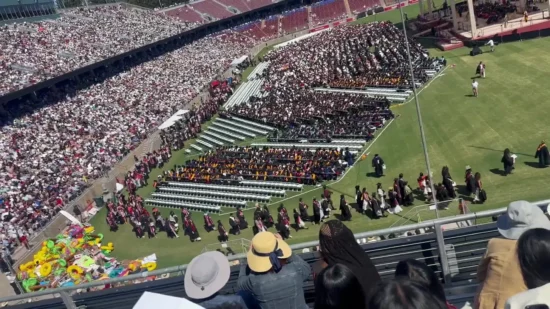
 Stanford Stadium, Sunday. Sundar Pichai, Chief Executive of Google and Alphabet, rises to deliver the commencement address to the graduating class of 2026. As he begins, an estimated couple of hundred students stand up, unfurl Palestinian flags, raise whistles, and walk out, some chanting “Free, free Palestine”. They head towards a parallel event—a self-styled “People’s Commencement”—organised by groups including Students for Justice in Palestine and No Tech for Apartheid. The target of their anger was not the man at the podium personally, but the company he leads, and specifically Project Nimbus, the multi-billion-dollar cloud and artificial intelligence contract Google signed with the Israeli government and military back in 2021. The protesters accuse Google of enabling surveillance, targeting and occupation in Gaza, and of cosying up to America’s own security apparatus through work with the Department of Homeland Security and the Immigration and Customs Enforcement agency.
This was not a spontaneous outburst. It was choreographed, trailed in advance on social media, and consistent with a three-year pattern of pro-Palestinian protest at Stanford commencements. Whatever one thinks of the cause—and reasonable people across the world hold passionate views on Gaza, on Israel, and on the moral accounting of this terrible war—the fact remains that this was a graduation ceremony. It was a day set aside for families who had travelled from across America and beyond, for parents who had saved and sacrificed, for young men and women crossing a threshold that comes but once in a lifetime. To turn that moment into a stage for a walkout, however sincerely felt the cause, was an act that deserved sharper condemnation than it has received in much of the commentary that followed. There is, as the old phrase goes, a time and a place for everything. A commencement ceremony, with thousands of families watching, is neither the time nor the place to stage a political confrontation that could have been mounted—with equal force and far greater dignity—outside the stadium gates, or at any of a hundred other moments in the academic calendar.
II. What Pichai Actually Said
Set against this noisy backdrop, Pichai’s own remarks were almost defiantly quiet. Here was the head of one of the world’s most consequential artificial intelligence companies, addressing a graduating class at the height of a season in which AI itself has become a lightning rod—other speakers, including Eric Schmidt at the University of Arizona, were booed for precisely this subject—and Pichai chose, deliberately, to say nothing about it. Not a word about large language models, not a word about the technology that bears his company’s name across the world’s search bars and now its AI assistants. Instead, his speech was personal, almost confessional: stories of skipping classes as a young man, of getting lost, of the winding path that eventually led him to Google. The tone was philosophical rather than triumphant—an invitation to “choose optimism”, to be patient with oneself when plans go awry, to find meaning in the unplanned detours of a life.
There is something almost touching about a man of Pichai’s stature choosing, on the biggest stage available to him that week, to speak about life rather than about his life’s work. It was a speech about humility, about second chances, about the unglamorous business of growing up—the sort of address that, in a calmer year, might have been remembered fondly as a refreshing change from the usual chest-thumping about disruption and the future. That it was instead overshadowed by a walkout, and that the walkout itself was aimed at the very company whose triumphs Pichai modestly declined to recount, is one of the odder ironies of this commencement season. He came bearing reflection and philosophy; he left having barely been heard.
III. Vinod Khosla’s Retort
Into this scene stepped Vinod Khosla, the veteran India-born venture capitalist, with characteristic bluntness. Reacting on social media to coverage of the walkout, Khosla accused the protesting students of “stupidity”, calling them “biased, idiotic, short-sighted and very selfish” for turning their backs on Pichai and on Google—a company he credits with pioneering technology that could, in his words, “really free humanity”. He linked the moment to his long-standing argument that artificial intelligence represents the greatest levelling force in human history: a means of delivering near-free medical advice, tutoring, and agricultural expertise to what he calls the “bottom three billion” of the world’s population. For Khosla, the students at Stanford—among the most privileged young people on the planet—were, in walking out, turning their backs not on one company’s contracts but on a technology with the power to lift up the global poor, and doing so out of what he sees as a kind of misplaced, self-regarding moral theatre.
Khosla’s framing is not without its own simplifications—the students would say, with some justice, that their objection was to specific military and policing contracts, not to artificial intelligence as a category of human endeavour. But his underlying instinct, that there is something deeply incongruous about a gathering of Stanford’s most fortunate graduates staging a walkout against the very company and the very technology that have made Silicon Valley, and by extension Stanford itself, the wealthiest and most influential corner of the academic world, is one that deserves to be taken seriously rather than dismissed as the grumbling of an ageing billionaire out of touch with the young.
IV. The Question of Consistency
And here one arrives at the heart of the matter. If these young men and women feel so strongly that Google is complicit in injustice—so strongly that they would disrupt their own graduation, walk out in front of their own families, and forgo the moment they had worked four years to reach—then intellectual honesty and a functioning moral compass would demand a great deal more of them than a fifteen-minute walk to a parallel ceremony. It would demand that they stop using Google Search. That they delete Gmail. That they abandon Google Maps, Google Docs, Android, YouTube, Chrome, and—pointedly, given the subject of Pichai’s unspoken expertise—that they swear off Gemini, Google’s own artificial intelligence assistant, entirely. It would demand a boycott not of a single ceremony but of an entire ecosystem, sustained not for an afternoon but for a lifetime.
One suspects that very few, if any, of the students who marched out of Stanford Stadium that Sunday will do anything of the sort. Most will, by Monday morning, be back on their laptops, signed into their Google accounts, searching for jobs—quite possibly at Google itself, or at one of the many firms that run on its cloud infrastructure—drafting cover letters with the help of an AI chatbot, and navigating to their next meeting with the very mapping software whose parent company they so theatrically denounced. This is not to say that conscience must always translate into total abstention, nor that moral protest is only legitimate when it is total and absolute. But there is a meaningful difference between protest that costs something and protest that costs nothing—between conviction that is lived, day after unglamorous day, and conviction that is performed once, for an audience, and then quietly set aside the moment the cameras and the crowds have gone.
V. A View From the Other Side of the World
It is worth pausing, too, on who exactly was doing the walking out. The students of Stanford are, by any global measure, among the most fortunate young people alive—admitted to one of the world’s most selective universities, surrounded by the wealth and infrastructure of Silicon Valley, and almost certainly destined, whatever their politics, for careers of comfort and consequence. Theirs is a discontent born not of want but of conscience, or at least of the luxury of being able to afford one. Travel halfway around the world, to India, and one finds a very different cohort of restless youth—the constituency increasingly drawn to the politics of the nascent Cockroach Janata Party and its imitators. These are, for the most part, not Stanford material. They are graduates of the thousands of nondescript colleges that have mushroomed across small-town and middle-class India, holding degrees that open no doors—credentials that promise a white-collar future and deliver neither jobs, nor livelihoods, nor the basic dignity of meaningful work. Two poles apart, in wealth, in privilege, in the calibre of the institutions that produced them—and yet, in their own ways, both are expressions of the same underlying phenomenon: a generation of young people, in America and in India alike, who have concluded that the systems built by their elders—corporate, academic, political—no longer work in their favour, and who are each, in their own register, making that anger known. One does so by walking out of a stadium in Palo Alto; the other, by voting for parties that promise to burn down the old order entirely. The forms differ enormously. The underlying disaffection of youth, across continents and classes, does not.
VI. A Concluding Thought
None of this is to suggest that the underlying grievance—about the role of technology companies in conflict and surveillance—is unworthy of debate. It plainly is, and serious people on every side of the Gaza conflict will continue to argue about where the lines of complicity and responsibility should be drawn. But the manner of protest matters, and so does its consistency. A commencement ceremony is a poor venue for a geopolitical reckoning, and a one-afternoon walkout is a poor substitute for the sustained personal sacrifice that genuine moral conviction usually demands. Pichai, for his part, came to Stanford with a speech about life rather than about Silicon Valley’s latest triumph, and walked away having said almost nothing about the technology for which he is, fairly or unfairly, now the most recognisable face in the world. Khosla’s intervention, however abrasive in tone, asked the one question that the walkout itself never quite answered: if you object so strongly to what this company does, what, precisely, are you prepared to give up to prove it? Until that question is answered, the walkout will remain what it largely was—a gesture, made at the wrong time, in the wrong place, by those for whom the cost of conviction appears to end the moment the chant does.