
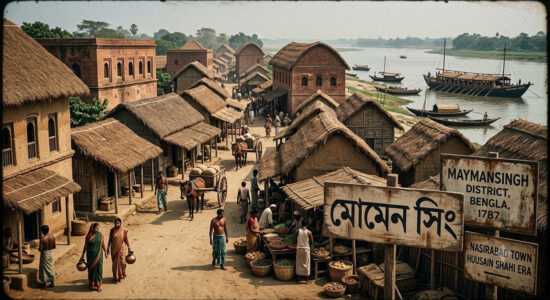
 Some questions arrive disguised as trivia and turn out to be doorways into history. One such question: why does a major Bangladeshi city carry a name that, to any Punjabi ear, sounds suspiciously like “Maymansingh” — a Singh’s city? Did some Sardar, posted to the eastern Mughal frontier, leave his name on a town nearly two thousand kilometres from Punjab? The honest answer is: almost certainly not — though the truth, traced through Mughal Persian, Bengali phonology and British cartography, is more interesting than the myth.
I. Momen Shah, Not a Singh
The dominant scholarly tradition points not to a Singh but to a Muslim notable remembered as Momen Shah, whose name later acquired the corrupted form “Momen Singh”. The associated pargana appears in the Ain-i-Akbari, Akbar’s administrative gazetteer, under Sarkar Bajuhar, transliterated as “Mihmanshahi” and “Manmanisingh” — the latter easily mistaken for a personal name ending in “Singh”, but understood as a corrupted rendering of “Momenshahi”, refracted through Persian and then Bengali pronunciation. A modern lexicographical gloss confirms this: ময়মনসিংহ (Maymansingh) derives from মোমেন সিং (Momen Singh) — Arabic mu’min (“believer”) plus Sanskrit siṃha (“lion”), “believing lion”. A title-name, not a Sikh chieftain’s grant.
II. Rennell’s Atlas and Nasirabad
James Rennell’s Bengal Atlas (1779) labels the region “Momesingh” — an intermediate form between the Ain-i-Akbari’s “Mihmanshahi/Manmanisingh” and the later standardised “Maymansingh”. Once such a form appears on an authoritative map, it tends to calcify in administrative usage.
A further complication: under the Husain Shahi dynasty, the region was linked to Nasiruddin Nasrat Shah, and “Nasratshahi” evolved into “Nasirabad”, the name actually used for the town before 1787, when the British created the district. The 1911 Encyclopaedia Britannica still opens its entry “Nasirabad, or Maymansingh”, reflecting two names current well into the colonial period — one from a Husain Shahi sultan, the other from Momen Shah. Neither traces to a Sikh Singh.
III. A Folk Counter-Tradition
Competing folk etymologies exist: one traces the name to a legendary king “Main Singh”, giving “Maimansingh” and thence “Maymansingh”; another, from a Bodo root where “moy/may” means paddy, reads it as “place of abundant paddy”. The “Main Singh” figure is legendary and undocumented, not a historical Sardar, and the Bodo derivation removes “Singh” altogether.
IV. The Verdict
Three documentary strata — the Ain-i-Akbari’s pargana lists, Rennell’s 1779 atlas, and British records distinguishing Nasirabad from Maymansingh — converge on Momen Shah, a Mughal-era Muslim notable, as the toponym’s most defensible root, Bengali-ised and anglicised into something that merely resembles a Singh’s name. There is no credible evidence of a Sikh Sardar embedded in this Bengal city’s name — only administrative Persian becoming Bengali becoming English cartography, somewhere acquiring a “Singh” it never possessed.
V. A 1971 Postscript: A Sikh General’s Army Did Pass Through
If etymology offers no genuine Sikh Sardar, history offers one. In the 1971 war, the northern thrust toward Dhaka fell to 101 Communication Zone Area, with 95 Mountain Brigade and the ad hoc “FJ Sector” tasked to capture Jamalpur and Maymansingh before pushing on to Tangail. Pakistan’s 93 Brigade held fortress positions at both towns; Indian columns advanced along the Haluaghat–Maymansingh and Jhangal–Maymansingh axes through early December 1971, with Kamalpur’s garrison surrendering on 4 December. This northern axis, alongside Lieutenant General Sagat Singh’s Meghna crossing and the Tangail paradrop, helped close the noose around Dhaka by 15–16 December.
The “12 Days to Dacca” plan, conceived by Brigadier Hardev Singh Kler, was approved on 12 November 1971 by Lieutenant General Jagjit Singh Aurora, GOC-in-C Eastern Command — the same Sikh general who, weeks later, accepted Pakistan’s surrender at the Dhaka Race Course. No Sardar’s name was ever woven into “Maymansingh”, but a Sardar’s signature was on the order that sent Indian troops through it. History supplied the connection that philology declined to.
VI. Envoi
So the riddle resolves itself, but not in the direction it first promised. “Maymansingh” carries no hidden Sardar, no forgotten Sikh fiefdom — only the slow erosion of “Momen Shah” through Persian, Bengali and English mouths until it acquired a Rajput ring it never earned. And yet the city’s real brush with Sikh history is more substantial than any toponym could be: a campaign plan, a general’s signature, a surrender that redrew a map. Names deceive; the record, patiently read, does not.