
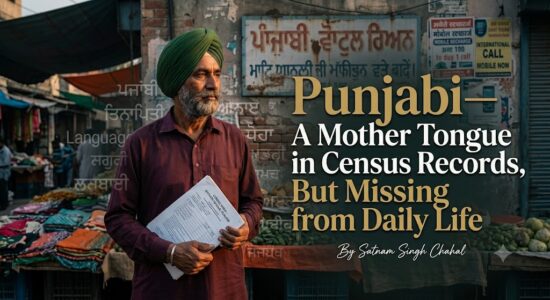
Language is not merely a means of communication; it is the soul of a people, the carrier of their history, culture, and collective memory. For Punjabis, the Punjabi language is far more than words spoken in everyday life—it is the voice of the Gurus, the language of folklore and poetry, and the voice of a civilisation that has flourished for centuries. Yet, a paradox exists in Punjab today: while many proudly proclaim Punjabi as their mother tongue and raise slogans for its promotion, a significant number hesitate to speak it in daily life, often preferring Hindi or English. This contradiction raises important questions about the future of Punjabi and the responsibility of Punjabis themselves toward preserving their linguistic heritage.
The Punjabi language has ancient roots and belongs to the Indo-Aryan family of languages. Its origins can be traced to the Shauraseni Prakrit spoken in northwestern India over a thousand years ago. Over centuries, Punjabi evolved through the influence of Sanskrit, Persian, Arabic, and local dialects. The language achieved literary prominence through the compositions of Sikh Gurus, especially Guru Nanak Dev Ji, whose teachings in Punjabi and related dialects laid the foundation for a rich spiritual and literary tradition. The development of the Gurmukhi script by Guru Angad Dev Ji gave Punjabi a distinct written identity and helped preserve its religious and cultural heritage.
Punjabi is among the world’s most widely spoken languages, with an estimated 120–150 million speakers globally. It ranks among the top ten most spoken languages in the world. Today, Punjabi is spoken not only in India and Pakistan but also across a vast global diaspora. Countries with significant Punjabi-speaking populations include Canada, the United Kingdom, the United States, Australia, New Zealand, Italy, Malaysia, Singapore, and several Gulf nations. In Canada, Punjabi has become one of the most commonly spoken languages after English and French, reflecting the strength and growth of the Punjabi diaspora.
Ironically, while Punjabi thrives abroad, concerns are increasing about its status in its own homeland. In many urban areas of Punjab, speaking English is often associated with modernity and social prestige, while Punjabi is sometimes unfairly viewed as less sophisticated. As a result, some parents prefer English-medium education and communicate with their children in languages other than Punjabi. This trend has created a generation of young Punjabis who may understand Punjabi but are less comfortable reading or writing it in the Gurmukhi script.
This contradiction becomes even more striking when individuals and organizations publicly advocate for the promotion of Punjabi while neglecting to use it in their own homes, businesses, or institutions. A language cannot survive on slogans alone. It survives when it is spoken at home, taught in schools, used in administration, and cherished in everyday life. The true promotion of Punjabi lies not merely in celebrating “Mother Language Day” or organizing conferences, but in making Punjabi the language of daily interaction and public life.
Recognizing the importance of Punjabi, the Punjab government enacted the Punjab Official Language Act, 1967, declaring Punjabi in the Gurmukhi script as the official language of the state. Subsequent amendments and related legislation have further strengthened its status, requiring its use in government offices and public administration. Additionally, the Punjab Learning of Punjabi and Other Languages Act, 2008, made Punjabi a compulsory subject in schools from Class I to X. These laws seek to ensure that future generations remain connected to their linguistic heritage.
Punjab also has provisions for enforcing the use of Punjabi in official communications and public signage. Businesses and institutions that fail to comply with rules requiring Punjabi signboards or official usage may face penalties under various regulations. Recent enforcement measures have included fines for establishments that do not prominently display Punjabi on signboards. However, activists argue that enforcement remains inconsistent and that stronger implementation is necessary.
The challenge facing Punjabi today is not merely legal but cultural. Governments can pass laws, but the survival of a language ultimately depends on its speakers. History provides numerous examples of languages that declined when their communities abandoned them in favor of more dominant languages. Conversely, languages such as Hebrew have experienced remarkable revivals because communities actively embraced them in everyday life.
The future of Punjabi remains bright if Punjabis themselves choose to embrace it. The language possesses a rich literary tradition that includes the poetry of Bulleh Shah, Waris Shah, Baba Farid, Shiv Kumar Batalvi, and countless others. Punjabi music and cinema enjoy worldwide popularity, demonstrating the language’s enduring cultural appeal. The growing Punjabi diaspora has also contributed significantly to the global spread of Punjabi culture.
However, preserving Punjabi requires more than pride it demands practice. Parents should speak Punjabi with their children, schools should strengthen Punjabi education, businesses should use Punjabi in signage and communication, and government departments should fully implement existing language laws. A community that neglects its mother tongue risks losing a vital part of its identity.
Punjabi has survived invasions, partitions, and migrations over many centuries. Its future now depends not on external threats but on the choices made by Punjabis themselves. If Punjabis speak, read, and write their language with pride, Punjabi will continue to flourish across generations and continents. But if the language is reduced merely to slogans while daily life shifts elsewhere, the greatest threat to Punjabi will come not from outsiders but from its own speakers.
As the saying goes: “A people without their language are a people without their soul.” The preservation and promotion of Punjabi is therefore not merely a cultural responsibility it is a duty toward history, identity, and future generations.
Disclaimer: The photographic elements used in the accompanying graphic are for symbolic and illustrative purposes only. The individuals depicted do not imply actual endorsement, involvement, or association with substance