
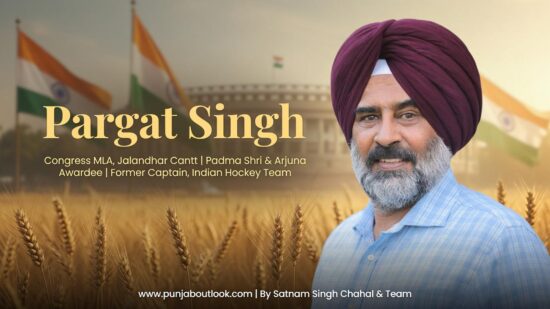
 CHANDIGARH: The controversy over Punjab’s anti-sacrilege legislation has moved beyond a disagreement over legal provisions, with Congress MLA Pargat Singh questioning the manner in which the Bhagwant Mann government pushed the legislation through the Punjab Assembly without adequate scrutiny and consultation.Pargat Singh’s intervention assumes renewed significance after the deadline fixed by Sri Akal Takht Sahib for correcting the contentious provisions of the Jaagat Jyot Sri Guru Granth Sahib Satkar (Amendment) Act, 2026 expired on July 29. The Akal Takht had directed the Punjab government to address its objections within one month after Sikh MLAs appeared before the temporal seat on June 29.
The Congress MLA had already raised fundamental concerns during that hearing, arguing that the Assembly had not fully appreciated the implications of the legislation and that a matter involving the sanctity of Sri Guru Granth Sahib could not be treated like an ordinary piece of legislation.That criticism now looks even more significant because the government has reached the end of the deadline with the controversy still unresolved.
A law passed unanimously — but not fully understood?
The Punjab Assembly passed the amendment Bill unanimously on April 13, introducing stringent punishments for sacrilege, including life imprisonment in specified circumstances. Yet the June 29 hearing before Sri Akal Takht exposed serious questions about how thoroughly legislators had examined the legislation before voting on it.Reports from the hearing said some AAP legislators acknowledged that they had not read the Bill in full before approving it, while others said they had received the legislation only shortly before it was tabled.
That revelation creates an uncomfortable question for the Punjab government:
How could a law concerning one of the most sensitive religious issues in Punjab’s history be passed unanimously if legislators themselves were unclear about important provisions?Pargat Singh’s position was that the legislation was too important and sensitive to be pushed through in haste.And that raises an even bigger issue: Was political speed placed above legislative responsibility?
Pargat Singh’s warning was not about opposing punishment
The Congress MLA’s intervention should not be interpreted as opposition to strict action against sacrilege.The issue raised by Pargat Singh was fundamentally about how the law was drafted and passed.Punjab needs a strong and legally sustainable framework to punish sacrilege. But a strong law is not necessarily one carrying the harshest punishment. A strong law must also be clearly drafted, constitutionally defensible, administratively workable and capable of surviving judicial scrutiny.If provisions are vague, contradictory or inconsistent with established legal principles, they can create opportunities for prolonged litigation rather than delivering justice.That is precisely why consultation matters.
Why was the Sikh community not consulted first?
The most damaging question confronting the Mann government is perhaps not about punishment at all.
It is about consultation.
The June 29 proceedings made clear that Sri Akal Takht and other Sikh institutions had serious objections to several provisions of the Act. The objections included terminology concerning the Guru Granth Sahib, the definition and responsibilities of a “custodian”, the proposed central registration system and other provisions touching upon Sikh religious practices.If the government was genuinely attempting to protect the sanctity of Guru Granth Sahib, why were the relevant Sikh institutions not brought into the drafting process before the Bill was passed?
Why was the SGPC not adequately consulted?
Why were Sikh scholars and representatives of the Takhts not given an opportunity to examine the draft?And why did the Assembly have to confront these questions after the law had already been passed?These are legitimate questions of legislative procedure and public accountability.
The April 13 rush now haunts the government
The sequence of events tells its own story.The Assembly passed the legislation on April 13.Questions were subsequently raised about its provisions.The Speaker was summoned before Sri Akal Takht in May.Then, on June 29, Sikh MLAs across political parties appeared before the Takht, where the legislation was subjected to detailed questioning.The Akal Takht subsequently directed that implementation be kept in abeyance and gave the government one month to make the required amendments.
That sequence raises a difficult question:
If the legislation was properly prepared and adequately scrutinised, why did so many fundamental objections emerge only after its passage?From legislative chamber to Akal TakhtThe unprecedented appearance of Sikh MLAs before Sri Akal Takht transformed the issue.The dispute was no longer confined to the political opposition questioning the government.Legislators from the ruling party itself faced questions about the law’s provisions and the legislative process.
Pargat Singh and other Congress legislators argued that more time should have been given for discussion and consultation. The Indian Express reported that Pargat Singh specifically argued that the Assembly had not fully appreciated the implications of the Bill and that such a sensitive religious issue should not have been rushed.That is a serious indictment of the legislative process — regardless of which political party is making it.
The deadline has now expired
The biggest test for the Mann government has arrived.The one-month period granted by Sri Akal Takht expired on July 29. On the final day, the government submitted its response through AAP MLA Dr Inderbir Singh Nijjar and indicated that it had addressed the objections in a revised draft. It also said it would approach the Centre regarding a possible nationwide anti-sacrilege law.But the response has not automatically ended the controversy.The Akal Takht’s side has raised concerns that meaningful coordination with the institution should have begun earlier during the one-month period. Reports also indicate that further discussions may be required through a joint committee involving Sri Akal Takht Sahib, the SGPC and the Punjab government.That means the government’s submission may be the beginning of another stage of the dispute rather than its conclusion.
Pargat Singh’s bigger political question
Pargat Singh’s intervention ultimately points towards a much larger issue concerning the functioning of the Punjab Legislature.Can legislation involving the religious sentiments of millions of people be drafted behind closed doors, circulated at the last minute and passed unanimously — only to be reconsidered after intervention from Sri Akal Takht Sahib?If the answer is no, then the government needs to explain why the process happened this way.Punjab does not need laws written merely to create headlines.Punjab needs laws that deliver justice.And in cases of sacrilege, justice must be both swift and legally sustainable.
The real test for Bhagwant Mann
Chief Minister Bhagwant Mann’s government now has an opportunity to demonstrate that the controversy can be resolved through consultation rather than confrontation.The government should put the revised provisions in the public domain, explain each change, disclose the legal reasoning behind them and establish a transparent consultation process with the relevant Sikh institutions.Most importantly, it must ensure that the final law does not inadvertently create new disputes while attempting to solve an old one.Because the people of Punjab have heard promises about sacrilege legislation for years.
They have witnessed investigations, commissions, political accusations and legislative initiatives.What they have not consistently witnessed is final, unquestionable justice.Pargat Singh’s warning therefore deserves to be examined beyond party politics.His central argument is simple: when legislation concerns the sanctity of Sri Guru Granth Sahib, the government cannot afford haste, inadequate consultation or legislative ambiguity.The Mann government may have passed the law unanimously.But the events that followed have demonstrated that unanimity inside the Assembly does not necessarily mean consensus outside it.
And after the expiry of the Akal Takht deadline, the government now faces the ultimate test:
Will it correct the law through genuine consultation — or will Punjab once again enter another cycle of assurances, amendments, controversy and delay?