
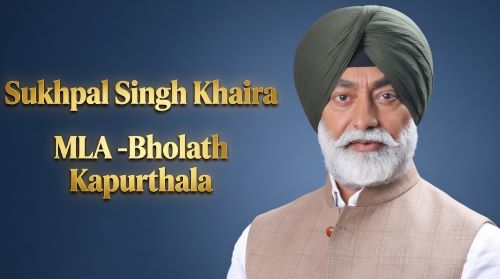
 CHANDIGARH: The expiry of the deadline given by Sri Akal Takht Sahib to the Punjab government over amendments to the Beadbi law has opened a much bigger question than a mere delay in legislation: Does an assurance made before the highest temporal seat of the Sikhs still carry any meaning for the Punjab government?Congress MLA Sukhpal Singh Khaira has launched a sharp attack on the Bhagwant Mann government, alleging that the deadline expired yesterday but the government failed to make the promised amendments despite assurances given before Sri Akal Takht Sahib following an ardaas.
Khaira has described the government’s failure as a “clear breach of faith and commitment” and accused Chief Minister Bhagwant Mann of repeatedly challenging the authority of Sri Akal Takht Sahib.The allegation is politically explosive because this is not simply a dispute between the government and an opposition MLA. The controversy concerns an assurance that, according to Khaira, was given before Sri Akal Takht Sahib, an institution whose authority carries enormous religious and historical significance for Sikhs.
The central question now is brutally simple: If the government gave its word before Sri Akal Takht Sahib, why was the deadline allowed to expire without the promised amendments?And if the government required more time, why was that not publicly communicated before the deadline?
Where is the government’s explanation?
The Mann government now faces an obvious accountability test. It needs to explain what prevented it from completing the amendments within the stipulated period.
Was the draft legislation not ready?
Were there legal complications?
Did the government discover constitutional or procedural obstacles?
Was there disagreement within the government?
Or was the commitment made before Sri Akal Takht Sahib never backed by a concrete legislative roadmap?
These questions cannot simply be brushed aside as political rhetoric.
If amendments require consultation with legal experts, departments, the Advocate General’s office or the legislature, the government should place that process before the people of Punjab.Silence will only deepen suspicion.
Beadbi is not an ordinary political issue
The question of sacrilege has remained one of Punjab’s most emotionally charged and politically sensitive issues for years.The state has witnessed repeated incidents involving the Guru Granth Sahib and other religious scriptures, followed by public outrage, protests, investigations, political accusations and demands for stronger punishment.Yet the fundamental grievance has remained remarkably consistent: Why have those responsible for sacrilege so often appeared to escape meaningful and final punishment?
For ordinary Punjabis, particularly the Sikh community, the issue is not merely about sections, clauses and legal terminology. It is about the protection of the sanctity of the Guru Granth Sahib and the ability of the criminal justice system to deliver justice in cases that have repeatedly shaken Punjab’s social fabric.That is precisely why every government promise on the Beadbi law is subjected to intense scrutiny.
The credibility question for Bhagwant Mann
Khaira’s attack puts Chief Minister Bhagwant Mann personally at the centre of the controversy.According to Khaira, Mann’s government gave an assurance before Sri Akal Takht Sahib and then failed to meet the deadline.If that allegation is accurate, the issue goes beyond legislative delay. It becomes a question of political credibility.Governments routinely miss administrative deadlines. But a commitment made before a major religious institution carries a different political and moral weight.The government therefore cannot simply respond with another announcement or press statement.It needs to show what was promised, what has been completed, what remains pending and when the amendments will actually reach the legislature.
Another promise, another deadline?
Punjab has seen no shortage of promises on sacrilege.Over the years, governments have announced commissions, investigations, special measures, stronger laws and assurances of justice. Yet the passage of time itself has become part of the public frustration.That history makes the latest deadline particularly important.The question is no longer whether Punjab needs a stronger Beadbi law. The question is whether the political system has the determination to actually deliver one that can withstand judicial scrutiny and result in convictions where guilt is established.A law can be politically attractive but legally weak.A government can announce an amendment but fail to implement it.And a deadline can be announced but quietly allowed to pass.
Punjab has seen all three before.
What exactly did the government promise?
This is where the Mann government must come clean.
The government should publicly disclose the exact commitment made before Sri Akal Takht Sahib, the amendments proposed, the legal advice received, the administrative steps completed and the reason the deadline was not met.
If the government believes the deadline cannot be fulfilled because of legal or constitutional constraints, it should explain those constraints publicly rather than allowing the controversy to be reduced to accusations and counter-accusations.
And if the amendments are ready, then there is an even simpler answer:
Bring them before the Punjab Legislature.
Khaira’s bigger allegation
Khaira has gone beyond accusing the government of missing a deadline. He alleges that Bhagwant Mann is “constantly challenging the authority of Akal Takht Sahib.”That is a serious political charge.Whether that allegation can be substantiated is a matter for the political and religious debate now unfolding. But the fact that such an accusation has been made illustrates the growing tension between the Punjab government and Sikh religious institutions.The Mann government therefore has two issues to address: the substance of the Beadbi law and the question of its relationship with Sri Akal Takht Sahib.Ignoring either will not make the controversy disappear.
The uncomfortable question Punjab must ask
Perhaps the most uncomfortable question is this:Why does it repeatedly take pressure, protests, religious intervention or political confrontation to force governments to act on issues that have remained unresolved for years?If the government genuinely believes stronger legislation is necessary, it should legislate.If it believes the existing law is sufficient, it should explain why.If legal obstacles exist, it should disclose them.But what Punjab cannot afford is another cycle of assurance → deadline → delay → controversy → another assurance.That cycle has already damaged public confidence.
A test of more than legislation
The expired deadline now presents Chief Minister Bhagwant Mann with an opportunity to settle the controversy through action rather than political argument.He can publish the government’s position, explain the delay, place the proposed amendments before the public and legislature, and demonstrate precisely how the government intends to strengthen the law while ensuring that it survives constitutional and judicial scrutiny.Until then, Khaira’s accusation will continue to hang over the government:If an assurance was made before Sri Akal Takht Sahib after ardaas, why did the government allow the deadline to expire?For a government that came to power promising a new political culture, that is not merely a question about one law.It is a question about whether a promise made in Punjab still means anything when the cameras are gone, the headlines disappear and the deadline arrives.