
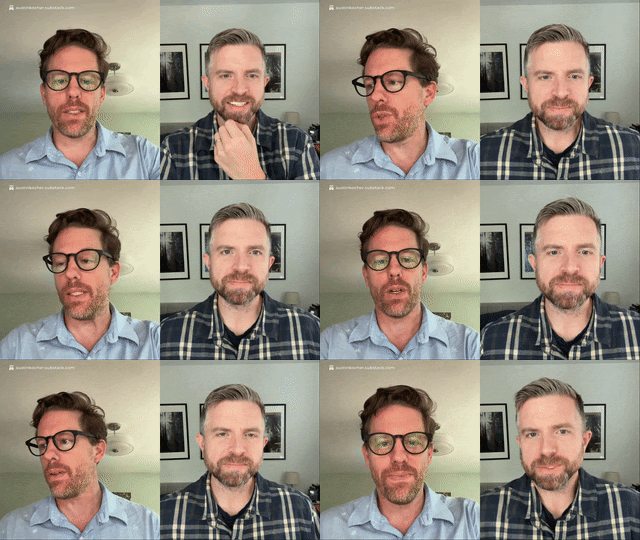
 Army National Guard veteran Christopher Purdy is training fellow veterans to defend democracy, fixing misconceptions about active duty military and veterans, and funding veteran-led projects that realize the aspirations of a better America. Chris’s work has inspired me since Camille Mackler first introduced me to him, but today was the first time he and I had ever talked beyond a few text messages—so what you get here is 100% authentic.
Chris is the founder of the Chamberlain Network, a nonprofit that trains veterans to engage in civic life, not as partisans, but as people with a specific skill set and the moral authority to fight for the institutions they once wore a uniform to defend. He is the son of an Irish immigrant from Belfast, a National Guard veteran who deployed to Iraq in 2011, and before he started the Chamberlain Network, he ran Veterans for American Ideals at Human Rights First, where he spent years using the veteran voice in support of immigrants and refugees.
When I asked Chris to help us think about the connection between veterans and immigrants, he said: “I served alongside immigrants. The average veteran has a very similar story.” His own gun truck crew in Iraq included an Ethiopian refugee, an Egyptian-American, a country boy from West Virginia, and the son of an Irish immigrant. “I really saw America captured in the people there.”
While Chris acknowledges the many problems with America, he returns to the idea that “America is an aspirational country.” I understood what he meant. Our ideals as a revolutionary country are not always realized quickly, but the ideals are still there waiting to be actualized by people who are willing to work together for the greater good. Despite my own deep misgivings about U.S. foreign policy and the negative ways in which militarism shapes society (for one critique, see “How the Military Mindset Has Crushed Our Country’s Men”), the underlying principles of public service and personal sacrifice remain core to my beliefs and values. I don’t know if the United States can ultimately be saved. But I know that what’s at stake isn’t just an abstract idea about the soul of a country, but about the damage that will continue to unfold if we do nothing. As I said on Monday:
“I will focus much of the week leading up to Memorial Day discussing the relationship between military service, immigration enforcement, and the often overlooked role of veterans in trying to protect the best parts of American democracy from the worst parts of American tyranny.”
That comment was aspirational when I wrote it on Sunday evening. Now that I’ve talked with Shawn and Chris, I am starting to feel more hope in the resilient, overlooked goodness that is around us if we look for it. This conversation was part interview and part counseling session for me. I am a veteran who has spent the last several years deep inside immigration enforcement research, and I have not always known what to do with that identity in relation to this work. Chris helped me think through it today in ways that were profoundly meaningful. If you’re in the military now or a veteran, I think you’ll get a lot from our conversation, too.
Huge “thank you” to Chris and to everyone at the Chamberlain Network for what they do. Learn how you can get involved below.
Have you or someone you know served and then gotten involved in civic or advocacy work? Leave a comment with names and organizations you think I should learn about.