
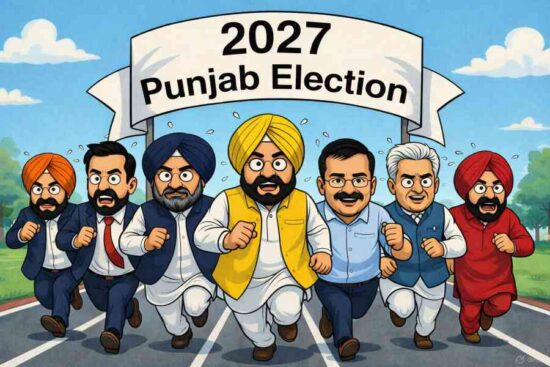
 The political landscape in Punjab has entered a highly dynamic and fragmented phase following the recent civic body and municipal polls. Traditionally dominated by a bipolar contest between the Congress and the Shiromani Akali Dal (SAD), the state’s local governance politics has transformed into a multi-cornered battleground. The civic poll outcomes have served as a critical mid-term reality check for all major political stakeholders, signalling shifting voter loyalties and a changing grassroots narrative ahead of larger legislative tests.
For the ruling Aam Aadmi Party (AAP), the civic polls carried immense high-stakes pressure to validate its governance model. Winning control over key municipal corporations and councils has allowed the party to consolidate its hold on urban and semi-urban pockets, which are traditionally harder to retain after the initial euphoria of a landslide assembly victory wears off. However, the elections also exposed areas of fierce localised anti-incumbency, forcing the leadership to confront public grievances regarding civic infrastructure, local corruption, and bureaucratic delays directly at the ward level.
Concurrently, the traditional opposition parties have used the civic elections as a springboard for revival. The Congress party, leveraging its deeply entrenched local networks, put up a spirited performance in several sectors, demonstrating that its grassroots cadre remains resilient despite past organisational fractures. Meanwhile, the Shiromani Akali Dal (SAD), navigating internal leadership transitions and ideological reassessments, viewed these polls as a vital survival test to reclaim its traditional Panthic and rural-urban support base, meeting with mixed but highly instructive outcomes.
A defining feature of the post-civic poll scenario is the aggressive posturing of the Bharatiya Janata Party (BJP) in Punjab’s urban centers. Operating independently rather than as a junior coalition partner as it did in decades past, the BJP has successfully penetrated several municipal wards, positioning itself as a distinct ideological alternative. This rising footprint has effectively broken the old political paradigms of the state, ensuring that future contests will feature intensely competitive three-way or four-way splits in urban voter shares.
Ultimately, the political situation in Punjab post-civic polls is one of intense recalibration. No single party can claim absolute hegemony over the state’s diverse electorate. The results have sent a clear message to the ruling dispensation that urban voters demand swift execution of development promises, while simultaneously warning opposition factions that mere rhetoric without strong, unified local leadership will not suffice to dislodge the incumbents.
As the dust settles, all parties are restructuring their local units, using the valuable data from these municipal micro-contests to shape their long-term strategies for the state.