
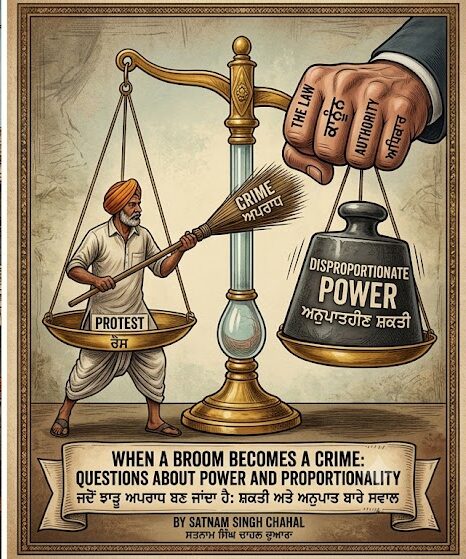
 A broom is an ordinary household object. It cleans drains, streets, courtyards, and toilets. Every day, millions of people use it to remove dirt and maintain hygiene. Yet, in a troubling incident, a person was reportedly sent to jail over the alleged “spreading” or scattering of a broom.
This raises a fundamental question: How can breaking or distributing pieces of a broom amount to desecration? A broom is not a sacred object in the traditional sense. If four pieces of a broom are placed somewhere, does that automatically become an act deserving criminal prosecution?
The issue is larger than the broom itself. It concerns the principle of proportionality in governance. Laws and police powers exist to protect public order and justice, not to create fear over symbolic or trivial acts. When authorities react harshly to actions that many citizens would regard as harmless expression or political symbolism, it can create the impression that state power is being used excessively.
Democracy requires tolerance of dissent, criticism, satire, and symbolic protest. Citizens may disagree strongly with political parties, governments, or public figures, but the response should be guided by law, reason, and proportionality. Arrests and imprisonment should be reserved for genuine threats to public safety and order, not for actions that primarily carry symbolic meaning.
The real question is not whether a broom was scattered. The real question is whether the state’s response was justified, necessary, and consistent with democratic values. A confident government wins respect through fairness and restraint, not through the appearance of punishing symbolic acts.
When ordinary objects become grounds for criminal action, citizens are right to ask where the line between law enforcement and overreach is being drawn.
Can a Broom Be a Case of Beadbi?
The word beadbi carries great weight in Punjab. Historically and socially, it is used in situations involving disrespect or desecration of sacred religious texts, places of worship, or objects that are revered by a community. Whenever the word beadbi is used, it evokes strong emotions because it is associated with matters of faith and religious sanctity.
A broom, however, is an ordinary household tool. It is used to clean streets, drains, homes, courtyards, and toilets. Every household keeps one, and it is regularly cut, repaired, replaced, and discarded after use.
The question that many Punjabis are asking is simple: How can the breaking or scattering of a broom be equated with beadbi?
Political parties across India use different election symbols. Citizens support them, criticize them, and often use those symbols in political demonstrations. Such acts may be political expression, protest, or criticism, but calling them beadbi stretches the meaning of the word far beyond its traditional and accepted usage.
If every political symbol is treated as sacred and every act of criticism is labeled desecration, then democratic protest itself comes under threat. Political symbols represent parties and ideologies; they are not objects of religious worship.
The issue is not whether people agree or disagree with a particular political act. The issue is whether a common household broom can be elevated to a status where its handling becomes a matter of alleged desecration.
Words matter. The term beadbi should be reserved for circumstances where genuine religious sanctity is involved. Using such a serious term for an ordinary broom risks diluting the meaning of a word that carries profound significance for millions of people.
Punjab deserves a mature debate on this question. A broom is a political symbol and a household tool. It is not a sacred scripture, a place of worship, or an object traditionally associated with beadbi. Equating the two raises serious questions about proportionality, freedom of expression, and the proper use of the law.