
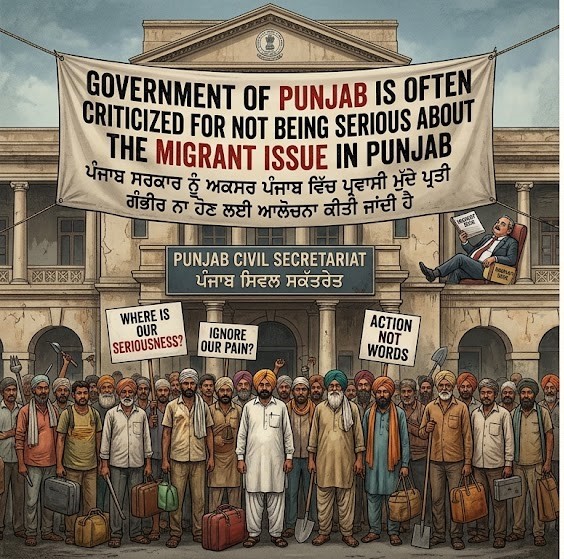
 Punjab has been one of India’s most prosperous agricultural states and has attracted migrant workers from states such as Bihar, Uttar Pradesh, Jharkhand, and West Bengal for decades. These workers have become an important part of Punjab’s economy, contributing to agriculture, construction, transportation, manufacturing, and other sectors. However, the increasing number of migrants has also generated debates regarding employment opportunities, infrastructure, social integration, and demographic changes. Many critics argue that the Punjab government has not shown sufficient seriousness in addressing migration-related concerns, and this perception is influenced by several factors.
One major reason is Punjab’s economic dependence on migrant labour. The state’s agricultural sector, particularly during planting and harvesting seasons, relies heavily on workers from outside Punjab. Many industries and construction projects also depend on migrant labour because local labour shortages often make it difficult to meet workforce demands. Since migrants play such an essential role in sustaining economic activity, governments may hesitate to introduce strict regulations that could discourage workers from coming to the state. As a result, economic considerations often take priority over long-term migration management.
Political considerations also play a significant role. Migration is a sensitive issue that can easily become controversial. Political parties generally avoid policies that may be viewed as discriminatory or hostile toward workers. Governments often fear that aggressive measures could create social tensions or attract criticism from human rights groups and political opponents. Consequently, many administrations prefer temporary solutions and administrative adjustments rather than developing a comprehensive migration policy that addresses both the benefits and challenges of migration.
Another challenge is the lack of reliable and updated information about migrant populations. Many migrants work in the informal sector and frequently move between locations depending on employment opportunities. This mobility makes it difficult for authorities to maintain accurate records. Without comprehensive data, governments struggle to plan effectively for housing, healthcare, education, transportation, and social welfare services. Critics argue that stronger registration and monitoring systems could help policymakers make better-informed decisions and address concerns more efficiently.
The growing population in certain urban and industrial areas has also increased pressure on public services. Schools, hospitals, roads, sanitation systems, and housing facilities often face additional demands as populations expand. Some residents believe that infrastructure development has not kept pace with population growth and that governments have failed to adequately prepare for these changes. When public services become strained, people may conclude that authorities are not paying sufficient attention to the broader impact of migration.
Employment concerns among local residents further contribute to the debate. Some people feel that migrants increase competition for low-skilled jobs and may contribute to lower wage levels in certain sectors. While many economists argue that migrants frequently fill labour shortages rather than replace local workers, public perceptions can differ from economic analyses. When governments do not effectively address these concerns through employment programs, skill development initiatives, or public communication, dissatisfaction can grow among local communities.
Punjab’s distinct cultural and linguistic identity also raises questions about social integration. As migrant communities become larger, discussions emerge regarding language, education, cultural adaptation, and community relations. Some critics believe that governments have not invested enough in programs that promote understanding and cooperation between local residents and migrant populations. Stronger integration efforts could help reduce misunderstandings and strengthen social harmony.
Administrative challenges further reinforce the perception that the migrant issue is not being handled seriously. Migration-related matters often involve multiple departments, including labour, housing, education, health, and law enforcement. Without coordinated planning and implementation, policies can become fragmented and ineffective. Many observers believe that governments have treated migration primarily as a short-term labour issue rather than as a long-term social and economic challenge requiring comprehensive planning.
In conclusion, the belief that the Punjab government is not serious about the migrant issue stems from a combination of economic dependence, political sensitivity, administrative limitations, infrastructure pressures, and social concerns. Migrant workers contribute significantly to Punjab’s development, but effective governance requires balanced policies that protect worker rights, address local concerns, strengthen public services, and promote social integration. A comprehensive and forward-looking migration strategy could help create a more sustainable and harmonious future for all residents of Punjab.