
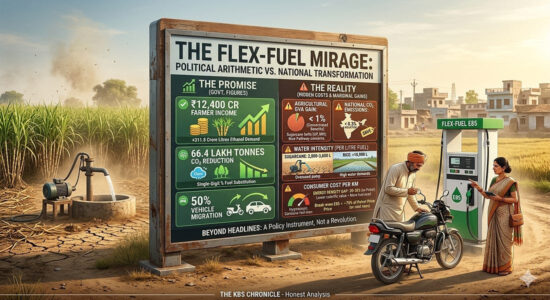
 Union Minister Hardeep Singh Puri has been making the rounds of press conferences and policy conclaves with infectious enthusiasm about India’s flex-fuel future. Fifty per cent of new two- and four-wheelers eventually migrating to flex-fuel platforms. An additional 311.8 crore litres of ethanol demand annually. Twelve thousand four hundred crore rupees in extra farm income. A reduction of 66.4 lakh tonnes of CO₂. The language is unapologetically grand: “massive,” “transformative,” a “practical solution” to crude import dependence and agrarian distress simultaneously.
The figures, cited from official PIB releases, are not in dispute. The issue is not what they say, but what they omit — and the interpretive frame in which they are invariably presented. When you translate absolute numbers into incremental percentage gains, set them against the baselines they claim to shift, and account for costs that do not appear in the government’s ledger, the transformation shrinks considerably. A useful policy instrument remains — but an instrument, not a revolution. India deserves a conversation proportionate to the evidence.
Begin with the headline claim on farmer income. Twelve thousand four hundred crore rupees commands attention in isolation. But India’s agricultural gross value added runs at roughly ₹30–35 lakh crore annually. The claimed gain represents well under one per cent of that base — a low single-digit incremental improvement, assuming full realisation, with benefits concentrated in sugarcane-growing belts of Uttar Pradesh and Maharashtra rather than distributed across Punjab’s grain farmers or Vidarbha’s cotton cultivators. This is a targeted support mechanism for specific crops and specific geographies. Describing it as structural transformation of Indian agriculture asks more of the numbers than they can bear.
The import-dependence arithmetic tells a similar story. India’s annual petrol consumption sits in the 3.5 to 4 crore tonne range. The additional 311.8 crore litres of ethanol demand translates to a single-digit percentage substitution of current petrol volume — somewhere between seven and eight per cent under optimistic assumptions of full market penetration. The direction is sound. The magnitude does not justify the energy-sovereignty framing that accompanies it.
Most instructive is the emissions claim. India’s total CO₂ output exceeds 2,500 million tonnes annually. The projected saving of 66.4 lakh tonnes amounts to less than 0.3 per cent of national emissions. When climate commitments are being discussed in terms of megatonnes and structural transitions across power, industry and land use, a sub-0.3 per cent gain through flex-fuel rollout warrants correspondingly measured billing.
The Water and Power the Minister Does Not Invoice
There is a second layer of concern more consequential than the scale problem: the costs that do not appear in the government’s presentation.
Ethanol production is extraordinarily water-intensive. NITI Aayog and independent energy research institutions have estimated that sugarcane-based ethanol requires between 2,800 and 3,600 litres of irrigation water per litre of fuel produced. Rice-based ethanol — a pathway India has actively pursued given surplus grain stocks — can demand over 10,000 litres of water per litre. Scaling India’s ethanol targets to their stated ambitions could raise irrigation water demand by around 50 billion cubic metres by 2070: the equivalent of over fifteen years of Delhi’s current total water consumption.
This water is not free. In most Indian states, agricultural power for pumping is either entirely free or heavily subsidised. The implicit cost of that electricity subsidy — borne by state electricity boards already under financial stress — is nowhere netted out of the farmer income figures the Minister presents. The gross gain to the farmer is real. But the net gain to society, once the power subsidy is recognised as an economic cost rather than a political given, is materially lower. In structural terms, the policy transfers costs from the Ministry of Petroleum’s accounts to state government balance sheets, groundwater aquifers, and long-run water security across the Indo-Gangetic plain. These are not abstract concerns; they are fiscal and hydrological liabilities accumulating in slow motion.
What Happens at the Pump — and Beyond
The consumer-side economics deserve equal attention. Ethanol carries a calorific value of approximately 24 to 27 megajoules per litre, against petrol’s 34 to 43 megajoules per litre — an energy density gap of roughly 30 to 35 per cent. This is not a technology problem that future engineering will resolve; it is organic chemistry.

For vehicles running E20 fuel in engines calibrated primarily for petrol, independent and official estimates project a 6 to 7 per cent increase in fuel consumption — that is, 6 to 7 per cent lower kilometres per litre. For flex-fuel vehicles running E85, the fuel economy penalty rises to between 20 and 30 per cent compared to petrol. The relevant metric for any household is not the price per litre but the cost per kilometre. If E85 is priced 20 per cent below petrol but delivers 25 to 30 per cent fewer kilometres per litre, the effective cost of mobility rises. The pump price discount must therefore be deep enough to overcome the energy density gap — not merely visible enough to create the impression of consumer benefit.
Flex-fuel engines can theoretically recover some of this deficit by exploiting ethanol’s higher octane rating — around 108 to 110 Research Octane Number — through higher compression ratios, adjusted ignition timing, and remapped fuel injection. But realising this advantage requires design choices that add upfront manufacturing cost, and it requires that the engine be optimised for high-ethanol operation, with petrol as the secondary fuel. Most flex-fuel vehicles proposed for the Indian market are designed petrol-primary and ethanol-tolerant — which means that the theoretical octane efficiency gains remain largely unrealised in practice.
There are also materials considerations: ethanol is hygroscopic and corrosive, requiring upgraded fuel lines, seals and storage systems. Cold-start behaviour is more complex. These are manageable engineering challenges, but they carry costs that do not surface in the ministry’s income and emissions tables.
The Back-of-Envelope the Policy Needs
The question the Minister’s own press release implicitly raises, but does not answer, is this: what per-litre discount on E20 or E85 would be required to keep the rupee-per-kilometre cost unchanged for a typical consumer?
For a two-wheeler running E20 with a 6.5 per cent fuel consumption penalty, if petrol is priced at ₹100 per litre, the break-even E20 price works out to approximately ₹93.5 per litre. E20 must therefore be priced at least 6.5 per cent below petrol simply to keep the consumer neutral — not better off. For a small car running E85 with a 25 per cent consumption penalty, the break-even E85 price against ₹100 petrol is around ₹75 per litre — a discount of 25 per cent merely to equalise costs per kilometre. Any price gap narrower than these thresholds means the consumer is quietly absorbing the cost of the ethanol programme through their fuel bills, without being told so.
This is not an argument against blending. It is an argument for honest pricing policy and transparent communication. If the government wishes to use ethanol as a policy instrument — and there are legitimate reasons to do so — the subsidy should be explicit and publicly accounted for, not embedded in the energy density arithmetic where most consumers will never find it.
The Honest Case for Flex-Fuel
None of this is to dismiss the programme. A meaningful reduction in crude import dependence carries genuine strategic value for an economy that imports over 85 per cent of its oil. Providing a supplementary income stream to sugarcane and maize farmers in specific distressed regions is a defensible rural support measure. Developing domestic flex-fuel manufacturing capability positions India for a future where advanced biofuels may play a larger role as feedstock efficiency improves.
But these are the arguments for a targeted, incremental policy tool — not for a transformative national programme. The programme can be supported on its actual merits. It does not require rhetorical amplification, because that amplification distorts investment signals, creates unrealistic consumer expectations, and substitutes headline management for the harder work of honest energy transition planning.
India’s energy challenges are large enough, and the trade-offs complex enough, that the country is best served by policy language that informs rather than impresses. The flex-fuel programme is a useful addition to a diversified energy strategy. It should be presented, and evaluated, as exactly that.
Massive is a word that should be earned. On the evidence, it has not been — not yet.