
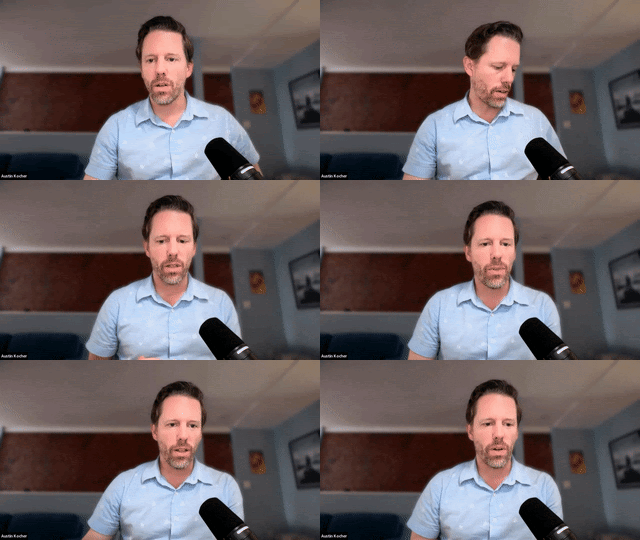
 Amelia Frank-Vitale, an assistant professor of anthropology at Princeton, has spent over a decade studying what deportation actually does to people in Honduras. Her new book, Leave If You Can: Migration and Violence in Bordered Worlds, argues that deportation is part of larger cycles of displacement that fuel further migration and leave untouched the underlying conditions that make people leave in the first place. Amelia and I sat down this week to talk through the book, and I’d encourage you to watch the full conversation above.
Leave If You Can provides the on-the-ground research needed to contextualize what reporters are finding at reception centers in Honduras right now. Caitlin Dickerson reported last month in The Atlantic that parents are arriving in detainee sweatsuits asking aid workers whether they lose their parental rights when they are deported. Research by Zain Lakhani at the Women’s Refugee Commission, which we covered earlier this year, finds that under the current administration, 800 mothers have been detained and 60 percent deported, nearly double the rate under Biden. My conversation with Amelia offers insights from a decade of research that connects the conditions producing displacement in Honduras to the enforcement cycles that perpetuate it.
There are plenty of places to get immigration news, but there aren’t many places where you can join a conversation between two researchers who’ve spent their careers studying migration. If you think this kind of rigor deserves a wider audience, a paid subscription is the best way to make it happen.
Upgrade to paid
Amelia’s central argument also reinforces broader patterns that researchers and journalists are documenting across the region. A new analysis from the Migration Policy Institute shows that the recent drop in border crossings does not mean people have stopped moving but that movement has become more fragmented, less linear, and more coercively shaped. A Human Rights Watch report released last month, covered by the Associated Press, documents that the Trump administration has deported nearly 13,000 Cubans and Venezuelans to Mexico, where they face cartel violence in a country unfamiliar to them. My conversation with Amelia offers the long-term research perspective needed to understand why deportation consistently reproduces the conditions for further displacement.
Amelia’s fieldwork challenges the assumption that deportation always registers as a unique rupture, though she is careful to note that this is not a universal finding. In some communities and at earlier moments in Honduras’s history, deportation carried heavy stigma, marking people as criminal or out of step with their society. What she found instead in the urban margins of Honduras, and at this particular moment, is that deportation had become so common that it no longer carried that weight, a shift she describes not as evidence of resilience but as evidence of how thoroughly violence had saturated everyday life.
“I am not saying that [deportation] is not violent. I’m saying that [deportation] is, in fact, quite violent, and violent in its ordinariness. That is. These guys are living with a whole suite of violences around them that are terribly, awfully, horribly ordinary. And deportation is one of them, but it is not a break. It is not a singular event in a life of otherwise stability. It is violent in a way that is familiar. And it is an extension of kinds of violences that they are already always navigating.”
Her reframing of caravans is equally precise, and particularly useful given how thoroughly Trump’s 2018 use of caravans as a political weapon distorted public understanding of what they actually are. What had been a tactical response to hostile terrain used by migrants, activists, and researchers since at least 2011 became, in the hands of the midterm news cycle, evidence of an invasion and a coordinated political movement. Amelia’s reframing offers something the 2018 media coverage rarely provided. She gives a structural explanation for a phenomenon that was treated almost entirely as a symbol.
“The caravan isn’t a thing. It’s a tactic that people employ at certain moments. It’s people coming together who, for the most part, are already in the process of migrating themselves. And I think what the caravan does for us, it is a really visible tip of the iceberg. It’s really legible, it’s easy to access. The idea of it rests on the fact that people are going to pay attention, that journalists and researchers are going to show up and film it and take photos and tell stories about it. But it is just a small, small piece of what is always happening in the margins, in the shadows, far from you, turning the protection that invisibility often is thought to have on its head, instead going for hypervisibility as the way to get across really hostile terrain safely.”
The argument that anchors the entire book is her insistence that migration itself is not what policymakers should be trying to solve. As a geographer who studies borders and enforcement, I think about this in terms of what our data is actually measuring. The detention numbers, court backlogs, and deportation flight counts all measure the enforcement response to human movement. The data tell us what the state is doing, but the data doesn’t tell us about the underlying conditions that produce migration in the first place, which are the things that actually need addressing.
“Migration isn’t a problem to be solved. Migration isn’t a problem. Migration is just a thing that people do when things at home get hard. It’s the thing that all people have done, our whole history of existing on this planet. There are other problems that produce more or less migration. There are policies that make migration deadly and clandestine, but migration itself is not the problem to be solved.”
Amelia brings years of fieldwork and a genuine commitment to getting the details right, and she is, as you can probably tell from this conversation, generous with her knowledge and her time. The book reflects both qualities. I recommend it to anyone who wants to understand what is actually happening in Central America and why U.S. deportation policy keeps reproducing the conditions it claims to address. My thanks to Amelia, and to everyone who joined us live and who is reading now.