
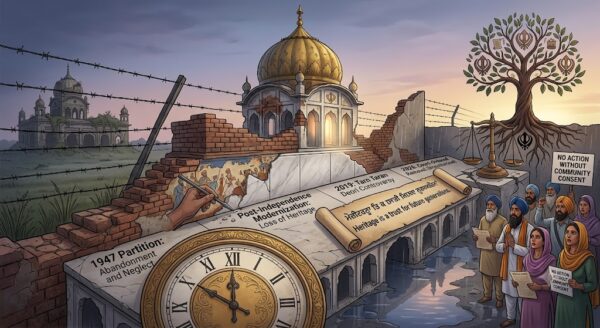
 The history of Sikh Gurdwaras in the Indian subcontinent since 1947 is not limited to outright demolitions. It includes destruction during Partition, damage from armed conflicts, unauthorised demolitions during renovation projects, court-ordered removals of illegal structures, encroachments on Gurdwara lands, and the gradual loss of historic Sikh heritage due to neglect. A distinction must therefore be made between the demolition of a functioning Gurdwara, the destruction of heritage portions of a shrine, and the removal of unauthorised religious structures.
The largest destruction of Sikh religious heritage occurred during the Partition of India in 1947. Hundreds of historic Gurdwaras in areas that became part of Pakistan were abandoned, damaged, occupied, or left to decay after the migration of Sikh populations. Many shrines that had flourished for centuries ceased functioning overnight as Sikh communities fled violence. Numerous historical buildings were subsequently converted to other uses, encroached upon, or fell into ruin because there was no local Sikh population left to maintain them.
The human tragedy accompanying the destruction of Sikh religious institutions was immense. Historic congregations were attacked during Partition violence, and many Sikh shrines became places of refuge for displaced families. The Budhal massacre of November 1947 remains one of the tragic examples of violence connected to a Gurdwara congregation during the Partition period.
After Independence, many historic Sikh shrines underwent large-scale reconstruction and expansion. While these projects improved facilities for pilgrims, heritage conservationists have repeatedly argued that valuable historical structures were lost in the process. At several major shrines, older buildings dating to the Sikh Empire period were demolished and replaced with modern marble and concrete structures. Critics contend that portions of Sikh architectural heritage disappeared because preservation standards were not always followed.
Tarn Taran Darshani Deori Demolition (2019)
One of the most controversial incidents in modern Sikh history occurred at the historic Gurdwara Darbar Sahib, Tarn Taran. In March 2019, a significant portion of the historic Darshani Deori, dating back to the Sikh kingdom era, was demolished during a kar seva renovation project. The demolition sparked outrage among Sikh scholars, historians, and devotees who viewed the structure as an irreplaceable heritage monument. Following widespread criticism, plans for complete replacement were abandoned and restoration efforts were eventually undertaken.This incident reignited debate within the Sikh community regarding the preservation of historic architecture versus modernization projects at religious sites.
Sikkim Gurdwara Dispute (2017)
In 2017, controversy emerged regarding the historic Gurudongmar Gurdwara in Sikkim. Sikh organizations alleged that the shrine faced demolition in the name of renovation. The matter reached the Supreme Court of India, which ordered maintenance of the status quo while legal proceedings continued. The case highlighted concerns about the protection of historically significant Sikh religious sites.
Unauthorized Gurdwaras Removed by Court Orders (2025)
In recent years, courts have increasingly ordered the removal of unauthorized religious structures irrespective of religion. In May 2025, the Punjab and Haryana High Court directed the removal of an unauthorized Gurdwara constructed within a housing colony at Kharar in Punjab. The court held that the structure violated approved development plans and ordered that the Guru Granth Sahib be respectfully relocated before dismantling. This was not a heritage Gurdwara but an unauthorized construction. Public reports described it as one of the few documented Gurdwara demolitions in India during 2025.
In June 2025, another unauthorized Gurdwara built on encroached land in Mumbai’s Andheri area was dismantled following court orders. The action was taken as part of an encroachment removal process rather than any policy directed specifically against Sikh institutions.Several recent disputes have involved Gurdwara lands rather than demolition of the shrines themselves. Sikh organizations have raised concerns about alleged encroachments and government actions affecting Gurdwara properties in various parts of India, including Hyderabad. Such disputes have intensified demands for stronger legal protection of Sikh religious heritage and endowment lands.
Today, many Sikh historians argue that the greatest threat to Sikh heritage is not direct demolition by governments but the gradual disappearance of historic structures through neglect, poorly planned renovations, encroachments, and inadequate conservation policies. The Tarn Taran controversy remains a major example frequently cited by heritage activists. Similar concerns have also been raised regarding historic Sikh shrines in Pakistan, where abandoned structures have faced deterioration, vandalism, and partial destruction over decades.
From 1947 to 2026, Sikh heritage has faced multiple challenges. The most devastating losses occurred during Partition, when countless historic Gurdwaras were abandoned or damaged.
In modern India, there has not been a widespread campaign of Gurdwara demolitions, but there have been isolated cases involving unauthorized constructions, legal disputes, and controversial renovation projects.Many Sikh scholars believe that preserving historic Sikh architecture and protecting Gurdwara lands should be a priority so that future generations can inherit the rich religious and cultural legacy of the Sikh Panth.
A recurring concern among many Sikhs has been that decisions affecting Gurdwaras, historic Sikh sites, and Sikh religious properties are often taken without meaningful consultation with the wider Sikh community. Whether involving court-ordered demolitions of structures, disputes over Gurdwara lands, heritage renovation projects, or government actions affecting Sikh institutions, many community members have argued that Sikh sentiments and religious concerns are not always given sufficient consideration. The controversy surrounding the demolition of the historic Darshani Deori at Tarn Taran, disputes over Sikh heritage sites in different states, and recent actions against unauthorized Gurdwaras have reinforced a perception among sections of the Sikh community that decisions are frequently imposed from above rather than reached through dialogue and consensus with Sikh religious bodies and local Sangats.
Sikh organizations have repeatedly demanded that before any action is taken regarding a Gurdwara, regardless of whether it involves land disputes, encroachments, redevelopment projects, or court orders, there should be prior consultation with recognized Sikh institutions, local Sangats, and religious authorities. They argue that because a Gurdwara is not merely a building but a sacred institution central to Sikh identity and faith, any decision affecting it should be handled with transparency, sensitivity, and community participation.”Many Sikhs believe that several actions affecting Gurdwaras and Sikh heritage sites were carried out without obtaining broad community consent or adequate consultation with Sikh religious bodies.”
.