
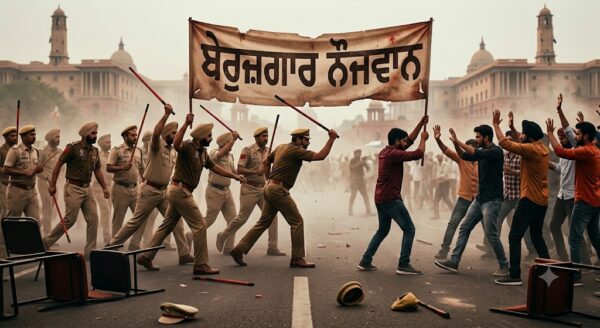
For decades, Punjab has witnessed repeated debates about the role, powers, and accountability of its police force. While law enforcement agencies play a vital role in maintaining peace, combating crime, and protecting citizens, concerns have frequently been raised by various sections of society regarding alleged misuse of power, excessive force, arbitrary detentions, and the suppression of democratic dissent. These concerns have emerged from farmers’ organizations, youth groups, labor unions, social activists, human rights advocates, journalists, political workers, and ordinary citizens.
The relationship between the people of Punjab and the police has often been marked by a trust deficit. Many citizens believe that while the police are expected to serve and protect the public, there have been instances where force has been used against those exercising their democratic right to protest. Whether it has been farmers demanding fair policies, unemployed youth seeking jobs, teachers fighting for regularization, contractual employees seeking job security, or pensioners demanding their dues, allegations of police excesses have repeatedly surfaced.
One of the most significant chapters in Punjab’s history remains the period of militancy and counter-insurgency operations during the 1980s and 1990s. Human rights organizations, affected families, and civil liberties groups have, over the years, raised concerns regarding alleged disappearances, extrajudicial killings, and unlawful detentions during that era. Even decades later, many families continue to seek justice, accountability, and closure. The legacy of those years continues to influence public perceptions of policing in Punjab.
In recent years, concerns have also been raised regarding police action against peaceful demonstrations. Unemployed youth seeking recruitment, farmers protesting agricultural policies, and various employee unions have on several occasions alleged the use of excessive force during demonstrations. Images of lathi-charges, detentions, and confrontations often generate public debate about whether authorities are responding to legitimate grievances through dialogue or coercion.
Journalists, social media commentators, and human rights defenders have also expressed concerns regarding what they perceive as attempts to discourage criticism of those in power. A healthy democracy depends on freedom of expression, and any perception that dissenting voices are being intimidated can weaken public confidence in democratic institutions.
Punjab’s marginalized communities also face challenges in accessing justice. Social activists have argued that vulnerable sections of society often struggle to obtain fair and timely responses when reporting crimes or seeking protection. Such concerns highlight the need for stronger mechanisms to ensure equal treatment under the law regardless of social, economic, or political status.
Custodial deaths and allegations of custodial torture remain among the most serious concerns raised by civil liberties organizations across India, including Punjab. Every such allegation damages public trust and underscores the importance of independent investigations, transparency, and strict adherence to constitutional safeguards. A democratic society cannot tolerate violations of human dignity, regardless of the circumstances.
The issue is not about weakening the police. Punjab faces serious challenges, including organized crime, drug trafficking, gang violence, cybercrime, and threats to public order. Police officers often perform difficult and dangerous duties under immense pressure. However, the effectiveness of law enforcement ultimately depends on public trust. A police force that enjoys the confidence of the people is better positioned to maintain law and order than one perceived as unaccountable.
The path forward lies in meaningful reforms. Independent oversight mechanisms, stronger human rights training, body-worn cameras, transparent investigation procedures, protection of the right to peaceful protest, and prompt action against misconduct can strengthen both policing and democracy. Accountability should not be viewed as an attack on the police; rather, it is an essential component of professional law enforcement.
Punjab’s future depends on strong institutions that respect both security and civil liberties. Citizens have a right to safety, justice, and dignity. At the same time, police officers deserve public support when performing their duties lawfully and professionally. Achieving this balance requires transparency, accountability, and an unwavering commitment to the rule of law.
A democratic society is ultimately judged not by how it treats the powerful,but by how it treats those who question authority, seek justice, and exercise their constitutional rights.The continuing debate surrounding policing in Punjab should therefore be viewed not merely as a law-and-order issue, but as a test of democratic accountability and public trust.