
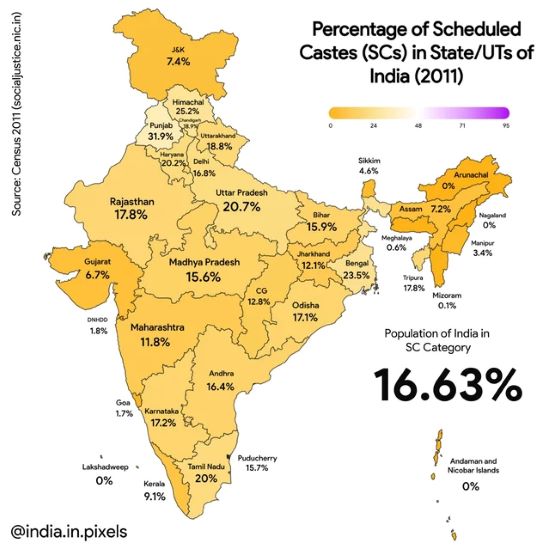
 The recent statement by the Punjab State Scheduled Castes Commission that the Scheduled Caste (SC) community constitutes around 37 per cent of Punjab’s population has once again brought attention to an important question: Does this large population have a proportionate share in political, administrative, and economic power? Punjab has long been recognised as the state with the highest proportion of the Scheduled Caste population in India, with Census data placing it at around 32 per cent and several community organisations claiming the figure has now reached 37-38 per cent.
Despite this significant demographic presence, many observers argue that the SC community remains underrepresented in key decision-making positions. While political parties regularly seek votes from Dalit communities during elections, their participation in the highest levels of governance often remains limited. Punjab has witnessed very few occasions where members of the Scheduled Caste community have occupied the most influential positions in government, administration, and policymaking. Critics contend that numerical strength has not translated into proportional political influence.
The issue extends beyond politics. Scheduled Caste organisations have repeatedly raised concerns regarding representation in government services, implementation of reservation policies, backlog vacancies, promotions, and appointments in senior administrative positions. Earlier this year, representatives of SC employee organisations informed the Punjab State Scheduled Castes Commission that reservation and representation policies require reassessment in view of the changing demographic realities of the state.
Economic disparities also remain a major concern. A substantial section of Punjab’s Scheduled Caste population continues to depend on agricultural labour, daily wage work, and low-income occupations. Access to land ownership, business opportunities, higher education, and financial resources remains uneven compared to their population share. Many social activists argue that genuine empowerment cannot be measured merely through welfare schemes but through meaningful participation in economic growth and wealth creation.
Another concern is the continuing rise in complaints related to discrimination and rights violations. Official figures show that the Punjab State Scheduled Castes Commission has handled thousands of complaints in recent years, indicating that social justice issues remain a significant challenge despite decades of constitutional safeguards.
Political analysts note that Punjab’s electoral landscape is unique because Scheduled Caste voters play a decisive role in dozens of Assembly constituencies. Yet, community leaders frequently argue that major political parties treat Dalit representation as an electoral necessity rather than a commitment to sharing power. The demand is no longer limited to reserved constituencies but includes greater participation in cabinet positions, government boards, commissions, bureaucracy, and policy-making institutions.
The debate ultimately centers on a fundamental democratic principle: whether representation should reflect population. If the Scheduled Caste community indeed constitutes nearly 37 percent of Punjab’s population, many believe its presence in positions of authority should be visible across all sectors of public life. For Punjab’s future social stability and inclusive development, policymakers will increasingly face pressure to ensure that demographic strength is matched by meaningful representation, equal opportunities, and a genuine share in governance and decision-making.
In a democracy, numbers alone do not guarantee empowerment. True empowerment comes when a community’s voice is reflected not only in election results but also in the institutions that shape the state’s future. For many within Punjab’s Scheduled Caste community, that remains an unfinished journey.