
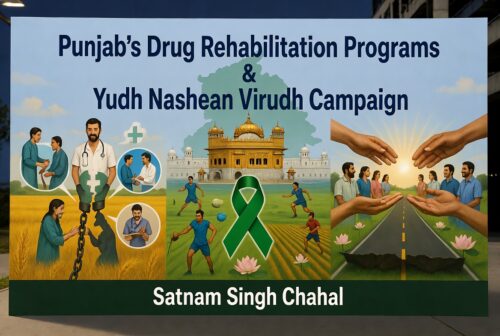
 “Punjab’s Pyramid Model vs Other States: How India’s Most Aggressive Drug Rehabilitation Strategy Stacks Up”
Punjab’s drug rehabilitation model stands out as one of the most structured and aggressively scaled state-level responses in India, largely because of the severity of its opioid and synthetic drug crisis. The state follows a three-tier Pyramid Model that begins with community-level Outpatient Opioid Assisted Treatment clinics offering buprenorphine-naloxone substitution therapy, moves up to district and sub-divisional de-addiction centers, and culminates in specialized model centers attached to government medical colleges.
This integrated approach combines medical detox, psychosocial counseling, family therapy, vocational training, and community reintegration programs, supported by the high-profile Yudh Nashean Virudh campaign that has already facilitated treatment for over ninety thousand individuals since March 2025.
Punjab also emphasizes strong enforcement linkage and grassroots mobilization through Village Defence Committees and volunteer networks, which most other states have not replicated at the same intensity.In comparison, Kerala has adopted a more prevention-oriented strategy focused on education and community awareness rather than large-scale medical substitution therapy. The state runs strong school-based programs and youth clubs under initiatives like the Student Police Cadets project, which help in early intervention and building resistance among young people.
While Kerala has good literacy and social awareness that aid prevention efforts, its coverage of opioid substitution treatment remains lower than Punjab’s, and the response to rising synthetic drug use has been relatively slower.Maharashtra presents a different picture with a stronger role for the private sector. Major cities like Mumbai and Pune host numerous well-funded luxury rehabilitation centers alongside government-run addiction treatment facilities. This creates better options for residential care and personalized therapy, but the model suffers from a clear urban-rural divide and lacks the uniform statewide pyramid structure and community mobilization drive seen in Punjab.
Private centers often provide higher comfort and holistic services, yet affordability and regulation remain concerns.Uttar Pradesh and Delhi largely depend on central government schemes such as the National Action Plan for Drug Demand Reduction, which funds Integrated Rehabilitation Centres and outreach programs. These states serve large populations and register high absolute numbers of treatment seekers, but per-capita coverage and treatment-seeking rates tend to be lower due to overburdened infrastructure, stigma, and weaker coordination between enforcement and rehabilitation wings compared to Punjab’s campaign-driven model.
North-Eastern states such as Manipur and Mizoram pioneered harm-reduction approaches because of high rates of injecting drug use and associated HIV prevalence. They emphasize needle-syringe exchange programs and opioid substitution therapy delivered through peer-led and NGO-supported networks. These models have influenced national guidelines and work well in culturally specific contexts, but they often face funding shortages and limited infrastructure in remote areas, unlike Punjab’s more centralized and government-owned system.
Overall, Punjab’s rehabilitation framework is more comprehensive and enforcement-linked than most other states, making it uniquely suited to its crisis. Other states may excel in specific areas such as preventive education in Kerala, private-sector innovation in Maharashtra, or targeted harm reduction in the North-East, but none match the scale, state-wide uniformity, and community mobilization intensity that Punjab has achieved under its current campaign. This comparative edge comes with its own challenges, including high relapse rates and the need for stronger long-term aftercare across all model
Disclaimer: This article and accompanying images are for informational and illustrative purposes only. Some visuals may be AI-generated or digitally enhanced and may not depict actual events or persons.
Views expressed are based on publicly available information and analysis.