
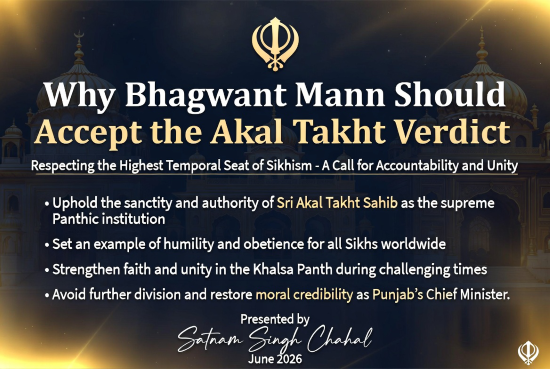
 The recent decision of the Sikh clergy at the highest temporal seat of Sikhism, the Akal Takht Sahib, regarding Punjab Chief Minister Bhagwant Mann has triggered intense debate across Punjab and the global Sikh community. While political parties have taken predictable positions either in support of or against the verdict, the larger question remains: Should a sitting Chief Minister accept the verdict of the Akal Takht? From the perspective of Sikh tradition, democratic leadership, and social harmony, there are compelling reasons why Bhagwant Mann should accept the verdict respectfully, even if he disagrees with some aspects of it.
The Akal Takht occupies a unique place in Sikh history and tradition. Established by the Sixth Sikh Guru, Guru Hargobind Sahib in 1606, it symbolizes temporal authority and justice in Sikhism. For centuries, Sikh rulers, generals, and ordinary followers have appeared before the Akal Takht whenever questions arose regarding conduct or community concerns. The institution derives its authority not from the Constitution of India but from the faith and reverence of millions of Sikhs worldwide. Respect for its decisions has historically strengthened Sikh unity and social cohesion.
Recent developments indicate that the Akal Takht declared Bhagwant Mann as “Guru Dokhi” and “Khalsa Panth Virodhi” over controversies linked to alleged remarks and a disputed video. The Sikh clergy stated that forensic examinations had found the video authentic, while Mann has rejected the allegations and maintained that the person in the video is not him.
Even if the Chief Minister disagrees with the findings, accepting the verdict does not necessarily mean admitting guilt. Sikh history offers numerous examples where leaders appeared before religious authority as an act of humility rather than submission. Acceptance in this context can be interpreted as respect for Sikh institutions and sentiments. A leader’s willingness to bow before community institutions often enhances, rather than diminishes, public stature.
Punjab is a state where religion and culture are deeply intertwined with politics and identity. The office of Chief Minister carries not only constitutional responsibilities but also moral obligations toward preserving communal harmony. If Bhagwant Mann openly rejects the verdict, it risks deepening divisions between political and religious institutions. Such confrontation could polarize society and create unnecessary tensions in Punjab’s already sensitive social fabric.
History demonstrates that conflicts between political power and religious authority often leave long-lasting scars. Punjab has witnessed several episodes where political disputes involving religious institutions escalated into broader societal conflicts. Therefore, de-escalation and dialogue remain essential. Respectfully accepting the verdict, while simultaneously exercising his democratic right to present his side, could help prevent further polarization.
Importantly, acceptance of the Akal Takht’s verdict does not undermine constitutional governance. India is a secular democracy where elected governments derive authority from the Constitution. However, secularism in India also means respecting religious sentiments and institutions. Bhagwant Mann can uphold constitutional values while showing deference to the religious sentiments of millions of Sikhs. The two are not mutually exclusive.
It is also noteworthy that when summoned earlier this year, Bhagwant Mann reportedly appeared before the Akal Takht as “a humble Sikh and not as Chief Minister,” emphasizing his respect for the institution. If that respect was genuine, continuing to engage constructively with the institution would be consistent with his earlier stance.
Political leaders are often judged not merely by their victories but by how they handle criticism and adversity. A statesman rises above confrontation and seeks reconciliation. By accepting the verdict with humility, even while maintaining his innocence, Bhagwant Mann could project himself as a leader who values Punjab’s religious heritage and social harmony above political calculations.
Ultimately, whether one agrees with the Akal Takht’s decision or not, institutions derive strength from the respect accorded to them by society. Punjab’s future requires cooperation between democratic governance and religious institutions rather than conflict. A respectful acceptance of the verdict, accompanied by dialogue and clarification, may serve not only Bhagwant Mann’s political future but also the larger interests of Punjab and the Sikh community worldwide.
Note: The controversy remains contested. While the Akal Takht has cited forensic findings and issued its decision, Bhagwant Mann has denied the allegations and asserted that political motives may be involved. The matter continues to generate debate across Punjab
Disclaimer: This article and accompanying images are for informational and illustrative purposes only. Some visuals may be AI-generated or digitally enhanced and may not depict actual events or persons. Views expressed are based on publicly available information and analysis.