
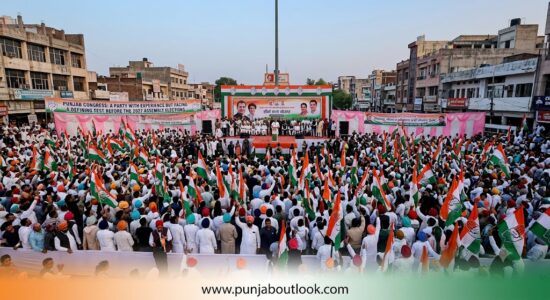
 The Punjab Congress remains one of the state’s oldest and most experienced political organisations. It has a wide grassroots network, leaders with administrative experience and a support base across different regions. Yet, despite these strengths, the party enters the run-up to the 2027 Assembly elections confronting significant organisational and political challenges.
One of Congress’s biggest strengths is its experienced leadership. Many of its senior leaders have served as Chief Ministers, ministers, Members of Parliament and legislators. The party also has a strong presence in rural Punjab and continues to attract support from sections of farmers, traders, government employees and urban voters. Compared with many regional parties, the Congress possesses a well-established organisational structure extending to the district and block levels.
However, experience alone is no guarantee of electoral success. Over the past several years, the Punjab Congress has repeatedly been affected by leadership disputes and factional politics. Differences among senior leaders have often played out in public, creating an impression of disunity. Whether these disagreements are ideological or personality-driven, they have distracted the party from building a consistent political narrative.
Another challenge is the absence of a single, undisputed face capable of uniting every faction. The party has several influential leaders, each with loyal supporters and political strengths. While internal democracy can be healthy, prolonged competition among leadership groups can slow decision-making, affect candidate selection and weaken campaign coordination.
The Congress also faces the difficult task of reconnecting with younger voters. A new generation is looking for practical solutions on employment, education, entrepreneurship, technology, industrial investment and skill development. The party will need to present a forward-looking vision rather than relying only on its historical legacy.
The party’s campaign will inevitably be judged on its ability to offer credible alternatives on key issues facing Punjab. These include agriculture, fiscal management, law and order, industrial growth, healthcare, education, drug trafficking, water resources, environmental concerns and the welfare of farmers, labourers and small businesses. Voters are increasingly interested in policy outcomes rather than political slogans.
Candidate selection will be another crucial factor. If tickets are distributed on the basis of organisational strength, public credibility and local performance, the party may strengthen its prospects. If factional considerations dominate the process, dissatisfaction among workers and independent candidates could become an electoral challenge.
The Congress also needs to strengthen its communication strategy. Modern elections are increasingly influenced by digital media, social media and rapid political messaging. A disciplined, coordinated communication campaign that responds quickly to public issues will be essential to remain competitive.
At the same time, the party retains opportunities. Anti-incumbency, if it develops against the ruling government, could create political space for the opposition. The Congress’s organisational reach and experienced leadership could allow it to benefit—but only if it presents a united front and a convincing programme for governance.
Ultimately, the 2027 Punjab Assembly election will not be decided solely by the weaknesses of the ruling party or by the strengths of the opposition. It will also depend on which party is seen by voters as the most united, credible and capable of addressing Punjab’s economic, social and governance challenges.
For the Punjab Congress, the months ahead are likely to be decisive. If it resolves internal differences, strengthens its organisation and focuses consistently on public issues, it can remain a major contender. If internal rivalries continue to overshadow its political message, it may find it harder to convert its organisational strength into electoral success.
For the Punjab Congress, the months ahead are likely to be decisive. If it resolves internal differences, strengthens its organisation and focuses consistently on public issues, it can remain a major contender. If internal rivalries continue to overshadow its political message, it may find it harder to convert its organisational strength into electoral success.
Punjab’s voters have repeatedly demonstrated that they are willing to reward performance and punish complacency. Every political party, including the Congress, will ultimately be judged not by internal calculations but by its ability to present a clear vision, maintain organisational discipline and earn the confidence of the electora
Disclaimer: This article and accompanying images are for informational and illustrative purposes only. Some visuals may be AI-generated or digitally enhanced and may not depict actual events or persons.Views expressed are based on publicly available information and analysis.