
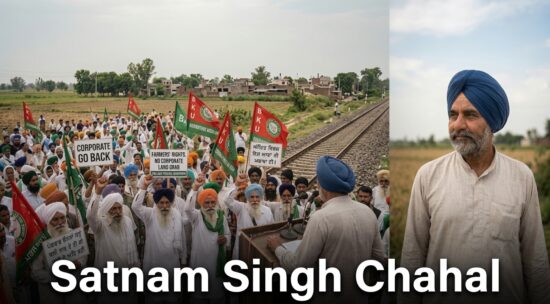
 In Punjab’s already sensitive agrarian landscape, a fresh debate has emerged over proposed policy amendments related to land and agriculture, triggering strong reactions from farmer unions, political parties, and the state government. At the centre of the controversy is the fear among farmers that corporate houses are increasingly looking toward the agriculture sector not merely as investors, but as dominant stakeholders who could gradually reshape control over land, production systems, and supply chains. Critics of this trend argue that such moves may weaken the traditional role of small and marginal farmers and could lead to a gradual exclusion of cultivators from decision-making in agriculture. Farmer groups have warned that any attempt—direct or indirect—to facilitate large-scale corporate entry into farmland ownership or control will be met with resistance on the ground.
The farmers’ unions have taken a particularly firm stand, stating that Punjab’s agrarian community is fully prepared to launch a large-scale agitation if they perceive any policy as enabling land concentration or “land grabbing.” Their concern is rooted in long-standing anxieties about land security, procurement systems, and market control, which have historically been central to Punjab’s political economy. In this context, Bharatiya Kisan Union (Lakhowal) leader Harinder Singh Lakhowal has publicly opposed the policy direction, reinforcing the view that farmer bodies are closely watching each legislative or administrative change. His statement reflects a broader sentiment among sections of the farming community that any structural shift in land or agriculture policy must be carefully scrutinised to ensure it does not undermine farmer autonomy.
Politically, the issue is beginning to acquire significant traction. The opposition, including the Shiromani Akali Dal, has criticised the proposed changes and signalled that it could become a major electoral issue if not handled carefully. Opposition parties are expected to frame the debate around farmer rights, land security, and corporate influence in agriculture, especially in the run-up to elections. Analysts suggest that any perception of the government facilitating corporate entry into agriculture-related land systems could create political vulnerability, particularly in rural constituencies where farming remains the dominant livelihood.
At the same time, the Government of Punjab has defended the amendments, stating that the changes have been introduced in response to demands raised by farmers themselves. According to the government’s position, the intent is not to displace farmers but to modernize agricultural frameworks and address structural inefficiencies in the sector. However, this justification has not fully eased concerns among protesting groups, who argue that policy language and implementation mechanisms often determine outcomes more than stated intentions.
Overall, the situation reflects a familiar pattern in Punjab’s policy environment, where agricultural reforms quickly become politically charged due to the centrality of farming to the state’s economy and identity. With farmer unions mobilizing, opposition parties sharpening their criticism, and the government defending its stance, the issue is likely to remain a flashpoint. If tensions escalate, especially around land-related provisions, it could evolve into a significant statewide agitation, with potential implications for both governance and electoral dynamics in the coming period.
Disclaimer: This article and accompanying images are for informational and illustrative purposes only. Some visuals may be AI-generated or digitally enhanced and may not depict actual events or persons.
Views expressed are based on publicly available information and analysis.