
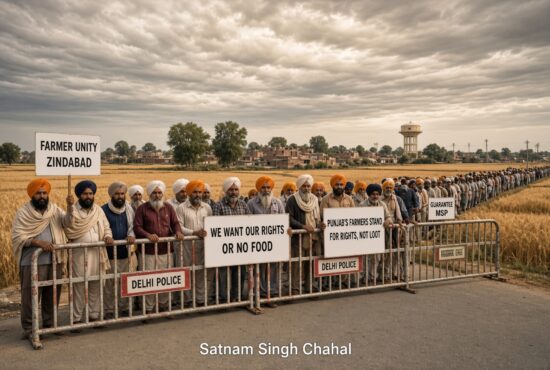
 The images of tear gas and water cannons being used to disperse protesters belonging to the Quami Insaaf Morcha in Chandigarh should force Punjab to ask a difficult question: Why has the use of force increasingly become the first response to public dissent?
The Quami Insaaf Morcha has been demanding the release of Sikh prisoners who, according to the protesters, have spent prolonged periods in jail. Whatever one’s position on the individual cases may be, their demands deserve to be heard through lawful democratic channels. A protest is not, by itself, a crime. In a democracy, citizens have the right to assemble peacefully and place their grievances before the authorities.
The disturbing concern is that this is not an isolated issue. Across Punjab, different sections of society—from farmers and workers to students, employees, religious groups, political parties, unemployed youth and other organisations—have repeatedly taken to the streets to demand action on their grievances. Too often, the government’s response appears to begin with barricades, police deployment, detention, water cannons or force rather than meaningful dialogue.
A government cannot solve every problem by treating every protester as a law-and-order problem. People protest because they believe normal channels have failed them. When petitions, representations and meetings do not produce satisfactory answers, the road eventually becomes the place where citizens make themselves heard.
The question is therefore not whether the government has the authority to maintain public order. Of course it does. The real question is whether that authority is being exercised proportionately, responsibly and with respect for democratic rights.
There is an important distinction between a peaceful protest and violent or unlawful conduct. If protesters attack police officers, damage public property or create a genuine threat to public safety, the authorities have a legitimate duty to intervene. But where people are exercising their right to peaceful assembly, the government’s first responsibility should be to communicate, negotiate and de-escalate—not automatically reach for the water cannon.
The Chandigarh incident involving the Quami Insaaf Morcha has once again brought this debate into focus. The protesters may have a demand with which everyone does not agree, but disagreement with a demand does not eliminate the protesters’ constitutional and democratic right to express it peacefully.
Punjab has a long and complicated history of political movements, public protests and struggles for justice. The state has also witnessed periods when excessive force deepened public anger rather than resolving the underlying dispute. Governments should therefore understand that force can disperse a crowd for a few hours, but it cannot disperse a grievance.
The larger problem is the growing perception that ordinary citizens, regardless of their background, have to take to the streets before the government listens. If farmers protest, there is a confrontation. If employees protest, there are barricades. If unemployed youth protest, there is police deployment. If religious or political organisations protest, the administration often prepares for a law-and-order battle before a political dialogue begins.
That approach risks creating a dangerous cycle: grievance, protest, barricade, confrontation, force and then another protest.
Punjab needs a different model. The government should establish stronger and transparent mechanisms through which citizens and organisations can raise grievances, receive time-bound responses and know who is responsible for resolving their issues. Ministers and senior officials should engage directly with protest representatives wherever possible.
A democratic government should not be afraid of people standing on the road with placards. It should be confident enough to stand across the table and listen.
The Punjab Police also deserves a clear distinction between maintaining order and suppressing dissent. Police personnel are responsible for protecting citizens, maintaining public safety and enforcing the law. They should not be placed in a position where every political or social dispute becomes a confrontation between the state and its own people.
The images of water cannons and tear gas may demonstrate the government’s ability to control a gathering. They do not demonstrate that the underlying problem has been solved.
Punjab needs governance that listens before it deploys force, negotiates before it confronts and resolves before grievances become movements.
The government may be able to clear a road with water cannons. It cannot clear Punjab’s grievances with them.