
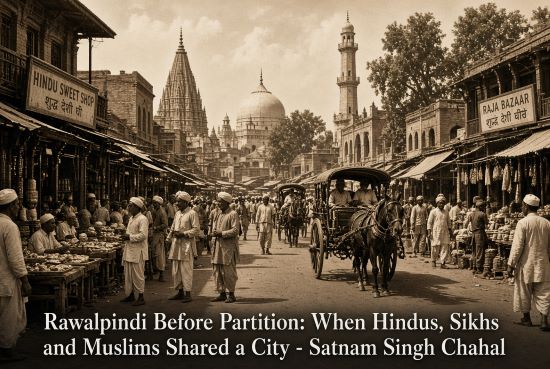
Rawalpindi today is known as one of Pakistan’s major cities, but its older streets carry memories of a very different social landscape. Before the Partition of Punjab in 1947, Rawalpindi was a multi-community city where Hindus, Sikhs and Muslims lived, worked and traded alongside one another. The city’s bazaars, religious places, homes and businesses reflected a society in which different communities were deeply connected through everyday life.
The old markets of Rawalpindi still preserve fragments of that forgotten history. Buildings with traditional wooden balconies, carved doors and old architectural features stand as reminders of a period when the city was commercially vibrant and socially diverse. Areas such as Raja Bazaar and Bhabra Bazaar were once associated strongly with Hindu and Sikh traders, shopkeepers, artisans and food sellers.Rawalpindi had developed considerably under Sikh rule before coming under British control in 1849. The British subsequently transformed it into an important military and commercial centre. Its location also made it an important link between the Punjab plains and the Kashmir region. Trade, transport and military activity brought people from different parts of the region into the city and helped create a busy urban economy.
According to memories preserved by elderly residents, Hindu and Sikh businessmen had a particularly strong presence in Rawalpindi’s commercial life before Partition. They operated shops, trading houses, sweet shops and other businesses, while Muslims were also active in transport, labour, skilled trades and other occupations. The economic roles of the communities were different in many cases, but their daily lives were closely intertwined.That diversity was not simply a matter of commerce. Families from different religious communities interacted socially and participated in civic life. Local leaders from different communities could serve together in public institutions. Religious sensitivities were also often respected because people understood that maintaining harmony was essential to the functioning of the city.
Then came 1947.
The political crisis surrounding the demand for Pakistan, competing territorial claims and growing communal tensions gradually destroyed the fragile balance that had existed for generations. Rawalpindi became one of the early flashpoints of communal violence in Punjab in March 1947.What began with confrontations and retaliatory violence soon developed into attacks on homes, businesses and places of worship. Fear spread rapidly. Rumours travelled from one locality to another, and communities that had lived together for decades began to view one another through the lens of suspicion and revenge.Rawalpindi became part of a much larger cycle of violence that eventually engulfed Punjab. Violence in one location produced retaliation somewhere else, creating a chain reaction that ordinary families could neither control nor escape.
For Hindus and Sikhs in Rawalpindi, the consequences were devastating. Many abandoned homes and businesses that their families had built over generations. Some fled with whatever belongings they could carry. Others were forced onto trains and refugee routes leading toward what became India.The departure of these communities was not merely a demographic change. It also transformed the economic and cultural character of the city.The disappearance of Hindu and Sikh traders meant the disappearance of generations of commercial knowledge, family businesses and traditional skills. Among the memories that survived were those of the city’s sweet shops and food vendors. Traditional preparations such as jalebi, rewri, patasa and other sweets had been associated with Hindu and Sikh confectioners. Popular foods such as chole bhature also travelled with displaced families as they rebuilt their lives elsewhere.
This is one of the less discussed dimensions of Partition. History is often measured through borders, political agreements, migration figures and casualty estimates. But Partition also divided kitchens, markets, neighbourhoods and family businesses. Recipes crossed borders with refugees. Business skills were carried into new cities. Names of old streets and shops survived in memories long after the people who created them had disappeared.Delhi, Amritsar, Ludhiana, Jalandhar and other cities received large numbers of refugees from West Punjab. Many displaced families started again from almost nothing. Some rebuilt successful businesses, while others spent decades trying to recover what had been lost.On the other side of the border, Muslims displaced from eastern Punjab experienced their own traumatic journey. The movement of people was enormous, and violence affected communities on both sides. No single community can claim a monopoly over the suffering of Partition.That is why the story of old Rawalpindi should not be reduced to a simple tale of one community against another. It is a warning about what happens when political uncertainty, communal mobilisation, fear and revenge overwhelm the ordinary relationships that hold a society together.
The old bazaars are therefore more than commercial spaces. They are historical witnesses.A building may remain standing while the family that once owned it is gone. A street may retain its old name while its population has completely changed. A recipe may survive even though the shop that made it disappeared nearly eighty years ago.Rawalpindi’s pre-Partition history reminds us that Punjab was once a shared civilisational space in which religious identity was only one part of people’s lives. People were also neighbours, customers, employers, employees, friends and fellow citizens.Partition created two countries, but it also created millions of personal histories of separation.Nearly eight decades later, the old streets of Rawalpindi still quietly tell that story. Behind the crowded markets and modern buildings lies another Rawalpindi — a city where Hindus, Sikhs and Muslims once lived side by side, conducted business together and contributed to a common urban culture.The greatest tragedy of Partition was not simply that a map was redrawn. It was that communities that had shared Punjab for generations were separated by violence, fear and political upheaval.
The buildings remain.
The memories remain.
Disclaimer: This article and accompanying images are for informational and illustrative purposes only. Some visuals may be AI-generated or digitally enhanced and may not depict actual events or persons.Views expressed are based on publicly available information and analysis