
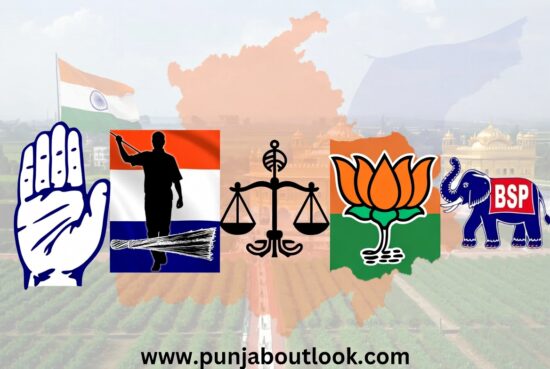
 Punjab’s political landscape in mid-2026 is marked by a ruling Aam Aadmi Party (AAP) government under Chief Minister Bhagwant Mann facing growing anti-incumbency, while the opposition remains fragmented and internally weakened. With assembly elections due in early 2027, the main opposition parties, particularly Congress, Shiromani Akali Dal (SAD), and BJP, are struggling to present a united or credible alternative.
Congress: Deepening Internal Crisis. The Indian National Congress, the principal opposition party, is currently embroiled in serious factional infighting. Recent organisational reshuffles by the high command have triggered open rebellion within the Punjab unit. Supporters of former Chief Minister Charanjit Singh Channi have publicly demanded the removal of state party president Amarinder Singh Raja Warring, arguing he lacks the mass appeal needed to challenge AAP. Leaders, including several MLAs, have gathered at Channi’s residence to pressure the central leadership, giving a one-week deadline for action. The high command’s attempts to manage these factions through multiple meetings have so far failed to restore unity. This internal discord has significantly damaged Congress’s ability to capitalise on anti-incumbency against the ruling AAP.
Shiromani Akali Dal: Fighting for Relevance. The Shiromani Akali Dal (SAD), once a dominant force in Punjab politics, is facing an existential crisis. After breaking its long-standing alliance with the BJP over the farm laws, the party has struggled to regain its traditional Sikh and rural support base. While it continues to raise issues related to Sikh identity, farmers, and state autonomy, its organisational strength and electoral performance have declined sharply. SAD leaders are attempting revival strategies, but the party remains a shadow of its former self and is currently the weakest among the major players
.
BJP: Going Solo with Limited FootprintThe Bharatiya Janata Party (BJP) has announced its intention to contest all 117 assembly seats independently in the 2027 elections. After years of alliance with SAD, the party is trying to build its own organisational network and has attracted some defectors from Congress and AAP. Its performance in recent civic body elections showed modest improvement, but it still lacks a strong independent base in Punjab. The BJP’s strategy appears to focus on urban voters, Hindu communities, and direct outreach, though analysts believe it will find it difficult to win a significant number of seats on its own.
The opposition in Punjab currently suffers from disunity and internal weaknesses. While anti-incumbency against the AAP government exists due to issues like unemployment, drug menace, farmer distress, and governance concerns, the divided opposition has been unable to convert public discontent into a strong political alternative.
Recent local body election results showed AAP maintaining a strong position in urban areas, further highlighting the challenges faced by Congress, SAD, and BJP.As Punjab heads towards the 2027 assembly elections, the ability of these parties to resolve internal conflicts, forge possible alliances, and present a coherent vision will determine whether they can effectively challenge the ruling AAP. For now, the opposition’s disarray remains one of the biggest advantages for the incumbent government.
Disclaimer: This article and accompanying images are for informational and illustrative purposes only. Some visuals may be AI-generated or digitally enhanced and may not depict actual events or persons. Views expressed are based on publicly available information and analysis.
Referances:Times of India