
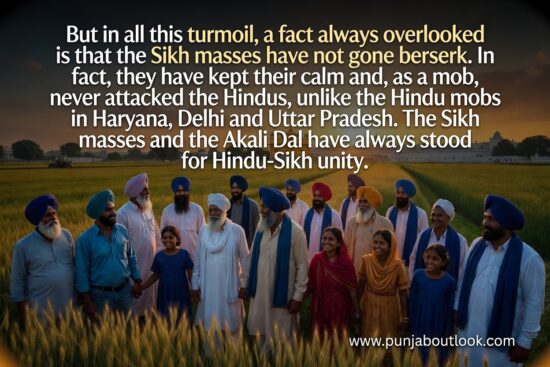
 In the heart of one of the most challenging chapters in recent Indian history, a profound truth emerged from the highest levels of administration in Punjab. Bhairab Datt Pande, who served as Governor of Punjab during the turbulent 1980s, recorded an observation that continues to resonate deeply today. In his memoirs In the Service of Free India, published posthumously in 2021, he wrote:“But in all this turmoil, a fact always overlooked is that the Sikh masses have not gone berserk. In fact, they have kept their calm and, as a mob, never attacked the Hindus, unlike the Hindu mobs in Haryana, Delhi and Uttar Pradesh.
The Sikh masses and the Akali Dal have always stood for Hindu-Sikh unity.”
This powerful statement serves as a reminder of Punjab’s true character — one of resilience, restraint, and deep-rooted unity.Outsiders often struggle to understand Punjab. From afar, the state is sometimes reduced to headlines of conflict. Yet those who know the land intimately understand its deeper rhythm. Even during periods of immense pressure and violence, ordinary Sikh farmers, mothers, shopkeepers, and community members chose humanity over revenge. They protected their Hindu brothers and sisters. They upheld the timeless teachings of the Sikh Gurus, which emphasise equality, compassion, and the welfare of all.This spirit is beautifully captured in the Sikh principle of Sarbat Da Bhala — “welfare of all” or “may everyone prosper.” Recited at the end of every Ardas (prayer), it calls upon Sikhs to pray not just for themselves, but for the peace, prosperity, and well-being of the entire humanity. It transcends religion, caste, and borders, reflecting the very soul of Punjab.Eh hai Punjab.
This is the Punjab where golden wheat fields stretch endlessly under vast skies, where the divine kirtan from the Golden Temple echoes alongside temple bells, and where “Sarbat da Bhala” is not just a phrase but a lived reality. It is a land where Hindus and Sikhs have walked together through generations — sharing festivals, joys, sorrows, and the simple dignity of daily life.Pande’s account highlights the stark contrast between fear-driven narratives often spread from distant capitals and the ground reality in Punjab’s villages and cities. Markets bustled, schools functioned, and communities continued to coexist peacefully even when the world outside expected otherwise.To those who keep twisting their heads in knots trying to understand Punjab from the outside: come closer. Sit in a village baithak, share a glass of fresh lassi, walk through the fields at sunset, or listen to the evening prayers at Harmandir Sahib. You will discover what many miss — a people whose hearts are larger than their wounds, whose spirit remains unbroken, and whose commitment to unity runs deeper than any division.Punjab does not merely preach harmony — it lives it.
This is the enduring message of Sarbat Da Bhala and the quiet strength that defines the land of the five rivers.