
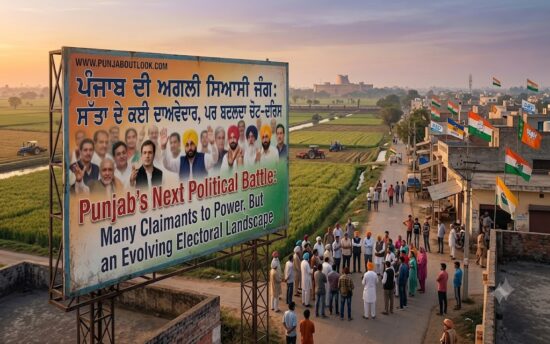
 As Punjab moves steadily toward the next Assembly elections, the state’s political atmosphere is becoming increasingly charged. Every major political party appears to have no shortage of leaders who see themselves as future chief ministers. Whether in the ruling party or the opposition, several senior politicians are positioning themselves as the natural choice to lead Punjab. The competition is no longer limited to defeating political opponents; it also involves winning internal battles for leadership.The result is a political environment in which there seem to be “a hundred and one contenders” for the seat of power. Ambition is abundant, but the larger question remains unanswered: who is discussing Punjab’s long-term future?
Behind the daily political rhetoric, Punjab is undergoing important demographic and electoral changes. Over the past four decades, the state has become home to a large population of interstate migrant workers. Initially arriving as seasonal agricultural labourers, many later found employment in industry, construction, transportation, hospitality, retail, domestic services, and small businesses. A significant number eventually settled permanently, established families, educated their children in Punjab, and, where eligible under Indian law, became registered voters.This gradual transition from temporary workers to permanent residents has begun to influence electoral politics in several constituencies. Political parties that once concentrated almost exclusively on traditional caste, regional, or religious vote banks now increasingly recognize that long-term interstate migrant communities also represent an important section of the electorate.
Campaign strategies reflect this shift. Political leaders visit labour colonies, interact with migrant welfare organizations, organize outreach programmes, and include issues affecting these communities in their election messaging. This does not necessarily mean that interstate migrant voters determine every election, but it demonstrates that parties consider them electorally relevant in many urban and semi-urban constituencies.Punjab’s electoral politics is therefore becoming more complex than ever before. Winning elections today requires building broad social coalitions rather than relying on a single support base. The candidate who can unite farmers, urban middle-class voters, industrial workers, youth, women, Scheduled Castes, business communities, and other eligible voter groups is likely to enjoy a stronger electoral position.
However, demographic change should not be exaggerated. Punjab’s electoral outcomes continue to be shaped by multiple factors: candidate credibility, party organization, local development, caste equations, economic conditions, voter turnout, and alliances. The influence of any one voting bloc including interstate migrants—varies from constituency to constituency. Broad claims that a single community will “dominate” statewide elections require careful empirical evidence and should be treated with caution.The greater concern for Punjab lies elsewhere. While politicians remain occupied with leadership contests, the state faces serious structural challenges. Public debt has risen significantly over the years, placing increasing pressure on future budgets. Agriculture continues to struggle with declining profitability, groundwater depletion, and climate-related uncertainties. Industrial growth has not kept pace with expectations, leading many young Punjabis to seek opportunities abroad. Drug addiction, unemployment, environmental degradation, and urban infrastructure remain pressing concerns that demand sustained policy attention.
Unfortunately, these issues often receive less attention than political rivalries. Internal factionalism, speculation over chief ministerial candidates, and public displays of personal ambition frequently dominate headlines, while discussions on governance take a back seat.Political parties would serve Punjab better by presenting comprehensive development agendas rather than personality-driven campaigns. Voters increasingly expect practical solutions: stronger public education, improved healthcare, employment generation, industrial investment, agricultural diversification, environmental protection, transparent administration, and fiscal discipline.
Punjab also stands at an important social crossroads. Interstate migrants have contributed significantly to the state’s economy, filling labour shortages in agriculture and industry during periods when local labour became scarce. At the same time, concerns raised by sections of society regarding demographic change, labour markets, infrastructure, and public services deserve thoughtful discussion based on reliable data rather than emotion or misinformation. Sound public policy requires balancing economic realities with social cohesion and constitutional equality.The coming election will therefore be more than a contest among political personalities. It will be a test of whether Punjab’s political class can adapt to changing demographic realities while addressing the deeper challenges confronting the state.
Ultimately, democracy rewards those who understand society as it exists not as it existed decades ago. Electoral success will belong to the leaders who engage every section of the electorate respectfully, present credible policy solutions, and inspire confidence that Punjab can once again become a state known not only for its rich heritage but also for good governance, economic opportunity, and social harmony.The race for power may have many contestants, but the real winner should be the people of Punjab. They deserve leadership that rises above internal rivalries and focuses on rebuilding the state’s economy, strengthening institutions, and securing a prosperous future for every law-abiding resident of Punjab.
Disclaimer: This article and accompanying images are for informational and illustrative purposes only. Some visuals may be AI-generated or digitally enhanced and may not depict actual events or persons. Views expressed are based on publicly available information and analysis.