
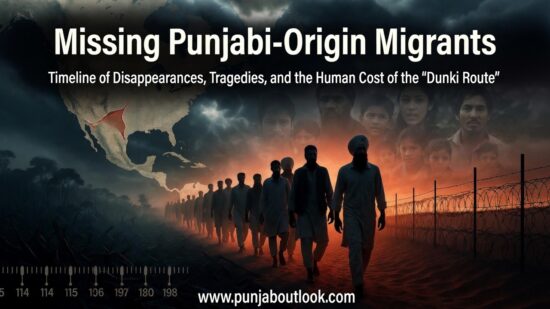
 For more than two decades, thousands of young men and women from Punjab have risked everything in search of better economic opportunities abroad. Many chose irregular migration routes—commonly known as the “Dunki Route”—to reach the United States, Canada, the United Kingdom, and parts of Europe after failing to secure legal visas. While many eventually arrived at their destinations, countless others disappeared during the perilous journey. Some died in deserts, rivers, jungles, or mountains, while others are believed to have been kidnapped by criminal gangs or abandoned by human smugglers. In many cases, their families in Punjab are still waiting for answers years after losing contact with their loved ones.
One of the greatest challenges in understanding the full extent of this tragedy is the absence of a centralized database documenting missing Punjabi migrants. Governments generally record migrant deaths without identifying ethnicity or place of origin, while many disappearances are never officially reported because families fear legal complications or have no idea where their relatives vanished. As a result, the actual number of Punjabi-origin persons who have gone missing between 2000 and 2026 is believed to be far higher than publicly documented cases.
During the early 2000s, organized human-smuggling networks expanded rapidly across Punjab. Instead of relying solely on fraudulent visas, many agents began transporting migrants through complex international routes involving Russia, Eastern Europe, the Middle East, and Africa before attempting entry into Western countries. Several Punjabi migrants reportedly disappeared after entering countries such as Russia, Ukraine, Belarus, and Poland, where language barriers, harsh weather, and criminal networks made them particularly vulnerable. Most of these cases received little attention and were never fully investigated.
Between 2006 and 2010, smugglers increasingly shifted their operations toward Latin America. Countries such as Ecuador, Guatemala, Nicaragua, Honduras, Panama, and Mexico became important transit points for migrants attempting to reach the United States. Families in Punjab began reporting that communication with their relatives often stopped after they entered Central America. Many migrants are believed to have disappeared while crossing remote forests or while being transported by criminal organizations controlling illegal migration routes.
The period from 2011 to 2014 witnessed growing violence along the Mexico-U.S. migration corridor. Mexican drug cartels became heavily involved in human smuggling, extortion, and kidnapping. Numerous Punjabi families from districts including Jalandhar, Hoshiarpur, Kapurthala, Tarn Taran, and Gurdaspur reported losing contact with relatives after they entered Mexico. Some families received ransom demands, while others never heard from their loved ones again. Since many migrants travelled without official documentation, tracing them became extremely difficult.
As the United States strengthened border security between 2015 and 2017, smugglers redirected migrants through increasingly dangerous desert regions in Arizona and Texas. Many Punjabi migrants attempted long walks across scorching deserts with limited food and water. Deaths from dehydration, heatstroke, exhaustion, and exposure became more common. Others simply disappeared in remote areas where rescue teams often arrived too late. U.S. authorities expanded search and rescue operations during this period, but many remains recovered in the desert were never identified.
By 2018 and 2019, Punjabi newspapers and television channels regularly carried reports of missing youth who had attempted illegal migration. Families publicly appealed for help after losing contact with sons and daughters believed to be travelling through Mexico. Human-smuggling fees climbed to between ₹25 lakh and ₹35 lakh, leading many families to mortgage land or take heavy loans. When migrants disappeared, families often faced not only emotional devastation but also severe financial ruin.
The COVID-19 pandemic in 2020 created additional hardships for irregular migrants. Border closures and lockdowns stranded many Punjabis in transit countries such as Panama, Guatemala, and Mexico. Communication became difficult as migrants were confined in detention centres, temporary camps, or isolated regions. Several families in Punjab spent months searching through social media, humanitarian organizations, and local contacts for any information about missing relatives.