
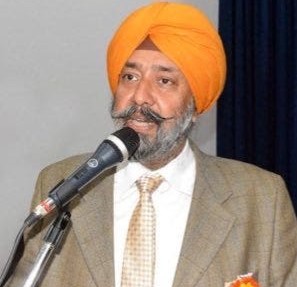
Author’s Note: I have written before on the withdrawal of Satluj from ZEE5, the magisterial inquiry I ordered as DC Amritsar, and Bibi Paramjit Kaur Khalra’s statement at Harike Pattan. Earlier this week I spoke to Pankaj Kapahi for close to an hour on Punjab First Voice, in Punjabi. What follows is not a word-by-word translation but my own English summation, for friends who may not follow the Punjabi easily. The video link is at the bottom.
I. A Delegation at My Doorword-for-word translation but my own English summary, for friends who may not follow
Six days after Chief Minister Beant Singh’s assassination on 31 August 1995, roughly ten persons arrived at my office to tell me that Bhai Jaswant Singh Khalra had been taken from his home by men in plain clothes, travelling in a private vehicle. This was Amritsar as it then was — before Tarn Taran had been carved out as a separate district — and the matter fell within my charge as Deputy Commissioner.
I rang the SSP Amritsar first, who denied any knowledge. I then reached SSP Tarn Taran, Ajit Singh Sandhu, by wireless message — no mobile telephones then. He too denied it. No FIR was registered, nor was the matter entered in the daily diary. That silence convinced me to order a magisterial inquiry at the Additional Deputy Commissioner’s level, recording statements on oath while memories were fresh. Such an inquiry convicts no one — it builds a record for a criminal investigation to stand on later. That record mattered more than I could have known.
Bhai Khalra had already moved the courts over unidentified cremations documented from municipal registers. After his disappearance, telegrams reached Justice Kuldip Singh, and the Supreme Court sought responses from the state; our affidavit disclosed the inquiry. On 15 November 1995, the Court directed the CBI to register a case and report back periodically, keeping the investigation alive. My evidence to the CBI was procedural: the delegation, the calls, the denials, the inquiry.
II. SPO Kuldeep Singh’s Testimony
The case rested on SPO Kuldeep Singh, a junior, vulnerable functionary in the Tarn Taran police. He testified that Bhai Khalra was held in custody, tortured, and taken to a house associated with Ajit Singh Sandhu; that he was made to bring food and water; that he heard gunshots on one such errand and returned to find Bhai Khalra dead; and that the body was disposed of thereafter. It has never been recovered.
Kuldeep Singh stayed silent until after Sandhu’s death, recording his statement only with court-ordered protection. That testimony withstood cross-examination and became the foundation for the conviction of six Punjab Police personnel — sentences the High Court later enhanced, holding that conspiracy carries equal responsibility.
III. A Question the Akali Dal Has Not Answered
The CBI investigation ran through the Badal Government’s tenure. Why, then, was SPO Kuldeep Singh — the witness on whom the whole prosecution depended — allegedly harassed by the Punjab Police in those very years, along with his family? If the Akali Dal now invokes Bhai Khalra’s name, it owes Punjab an answer for what happened while it commanded the police. I also recalled 2019, when Bibi Paramjit Kaur Khalra contested from Khadoor Sahib — and the Akali Dal fielded a candidate against her. If his memory were truly a Panthic cause above politics, that contest would not have happened.
IV. Two Officers, Weighed Honestly
Ajit Singh Sandhu was courteous in official dealings and regarded as a firm, effective officer — but the truth sits between hagiography and caricature. Firmness that crosses the law becomes illegality. An intense desire to crush militancy, I believe, pushed him past constitutional limits, and the convictions of the men under his command cannot be separated from his responsibility as officer in charge.
K.P.S. Gill, in my dealings, was cordial and genuinely knowledgeable — well-versed in Sikh history and Gurbani, and a commanding presence. But I reject the “super cop” theory of Punjab’s normalcy. Punjab spent nearly five years under President’s Rule under powerful police leadership, including Julio Ribeiro before him. What changed things was the restoration of democracy — the 1992 Assembly election, municipal polls, and above all the 1993 panchayat elections, when Punjabis began reclaiming their villages. It was the people, not any officer, who ended terrorism. Any accounting of Gill’s tenure must also reckon with Beant Singh’s assassination outside the Civil Secretariat while KPS Gill was still DGP.
V. Neither Every Encounter Was Genuine, Nor Every Encounter Fake
Fake encounters, custodial torture and illegal cremations are never defensible, even against an armed, externally supported insurgency. But it would be equally false to declare every encounter fake. Senior officers were killed, police stations attacked, civilians massacred. Each case must be tested on evidence, not slogans: where courts have found abduction and murder, as in the Khalra case, the guilty must be punished; where they have not, sweeping claims serve neither justice nor history. Several policemen were convicted in other, similar cases too — evidence the system was not simply looking away.
On numbers, I reject the inflated, communally loaded figures in circulation. By my own assessment, roughly 12,000 innocent civilians were killed — 60 per cent Sikh, 40 per cent Hindu — alongside some 8,000 militants and 1,784 policemen. Sikhs bore Blue Star, November 1984, disappearances and police excesses; Hindus were pulled off buses and murdered for their identity; police families were killed in their homes. Punjab’s grief belongs to no single community; no tragedy should erase another.
VI. On Satluj
The film should be shown; Bhai Jaswant Singh Khalra’s story deserves telling. But a film on so sensitive a period must be historically complete: the suffering inflicted by militant violence — on Hindus, on Sikhs who opposed militancy, on police and their families — needs its place too.
I also want to know why the film vanished from the OTT platform so quietly. If the government ordered its removal, that order should exist in writing, open to scrutiny and, if necessary, challenge in court. Removing a film once it is in the public domain rarely works — it manufactures curiosity and hands political parties a ready-made grievance.
VII. No Party Has Clean Hands Here
The Congress must answer for Blue Star, November 1984, and its governments’ excesses. The Akali Dal must answer for the harassment of the star witness on its watch, and for standing against Bibi Paramjit Kaur Khalra at the ballot box. The Aam Aadmi Party cannot hide behind free expression while silent on prison administration, parole, or remission for convicted officers. The BJP and the Union Government owe Punjab clarity on why the film disappeared — even as their own balancing act between Hindu sentiment, Sikh outreach and political alliance satisfies no one.
VIII. My Position, For the Record
I do not defend unlawful police conduct, nor accept a one-sided telling of Punjab’s history. Facts belong to evidence and official record — not slogans or partisan convenience. Bhai Jaswant Singh Khalra’s abduction and murder were heinous crimes, rightly punished. But the era was vast and brutal, and every community that suffered deserves remembrance, not selective invocation.
Punjab’s peace was restored, in the end, by Punjabis themselves — through elections, panchayats, civil society and everyday courage — not gifted by any one officer. I discharged my duties as Deputy Commissioner and District Magistrate as the law required: I ordered the inquiry, placed the facts before the courts, and cooperated fully with the CBI. I remain grateful to Guru Ram Das Patshah for the strength to do so.