
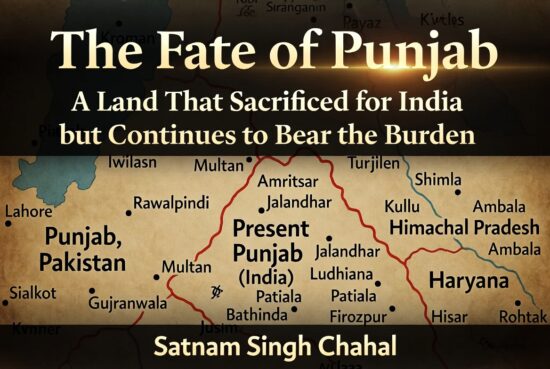
 Punjab has occupied a unique place in the history of the Indian subcontinent. Throughout centuries, it has served as the gateway to India, absorbing the first impact of foreign invasions while protecting the rest of the country. The story of Punjab is not merely one of geography; it is a story of sacrifice, resilience, and contribution. Yet, despite its unparalleled role in nation-building, many Punjabis believe the state has repeatedly paid a disproportionate price for national interests while receiving inadequate recognition for its sacrifices.
The first and perhaps the greatest tragedy in modern Punjab’s history came with the Partition of India in 1947. While the entire country celebrated independence from British colonial rule, Punjab witnessed one of the bloodiest human tragedies of the twentieth century. The historic province was divided between India and the newly created Pakistan. Millions of Punjabis—Sikhs, Hindus, and Muslims—were uprooted from ancestral homes where their families had lived for centuries. Entire villages disappeared overnight. Religious places, businesses, fertile agricultural lands, and centuries-old cultural heritage were abandoned.
No other region witnessed migration and communal violence on the same scale. Historians estimate that millions were displaced and hundreds of thousands lost their lives during Partition. Families were separated forever, women suffered unimaginable atrocities, and generations were left carrying the trauma of displacement. The economic and emotional cost of Partition for Punjab was immeasurable. Yet, despite this devastation, the people of Punjab rebuilt their lives with remarkable determination.
Following Partition, Punjab became the frontline state of independent India. Sharing a long international border with Pakistan, the responsibility of protecting the nation’s western frontier fell heavily upon Punjab and its people. Thousands of Punjabi youth joined the Indian Army, Border Security Force, Punjab Police, and other security agencies. Generation after generation volunteered for military service, contributing far beyond the state’s share of the national population. During the wars of 1947–48, 1965, 1971, and the Kargil conflict of 1999, Punjabi soldiers displayed extraordinary courage, making supreme sacrifices to defend India’s territorial integrity.
The villages of Punjab have traditionally sent their sons to the armed forces not merely as a profession but as a matter of honour and national duty. Countless families have sacrificed multiple generations in military service. Border farmers, too, have endured shelling, displacement, and uncertainty during periods of conflict while continuing to cultivate the land that feeds the nation.
Punjab’s contribution was not limited to national security. During the 1960s and 1970s, when India faced severe food shortages and depended on imported grain, Punjab became the engine of the Green Revolution. Punjabi farmers adopted modern agricultural practices, improved seeds, irrigation systems, and mechanized farming on an unprecedented scale. The result transformed India from a food-deficient nation into one capable of feeding its growing population. The grain procured from Punjab’s fields became the backbone of India’s Public Distribution System, ensuring food security for millions across the country.
Punjab also became a major contributor to India’s industrial growth, transportation, education, entrepreneurship, and overseas remittances. Punjabis established businesses across every state of India and around the world, contributing significantly to economic development while maintaining strong emotional and financial ties with their homeland.
However, many Punjabis believe that despite these enormous contributions, the state continued to experience political and constitutional decisions that weakened its position. In 1966, Punjab underwent another major territorial reorganization. The state was divided to create Haryana, while the hilly regions were merged into Himachal Pradesh. Although linguistic reorganization was presented as the guiding principle, several issues remained unresolved and continue to generate debate decades later.
Among the most significant concerns is the status of Chandigarh. Planned and built largely to serve as the capital of post-Partition Punjab after the loss of Lahore, Chandigarh eventually became a Union Territory and serves as the joint capital of both Punjab and Haryana. Many Punjabis argue that the prolonged Union Territory status of Chandigarh has remained a source of political dissatisfaction and has prevented the complete implementation of the promises associated with the 1966 reorganization.
Similarly, important institutions and infrastructure created through Punjab’s natural resources became subjects of shared administration. The Bhakra-Nangal Project and the Beas Project, among the largest river valley developments in independent India, came under the administration of the Bhakra Beas Management Board (BBMB). While the Board was established to coordinate the management of water and power among partner states, many voices in Punjab have argued over the years that the arrangement reduced the state’s direct control over resources originating within its territory. Water-sharing and river management continue to remain among the most sensitive political and legal issues in northern India.
Beyond constitutional questions, Punjab faced another painful chapter during the late twentieth century. The period from the late 1970s through the early 1990s witnessed militancy, terrorism, counter-insurgency operations, political instability, and widespread violence. Thousands of innocent civilians, police personnel, security forces, and militants lost their lives. Human rights organizations, journalists, and scholars have documented allegations of serious abuses during this period, while governments have consistently maintained that extraordinary security measures were necessary to combat terrorism and restore public order. The memories of this era continue to shape public discourse, and many families are still seeking truth, accountability, and reconciliation.
The prolonged violence had devastating consequences for Punjab’s economy, education, industry, and social fabric. Investment slowed, industries shifted elsewhere, tourism collapsed, and an entire generation grew up amid fear and uncertainty. Even after peace was restored, many observers argue that Punjab has struggled to regain the pace of economic growth it once enjoyed.
In recent decades, Punjab has faced additional challenges. Agricultural sustainability has become a major concern due to declining groundwater levels, soil degradation, rising production costs, and limited crop diversification. Industrial growth has lagged behind several neighbouring states. Youth unemployment, drug abuse, migration, and financial stress among farming families have become pressing social issues. Many educated young Punjabis now seek opportunities abroad, leading to concerns about brain drain and demographic change.
Despite these challenges, Punjab continues to contribute significantly to India’s defence, agriculture, industry, sports, culture, and global reputation. Punjabi entrepreneurs, professionals, scientists, artists, and members of the diaspora have strengthened India’s image across the world. The values of courage, hard work, generosity, and resilience remain deeply embedded in Punjabi society.
The future of Punjab should not be viewed merely as a regional concern. A strong and prosperous Punjab is essential for India’s food security, border security, economic development, and national unity. Addressing longstanding constitutional, economic, environmental, and developmental issues through democratic dialogue and cooperative federalism can contribute to greater trust and stability.
The history of Punjab is a history of repeated sacrifice. From the trauma of Partition to the defence of national borders, from feeding a hungry nation to enduring decades of violence and rebuilding afterwards, Punjab has repeatedly placed national interests above its own immediate concerns. Whether one agrees with every political demand or not, there is broad recognition that the contributions and hardships of Punjab deserve thoughtful reflection, fair policy consideration, and sincere engagement.
A nation becomes stronger when every region feels that its sacrifices are acknowledged and its aspirations are heard. Punjab’s story is therefore not only the story of one state; it is an important chapter in the continuing journey of India’s democracy, federalism, and national development.
Disclaimer: This article and accompanying images are for informational and illustrative purposes only. Some visuals may be AI-generated or digitally enhanced and may not depict actual events or persons.Views expressed are based on publicly available information and analysis.