
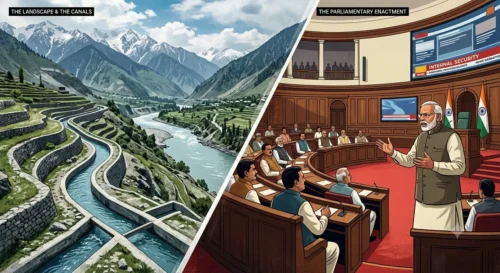
 On 24th April 2025, two days after the Pahalgam massacre, India did something it had not done in sixty-five years of the Indus Waters Treaty: it placed the Treaty in abeyance. For a country that had scrupulously honoured this Treaty through three wars and decades of provocation, this was a genuine departure — a signal that water, like everything else that sustains Pakistan’s ability to function as a state, would no longer be quarantined from the consequences of its export of terror.
It was the right call, and it was made at the right moment. But fifteen months on, it is worth asking a plain question: what, precisely, is holding this decision in place?
The answer is uncomfortable. It is a notification. A single executive act, issued under no specific statute, resting on the general treaty-making and foreign-affairs powers of the Union Executive. It can be reversed by the stroke of another pen, by any future government inclined to a different calculus, under any degree of diplomatic or international pressure. That is not the durability a decision of this magnitude deserves.
II. Why Abeyance Is Not Enough
Compare this to Article 370. Its abrogation in August 2019 was not left to a Cabinet note. It was legislated — debated in Parliament, voted upon, and subsequently tested and upheld by the Supreme Court in December 2023. Whatever one’s view of the substance, the form was unimpeachable: it was law, not merely policy.
There is a Punjabi sensibility to this that I think is worth stating plainly. The Treaty, for all practical purposes, is already dead — killed the moment India chose to stop treating Pakistan’s terrorism as something separate from Pakistan’s entitlements. What “abeyance” does is leave the body lying in state indefinitely, neither cremated nor consigned. That is not respect for the dead; it is simply an unfinished rite. A dead treaty needs a decent cremation, and its ashes need to be immersed — down the Eastern Rivers that remain unambiguously and permanently ours, not left drifting in the Western Rivers where Pakistan can still fish for a revival. Statute is that cremation. Executive notification is merely the deathbed.
The Indus Waters Treaty decision has had no equivalent legislative moment. And Pakistan has noticed. It has taken the matter to the Treaty’s own Court of Arbitration — a forum India does not recognise for this purpose, but one that Islamabad continues to use to manufacture the appearance of an unresolved international dispute. The Court has twice ruled against India’s position: first on jurisdiction, in June 2025, and again in May 2026, on the specific question of pondage limits for India’s run-of-river hydropower projects on the Chenab. India has rejected both rulings and continues to refuse participation. That is a defensible posture. But a posture is not a permanent structure, and structures are what outlast governments.

III. Why an Executive Notification Invites Contest
There is a particular vulnerability in resting so consequential a decision on executive action alone. Domestically, an aggrieved party — and there is no shortage of actors, state and non-state, who would relish reopening this question — could plausibly argue that a mere notification lacks the constitutional and statutory weight to survive serious challenge, particularly if a future government were less resolute in defending it. Internationally, Pakistan’s lawyers can point to the absence of any Indian legislative act and argue that India’s position is provisional rather than final, tactical rather than considered.
This is not a hypothetical risk. Treaties India has actually terminated or renegotiated in the past — and there have been a handful, though none of comparable strategic weight — have typically been accompanied, sooner or later, by some legislative or at least Cabinet-ratified instrument giving the decision institutional memory beyond the tenure of the government that took it. The Indus Waters Treaty abeyance, for all its significance, has not yet had that moment. It has had a notification, a great deal of diplomatic signalling, and considerable public support — but no Act of Parliament standing behind it.
Legislation closes both gaps at once. A law of Parliament cannot be undone by executive whim; it requires Parliament to undo it. And a legislative act is a far harder thing for any international forum to wave away as a temporary administrative measure.
This urgency has just been reinforced from the government’s own front bench. On 9th June 2026, Union Jal Shakti Minister C.R. Patil told the ANI news agency that it is now certain no water will reach Pakistan in the years ahead, and that the government is actively working towards this outcome on the Prime Minister’s directive. Subsequent reporting has characterised the government’s internal working timeline as somewhere between eighteen months and two years for the infrastructure required to make this a physical reality rather than a political statement.
That timeline changes the calculus for this Bill in one crucial respect. Constructing dams, tunnels and storage works on the Indus, the Jhelum and the Chenab at the scale needed to actually stop these flows is not something any government undertakes on the strength of an executive notification that its successor could reverse. Capital of this magnitude, committed over years, needs the certainty that only a standing law can provide. If Minister Patil’s pledge is to be more than a headline, the Treaty cannot remain merely “in abeyance” while these projects are designed, financed and built. It must be removed, by Parliament, as a legal impediment before the first spade goes into the ground — which is precisely what this Bill is designed to do.
IV. The Statutory Route: What the Bill Does
This is the thinking behind the Indus Waters Treaty (Abrogation) and Western Rivers Development Authority Bill, 2026, which I have drafted and released this week for public discussion, together with a companion Constitution Amendment Bill.
The Bill does four things. First, it converts the abeyance into a statutory abrogation — Parliament, not merely the executive, declares the Treaty at an end in respect of the Western Rivers: the Indus, the Jhelum and the Chenab. The Eastern Rivers — Ravi, Beas and Sutlej — are expressly untouched; nothing in this Bill reopens that settled question.
Second, it establishes a Western Rivers Development Authority to actually put these waters to use — for drinking water, which the Bill makes the first charge ahead of every other purpose, for irrigation, for hydropower, and for the long-term ecological health of the river basin itself, including afforestation, soil-erosion control and pollution monitoring. Water that India has a right to but does not use is water India has effectively conceded. This Authority exists to close that gap.
Third, it builds in the safeguards a law of this consequence needs to survive scrutiny: a time-bound, single-window environmental clearance mechanism that speeds up execution without diluting existing environmental standards; land acquisition strictly under the 2013 compensation law; and a forum-lock that channels any dispute from a non-riparian state exclusively to a suit under Article 131 before the Supreme Court, with the Union standing alongside the Authority as a necessary party.
Fourth — and this is the companion Constitution Amendment Bill’s job — it closes the narrow constitutional gaps that a determined challenger could otherwise exploit: an Explanation to Article 51 that prevents the Directive Principle on respecting treaty obligations from being read into the fundamental-rights review of this law; an amendment to Article 253 that extends Parliament’s treaty power from mere “implementation” to explicitly cover abrogation and termination; and a clarification to Entry 56 of the Union List placing beyond doubt that these newly available waters fall within Parliament’s competence.
V. Punjab’s Rightful Place at the Table
I would be less than honest if I did not flag the piece of this that matters most to me personally, and I suspect to most readers of this Chronicle. Punjab does not touch the Indus, the Jhelum, or the Chenab. Geographically, it has no claim to riparian status on the Western Rivers in the way Jammu & Kashmir, Ladakh and Himachal Pradesh do.
But Punjab has paid, and continues to pay, the security price for everything that flows from our western border. It is also, as a simple matter of engineering reality, the only viable corridor through which any water from the Chenab or the Jhelum could ever reach the plains of northern India — whether through a new link canal into the Ravi or otherwise. The Bill recognises Punjab’s stake on precisely these grounds: border security exposure and the terrorism it has borne directly, its role as an indispensable conveyance corridor, and its prospective riparian status the moment any such linkage project is actually built. These are honest, separate grounds — not a stretch of geography to fit a political convenience — and I believe they will hold up far better in law and in argument for being stated plainly rather than dressed up as something they are not.
VI. What Happens Next
I have written in my personal capacity to the Prime Minister, with copies to the Union Home Minister, the Union Minister for Jal Shakti, the Governor of Punjab, and the Chief Minister of Punjab, urging that this Bill — or something like it — be taken up. I do not present these drafts as finished legislation ready for introduction. They are exactly what I have called them: a citizen’s draft, offered for scrutiny, correction and improvement by people who know this subject better than I do in some particulars, and who care about it as much as I do in all of them.
VII. Why This Should Matter to You
We are a country still relearning, fifteen months after Pahalgam, what it means to hold a strategic decision and not simply announce one. The abeyance of the Indus Waters Treaty was the right instinct, correctly timed. What it has lacked, until now, is the institutional permanence that turns an instinct into an irreversible fact on the ground — the kind of fact that no future government, no international tribunal, and certainly no adversary across the border, can simply wish away.
That is what moving from abeyance to abrogation, by the statutory route, is meant to achieve. I invite you to read the drafts, argue with them, improve them, and — if you are persuaded — help carry this conversation forward.
I am under no illusion that a citizen’s draft becomes law simply because it is well-argued. That is not how legislation works, nor should it be. But every significant law begins somewhere outside the Cabinet room, in the friction of public debate, in the objections raised by people who have thought about a problem from a different angle than the one that first proposed a solution. If this draft survives that friction improved, or is overtaken by a better version altogether, it will have done its job. What it must not do is let this moment pass unmarked by anything more permanent than a press release.