
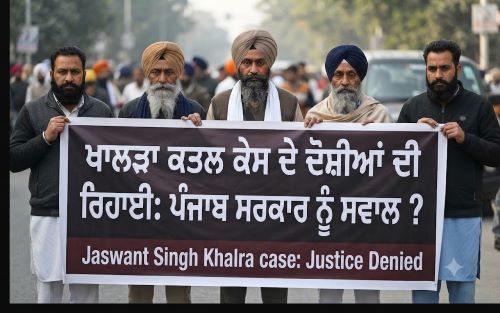
 The release of police officials convicted in the abduction and murder of renowned human rights activist Shaheed Jaswant Singh Khalra has once again become a matter of intense public debate. Renewed interest following the release of the film Satluj has brought the case back into the spotlight, with opposition parties, legal experts, and human rights activists demanding complete transparency over the release of former DSP Jaspal Singh and other convicted officials, including Satnam Singh and Jasbir Singh.
Jaswant Singh Khalra was abducted outside his residence in Amritsar on September 6, 1995, after exposing thousands of alleged illegal cremations during Punjab’s militancy period. His disappearance shocked Punjab and attracted international attention. Following a lengthy investigation by the Central Bureau of Investigation (CBI), several Punjab Police officials were prosecuted. After years of court proceedings, former DSP Jaspal Singh, Satnam Singh, Jasbir Singh, and others were convicted, with life imprisonment becoming the final punishment after judicial scrutiny.
The latest controversy concerns the release of former DSP Jaspal Singh from prison in 2023 and the legal process that led to his release. The complainant’s counsel has questioned whether all legal requirements were satisfied before he was released, including whether another sentence imposed in a separate case had been fully served. These issues have once again placed the case under public and legal scrutiny.
Political parties have alleged that the Punjab Government played a role in facilitating the release process by supporting remission or premature release proposals. These allegations have fuelled demands that all official records including prison files, recommendations, remission proposals, legal opinions, and correspondence between the Punjab Government, prison authorities, the Governor’s office, and the Union Ministry of Home Affairs be made public.
The Bhagwant Mann-led Aam Aadmi Party government has categorically denied these allegations. According to the government, the Chief Minister did not approve or sign any file recommending the premature release of the Khalra murder convicts. It has further stated that because the case was investigated by the CBI, the final authority to decide applications for premature release rests with the Union Ministry of Home Affairs and not with the Punjab Government.
Despite these denials, several important questions remain unanswered. Did the Punjab Government submit any recommendation, prison conduct report, legal opinion, or objection while the applications were being considered? If such records exist, should they not be placed in the public domain to remove any doubts? Human rights activists argue that complete disclosure is the only way to ensure transparency and maintain public confidence in the justice system.
The controversy has deepened following reports that prison authorities recently initiated verification of former DSP Jaspal Singh’s recorded address after the release of Satluj revived public attention on the case. This development has generated further debate regarding compliance with release conditions and post-release monitoring.
For many human rights defenders, the Khalra case is far more than a criminal prosecution. It symbolizes accountability for alleged custodial crimes and the rule of law. They argue that any decision relating to the release of those convicted in such a landmark case must withstand the highest level of public scrutiny.
More than thirty years after Jaswant Singh Khalra’s abduction, the demand remains the same: justice must not only be done but must also be seen to be done. The controversy surrounding the release of former DSP Jaspal Singh, Satnam Singh, and Jasbir Singh demonstrates that the Khalra case continues to raise difficult legal, political, and moral questions that deserve clear answers based on official records and judicial findings
Disclaimer: This article and accompanying images are for informational and illustrative purposes only. Some visuals may be AI-generated or digitally enhanced and may not depict actual events or persons.Views expressed are based on publicly available information and analysis.