
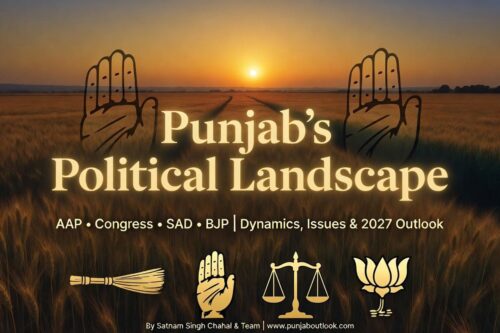
 Punjab’s political scene in mid-2026 is marked by intense competition, welfare expectations, and early positioning for the 2027 Assembly elections. The state continues to grapple with a complex mix of development aspirations, agrarian challenges, fiscal pressures, and identity-based mobilisation.
The Aam Aadmi Party government led by Chief Minister Bhagwant Mann remains in power with a comfortable majority. It continues to promote its welfare agenda — including free electricity, women’s schemes, healthcare clinics, and education improvements — while highlighting investment inflows and job creation claims. Recent engagements, such as participation in textile and industry events, reflect efforts to project an image of economic progress alongside social welfare.
The main opposition Congress party is actively rebuilding its organisational strength. With stable leadership under Punjab Congress President Raja Warring, the party is focusing on highlighting governance gaps and positioning itself as a credible alternative. Leaders like Pargat Singh have been vocal in calling for greater accountability from the ruling dispensation on issues of development and public promises.
Shiromani Akali Dal, once a dominant force in Punjab politics, is working to regain its traditional Panthic and rural support base. The party emphasises Sikh issues, farmer concerns, and its historical role in the state’s political evolution.The BJP maintains a presence in select pockets and aligns with national narratives while engaging on local development and security-related themes. Its influence remains limited in the assembly but is part of the broader multi-party contest.
Several cross-cutting issues dominate the political discourse. High public debt, rural distress linked to water management and agriculture, youth unemployment, and migration continue to shape voter priorities. Debates around law and order, drug control measures, and the effectiveness of welfare delivery remain active. Farmer organisations and civil society groups also exert influence on key policy discussions.
As the state moves closer to the 2027 elections, early positioning by all parties is visible. AAP seeks re-election on the strength of its welfare record and investment push. Congress aims to capitalise on any anti-incumbency and organisational revival. SAD and BJP are recalibrating strategies to expand their respective spaces. Multi-cornered contests are expected in many constituencies, with possible tactical understandings emerging closer to polling.Punjab’s political landscape remains deeply intertwined with its social fabric, agrarian economy, and Sikh identity. The coming period will test how effectively parties translate promises into visible outcomes on the ground. Independent and balanced journalism will play a vital role in helping citizens make informed choices.
Note: This overview is based on publicly available information and statements as of mid-July 2026. It aims to present a neutral, fact-oriented perspective for professional journalistic use.