
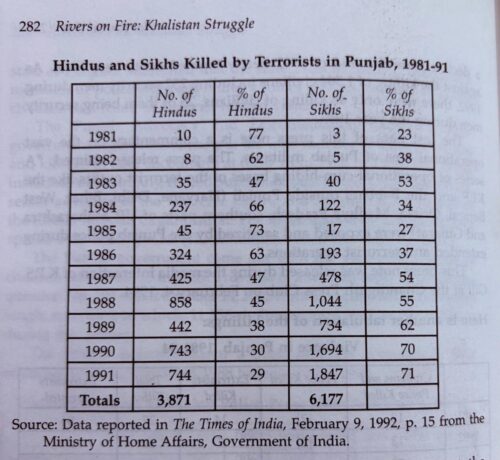
 The decade between 1981 and 1991 remains one of the darkest chapters in Punjab’s modern history. According to data reported by The Times of India on February 9, 1992 (p. 15), citing the Ministry of Home Affairs, Government of India, terrorists killed a total of 10,048 people in Punjab during this period — 3,871 Hindus and 6,177 Sikhs.The violence did not spare any community. In the early years, a higher proportion of Hindu civilians were targeted, with Hindus accounting for 77% of the victims in 1981 and 73% in 1985.
As the militancy intensified, the pattern shifted. By the late 1980s and early 1990s, Sikh casualties rose sharply. In 1990 and 1991 alone, Sikhs accounted for 70% and 71% of the deaths respectively.Year after year, the numbers paint a picture of unrelenting tragedy. In 1988, 858 Hindus and 1,044 Sikhs lost their lives. The following year saw 442 Hindus and 734 Sikhs killed. The violence reached a peak in 1991, when 744 Hindus and 1,847 Sikhs were reported killed. Overall, Sikhs constituted the majority of the victims across the decade, with 6,177 lives lost compared to 3,871 Hindus.These figures, drawn from official records and published in the book Rivers on Fire: Khalistan Struggle (p. 282), represent far more than cold statistics.
They reflect shattered families, orphaned children, and entire villages gripped by fear. The militancy not only claimed innocent lives but also triggered large-scale migration, destroyed livelihoods, and left deep psychological scars on the people of Punjab.Today, as the state enjoys relative peace, these numbers serve as a solemn reminder of the cost of extremism and the precious value of communal harmony. Punjab’s journey from those turbulent years to the present underscores the resilience of its people and the enduring need to uphold unity, justice, and the rule of