
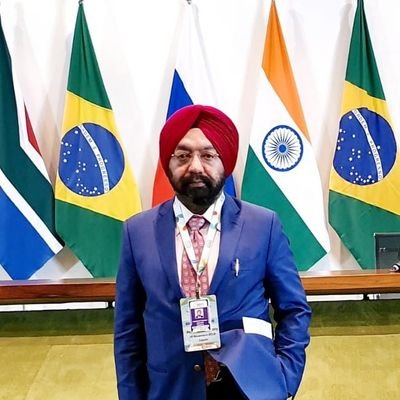
 Among contemporary Punjabi personalities who have successfully bridged the worlds of business, philanthropy, social service, and public life, Dr. Vikramjit Singh Sahney occupies a distinctive position. Unlike many politicians who begin their careers through electoral politics, Sahney first established himself as a successful entrepreneur, educationist, humanitarian, and global ambassador of Punjabi culture before entering Parliament. His nomination to the Rajya Sabha in 2022 brought decades of experience in industry, diplomacy, education, and social welfare into India’s Upper House.
Born on 20 February 1962 in Kotkapura, Punjab, Vikramjit Singh Sahney grew up in a middle-class family where education, discipline, and service to society were deeply valued. His humble upbringing has often featured prominently in his public speeches, where he encourages young people to believe that determination and hard work matter more than privilege. His journey from a government school student in Punjab to an internationally recognised entrepreneur illustrates a classic story of perseverance and self-made success.
Sahney pursued higher education with remarkable dedication. He completed postgraduate studies in Economics and Business Administration, equipping himself with both analytical and managerial expertise. Throughout his career, he has continued learning, including advanced executive education in public leadership, reflecting his belief that education should remain a lifelong pursuit. His educational background later proved invaluable in managing businesses, charitable institutions, and policy discussions in Parliament.
Long before entering politics, Vikramjit Singh Sahney established himself in the corporate world. His business ventures expanded nationally and internationally, creating employment opportunities and strengthening India’s industrial presence abroad. Colleagues frequently describe him as a leader who combines commercial success with social responsibility rather than treating business solely as a profit-making enterprise.
Unlike many industrialists who remain behind corporate walls, Sahney consistently maintained active engagement with educational institutions, charitable organizations, and community initiatives. This combination of entrepreneurship and public service eventually became one of the defining features of his career.
Perhaps one of Sahney’s greatest contributions lies in his work through the Sun Foundation, an organization devoted to education, healthcare, women’s empowerment, youth development, and humanitarian assistance. Through scholarships, vocational training, health camps, and educational support, the Foundation has reached thousands of beneficiaries across India.
During the COVID-19 pandemic, the Foundation became particularly active by supplying oxygen concentrators, medical equipment, protective gear, and relief material when healthcare systems faced unprecedented pressure. These efforts earned appreciation from several sections of society and reinforced Sahney’s image as a philanthropist committed to public welfare rather than publicity.
Education has remained one of the central themes of Sahney’s public life. He has repeatedly argued that Punjab’s future depends upon investment in human capital rather than merely physical infrastructure.His educational initiatives include scholarships for economically disadvantaged students, skill development programmes, career counselling, and financial assistance for higher education. After becoming a Rajya Sabha Member, he publicly announced that he would dedicate his parliamentary salary toward educational scholarships through the Shaheed Bhagat Singh Education Fund, reflecting his long-standing emphasis on youth empowerment.
One of Sahney’s most enduring achievements is the establishment and expansion of the World Punjabi Organisation (WPO).Founded with the objective of strengthening ties among Punjabis worldwide, the WPO has grown into an international organization operating in more than twenty countries. Its activities extend beyond cultural promotion to include educational conferences, business networking, interfaith dialogue, heritage preservation, and support for Punjabi language and literature.
Under Sahney’s leadership, the organization has organized international conventions, promoted Punjabi entrepreneurs, encouraged investment in Punjab, and strengthened relationships between the Punjabi diaspora and their ancestral homeland. Former Prime Minister I. K. Gujral served as the organization’s Patron-in-Chief during its formative years, lending further credibility to its mission.
Throughout his public life, Sahney has consistently advocated for preserving Punjab’s rich linguistic and cultural heritage.He has promoted Punjabi language education, organized cultural festivals, supported literary events, and encouraged younger generations living abroad to maintain connections with their roots. His initiatives often emphasize that economic progress should never come at the expense of cultural identity.This emphasis on preserving heritage has earned him respect among many sections of the Punjabi diaspora spread across North America, Europe, the Middle East, Africa, and Southeast Asia.
One of the most widely recognized chapters of Sahney’s humanitarian work came during the crisis in Afghanistan.When security conditions deteriorated and the Sikh and Hindu minorities faced grave threats, Sahney played a significant role in facilitating their evacuation through chartered flights and relief efforts. Hundreds of vulnerable individuals were assisted during this humanitarian mission, which drew appreciation across political and religious lines.Many observers regard this operation as one of the most significant examples of private humanitarian intervention undertaken by an Indian public figure in recent years.
Punjab’s struggle with substance abuse has remained a major concern for decades.Recognizing this challenge, Sahney supported drug de-addiction and rehabilitation programmes through dedicated institutions. These centres focus not only on medical treatment but also on vocational training, counselling, sports, yoga, and rehabilitation to help recovering individuals rebuild their lives with dignity.His approach reflects the belief that addiction should be addressed through rehabilitation and social reintegration in addition to law enforcement.
A lesser-known aspect of Vikramjit Singh Sahney’s personality is his passion for Sufi and devotional music.He has recorded numerous devotional and Sufi songs, collaborating with well-known artists. Through music, he promotes messages of peace, harmony, universal brotherhood, and spiritual reflection, believing that culture can unite communities beyond political or religious differences.
In recognition of his extensive contributions to social service, education, philanthropy, and community development, the Government of India conferred upon Vikramjit Singh Sahney the Padma Shri, one of India’s highest civilian honours, in 2008.The award acknowledged decades of work benefiting marginalized communities and promoting social development. Regardless of political affiliation, receiving a Padma Shri is widely regarded as recognition of sustained public service.
In 2022, Sahney entered Parliament as a Rajya Sabha Member representing Punjab. His election was notable because he entered the Upper House after a long public career outside electoral politics. His supporters argued that Parliament would benefit from individuals with practical experience in business, education, and social service.Since assuming office, he has emphasized agriculture, education, industrial growth, federal issues affecting Punjab, infrastructure, employment, and economic development.
During his tenure in Parliament, Sahney has raised several issues affecting Punjab. Among them are:
Release of Punjab’s Rural Development Fund (RDF) and Market Development Fund (MDF).
Expansion of agricultural infrastructure and cold-storage facilities.
Financial support for farmers and rural roads.
Protection of Punjab’s interests in river-water governance and the BBMB.
Measures to curb anti-Sikh hate content on social media.
Promotion of investment and industrial development in Punjab.
Punjab Vision 2047
Sahney has also promoted long-term planning exercises such as Punjab Vision 2047, bringing together experts, entrepreneurs, academics, and policymakers to discuss the state’s future in agriculture, industry, education, technology, healthcare, and environmental sustainability. Supporters see these initiatives as efforts to encourage evidence-based policy discussions for Punjab’s long-term development.
Observers often describe Vikramjit Singh Sahney as a consensus builder rather than a confrontational politician.His background outside traditional electoral politics has influenced his style, which tends to emphasize dialogue, policy solutions, and institution-building. Whether interacting with industrialists, educators, farmers, or members of the Punjabi diaspora, he generally projects an image of accessibility and moderation.Among the notable achievements associated with Dr. Vikramjit Singh Sahney are:
Padma Shri awardee for social service.
Successful entrepreneur with international business interests.
Founder and International President of the World Punjabi Organisation.
Chairman of Sun Foundation.
Humanitarian assistance during the Afghan Sikh and Hindu evacuation.
Scholarships and educational initiatives for disadvantaged students.
COVID-19 relief efforts.
Promotion of Punjabi language and culture globally.
Advocacy for Punjab’s economic and agricultural interests in Parliament.
Like every public figure, Sahney’s parliamentary career has also attracted scrutiny. Independent parliamentary trackers show that his attendance and debate participation have varied across sessions, while his record on asking parliamentary questions has been comparatively active. Public assessments therefore differ: supporters emphasize his philanthropy, policy advocacy, and institution-building, while critics argue that parliamentary engagement should continue to strengthen over time. Evaluating an MP’s performance involves considering multiple measures rather than any single statistic.
His political journey has also evolved. After entering the Rajya Sabha with AAP support in 2022, he later associated with the BJP, reflecting shifts in his political affiliations over time. Such transitions have drawn both support and criticism, illustrating the complex nature of contemporary Indian politics.
As Punjab faces challenges ranging from agricultural sustainability and industrial growth to youth employment and migration, leaders with experience in both the private and public sectors are likely to play an increasingly important role. Dr. Vikramjit Singh Sahney’s combination of entrepreneurship, philanthropy, cultural advocacy, and parliamentary service places him in a unique position to contribute to these discussions.
Whether through educational scholarships, humanitarian initiatives, business leadership, or parliamentary interventions, Sahney’s career demonstrates an effort to blend enterprise with public service. His future legacy will ultimately be measured by the long-term impact of the institutions he has built, the policies he influences, and the opportunities he helps create for the people of Punjab and the global Punjabi community.