
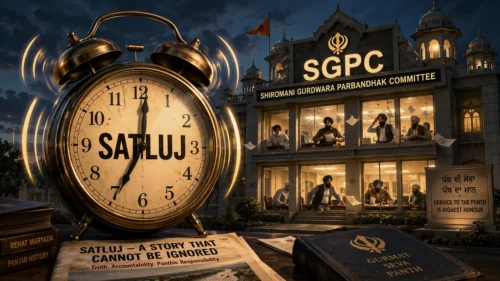
 The film Satluj, based on the life and sacrifice of Jaswant Singh Khalra, has stirred Punjab and the Sikh diaspora in a way that few political speeches or resolutions have managed.
A generation born after the violence of the 1980s and 1990s is asking who Khalra was. His name now dominates internet searches, social media and conversations in homes and gurdwaras. Families are again discussing disappearances, unidentified cremations and alleged extrajudicial killings.
Khalra was a human-rights activist investigating the secret cremation of “laawaris”, or unclaimed, bodies. Those dark years did not consume only one community. Sikhs, Hindus, police personnel, journalists, labourers, government employees and ordinary villagers all suffered. Competing narratives count 25,000 Hindus here and 35,000 Sikhs there.
Punjab should ask instead: how many Punjabis became victims after their state was turned into a political battlefield and laboratory?
The response of the Shiromani Gurdwara Parbandhak Committee has now been forceful with urgency. It has opposed the blocking of the film, supported screenings and demanded that Khalra’s story reach the people. Akal Takht has offered ardas for the victims, and the proposal for a memorial has gathered momentum.
These steps deserve appreciation. But appreciation must not prevent introspection.
Why did it take Satluj to generate this urgency?
It has been 31 years since Khalra was abducted in 1995. His murder was examined by the courts, police officers were convicted, and the issue of illegal cremations reached the Supreme Court and the National Human Rights Commission. Families spent decades searching for those who had disappeared.

This was never a hidden tragedy. It was an open wound, never healed.
The SGPC is not another social organisation. It is among the most important representative institutions of the Sikh community. It manages historic gurdwaras, preserves archives, runs educational institutions and commands enormous moral authority. If the SGPC does not preserve this history, who will?
That responsibility required more than occasional resolutions and tributes. Punjab needed a permanent archive of disappearances and unidentified cremations, district-wise testimony from families, legal assistance for those unable to pursue cases, and an independent research centre documenting that period.
The victims should not be divided into Sikh and Hindu compartments. To me, all Punjabis are Guru Nanak naam leva. Even if the SGPC, because of its institutional mandate, begins with Sikh victims, it should create a credible record instead of allowing memory to depend upon films and political controversies.
The SGPC must also state its institutional understanding of those years. Parkash Singh Badal and Gurcharan Singh Tohra were often seen as representing different approaches. Yet the community still lacks an authoritative, evidence-based account of what happened and where Sikh leadership itself succeeded or failed. SAD formed government thrice after the dark days, yet little has been done to write the history in the right perspective.
The SGPC should press the Union Government to declassify documents relating to Operation Blue Star. People have a right to know the chain of advice and decision-making that led to the Army entering the Golden Temple complex, who invited the then PM to send army into Golden Temple complex. History cannot remain hostage to sealed files, partisan accusations and selective memory.
The SGPC may rightly say it was never completely silent. But remembering an issue is not the same as institutionalising the memory and history.
A resolution is not an archive. A press conference is not a legal campaign. An ardas, however sacred, cannot substitute for documentation, rehabilitation and the sustained pursuit of truth.
Satluj has exposed an institutional weakness. The SGPC too often reacts after public anger has erupted, but does not always build mechanisms that survive beyond the news cycle. The film has done in days what our institutions should have been doing for three decades.
Bibi Paramjit Kaur Khalra’s demand for a People’s Commission deserves a formal response. The SGPC should establish a panel of retired judges, human-rights experts, historians, journalists and representatives of victims’ families and press Government of India to constitute the commission. Its purpose should not be to validate a politically convenient number, but to create a credible record.
Every available document should be preserved. Every willing family should be heard. The identified dead should be named, and the unidentified should not remain numbers. The exercise must include victims of fake encounters as well as innocent people murdered by terrorists.
This criticism is not an attack on the SGPC. It arises precisely because the SGPC matters and is capable of much more. Nor should criticism of institutional inaction be confused with disrespect towards Akal Takht, whose authority must remain above political manipulation.
Satluj has awakened public memory. The SGPC must now convert that awakening into a well documented, impartial historical archive for our future generations.
A film can start a conversation. Only an institution can preserve the truth, the history.