
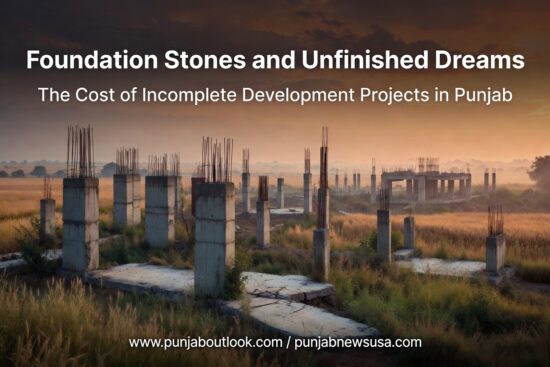
 For decades, the people of Punjab have witnessed a familiar cycle in public life: grand ceremonies, political speeches, the laying of foundation stones, and promises of rapid development. Yet in many cases, years pass and the promised projects either move at a slow pace or remain incomplete. These unfinished projects become symbols not of progress, but of public frustration, wasted resources, and lost opportunities.
The issue is not limited to one political party or one period of governance. Successive governments in Punjab have announced ambitious projects in sectors such as healthcare, education, infrastructure, tourism, and urban development. While many projects have been completed successfully, several high-profile initiatives continue to face delays due to land acquisition disputes, administrative hurdles, tendering problems, legal challenges, funding constraints, and changes in political priorities.
One of the most striking examples is the Ludhiana City Centre project. Conceived as a landmark urban development project with shopping, residential, and commercial components, it was launched with great enthusiasm in the mid-2000s. However, allegations of irregularities, legal disputes, and administrative issues led to years of stagnation. Even after nearly two decades, large portions of the site remain incomplete, serving as a visible reminder of how ambitious plans can become long-term liabilities when governance falters.Another example is the proposed 300-bed hospital in Mohali’s Sector 66 and associated public infrastructure projects that have become subjects of political criticism because of prolonged delays. Residents have repeatedly questioned why essential healthcare infrastructure announced with much publicity has taken so long to become fully operational.
The problem of delays is not limited to mega-projects. In Ludhiana, the beautification and revival project of the historic Nehru Rose Garden was announced with much optimism and its foundation stone was laid, yet more than a year later work had not started on the ground. Tender disputes, administrative delays, and lack of contractor participation have slowed progress, disappointing citizens who expected timely improvement of one of the city’s iconic public spaces.Major infrastructure projects have also faced setbacks. The Ludhiana–Bathinda Expressway and sections of the Delhi–Amritsar–Katra Expressway have experienced delays linked to land acquisition challenges and project execution issues. Such delays affect not only travel and logistics but also industrial growth, trade, and employment generation in Punjab.
Every delayed project carries a hidden cost. Public money is spent on planning, land acquisition, ceremonies, and preliminary works. When projects stall, costs often increase because of inflation, redesigns, legal expenses, and repeated tendering. In the meantime, citizens continue to wait for better roads, hospitals, parks, educational institutions, and employment opportunities.The social impact is equally significant. In rural areas, delayed road and irrigation projects affect farmers and small businesses. In urban areas, incomplete hospitals, public spaces, and civic infrastructure reduce the quality of life. Young people, who look to development projects as a source of jobs and progress, often become disillusioned when promises remain unfulfilled.
Punjab does not lack vision, talent, or resources. The state has demonstrated time and again that it can execute successful projects when there is political will, transparent governance, and consistent monitoring. The challenge is not in laying foundation stones, but in ensuring that the work is completed within a fixed timeline and with public accountability.To address this issue, experts have suggested that all major public projects should have publicly accessible timelines, independent audits, regular progress reports, and penalties for unnecessary delays. Citizens should be able to track the status of projects online, including funds allocated, work completed, and expected dates of completion.
The people of Punjab do not merely need announcements they need results. A foundation stone should mark the beginning of a completed journey, not the start of an indefinite wait. Development is ultimately measured not by ceremonies or slogans, but by functioning hospitals, completed roads, modern educational institutions, and public facilities that improve the lives of ordinary citizens.Punjab’s future depends on shifting the focus from symbolic politics to deliverable governance. The true legacy of any government will not be the number of plaques it unveils, but the number of promises it fulfills.
Major Foundation Stones, Delayed Projects and Unfulfilled Promises in Punjab
Punjab has witnessed numerous ceremonies where foundation stones were laid amid much publicity, accompanied by assurances that projects would transform the state’s infrastructure and improve the lives of its people. While several projects have been completed successfully, a number of high-profile initiatives have faced years of delay, repeated revisions, legal disputes, or remain unfinished, leaving citizens questioning whether announcements are being matched by timely execution.
One of the most prominent examples is the Ludhiana City Centre Project, launched in 2005 by the then Punjab Government as a flagship urban development initiative. Envisioned as a modern commercial and residential hub with shopping complexes, office spaces, hotels, entertainment facilities, and public infrastructure, the project was expected to change the face of Ludhiana. However, allegations of irregularities, legal disputes, investigations, and administrative changes stalled the project. Nearly two decades later, large portions of the ambitious development remain incomplete, making it one of Punjab’s most cited examples of delayed public projects.
Another project that has become symbolic of administrative delays is the Nehru Rose Garden Beautification Project in Ludhiana. The foundation stone was laid in 2023 under the Punjab Government with an estimated cost initially fixed at ₹8.80 crore. The estimate was later revised to ₹8.46 crore and subsequently reduced to ₹7.81 crore. Despite multiple rounds of tendering, allegations of corruption, legal disputes, and the arrest of a senior engineering official in a bribery case, work remained stalled for an extended period, while one of Ludhiana’s most iconic public parks continued to deteriorate.
The Delhi–Amritsar–Katra Expressway, one of North India’s largest infrastructure projects, was announced in January 2022 with an estimated investment of approximately ₹39,500 crore. The expressway was designed to significantly reduce travel time between Delhi, Amritsar, and Katra while improving connectivity to major Sikh religious sites and industrial centres in Punjab. However, several construction packages in Punjab have experienced prolonged delays due to land acquisition disputes, contractor issues, and administrative hurdles. The project, originally expected to progress much faster, is now scheduled to be completed in phases up to March 2028.
As part of the same development package announced in 2022, foundation stones were laid for the PGI Satellite Centre at Ferozepur (estimated cost ₹490 crore) and Government Medical Colleges at Kapurthala and Hoshiarpur (approximately ₹325 crore each). These institutions were intended to strengthen Punjab’s healthcare infrastructure and medical education system. However, implementation progressed more slowly than initially anticipated, with construction advancing in phases rather than according to the original expectations.
Punjab’s highway sector has also experienced persistent delays. According to recent reports, more than half of the ongoing National Highway projects in Punjab have exceeded their scheduled completion timelines, while several projects have come to a complete standstill. These delays have been attributed to land acquisition problems, contractor disputes, compliance issues, environmental clearances, and administrative bottlenecks. Such setbacks have affected connectivity, industrial growth, logistics, and regional economic development.
Every delayed project imposes a significant financial burden on the public exchequer. Escalating construction costs, inflation, repeated tendering, litigation, and project redesigns increase expenditure far beyond original estimates. More importantly, citizens are deprived of hospitals, roads, parks, educational institutions, and other public facilities that were promised at the time of the foundation stone ceremonies.
The issue is not confined to any single political party or administration. Successive governments in Punjab have announced ambitious development projects with great enthusiasm. While many have delivered important infrastructure, others have remained incomplete due to changing political priorities, weak project monitoring, funding constraints, legal challenges, or administrative inefficiencies. Ultimately, the people of Punjab judge governments not by the number of foundation stones unveiled, but by the number of projects completed and made operational for public benefit.
Disclaimer: This article and accompanying images are for informational and illustrative purposes only. Some visuals may be AI-generated or digitally enhanced and may not depict actual events or persons.Views expressed are based on publicly available information and analysis.