
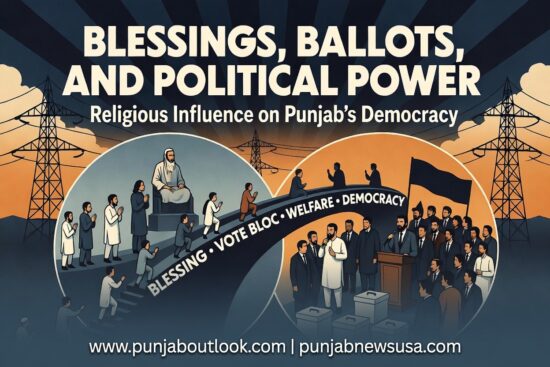
 Editor’s Note: This editorial is not directed at any particular dera, saint, or religious community. It recognises that many religious and charitable organisations perform valuable service. Its purpose is to encourage accountability, transparency, critical thinking, and the protection of vulnerable individuals from exploitation by anyone who misuses faith for personal, financial, or political gain. In a democratic society governed by the rule of law, no individual or institution should be above scrutiny, and allegations should be assessed fairly through evidence and due process.-Editor
Religion has always occupied a respected place in Punjab’s social fabric. Gurdwaras, temples, mosques, churches, and other places of worship have historically served as centres of spiritual guidance, education, charity, and community welfare. The Sikh institution of Langar remains one of the world’s finest examples of selfless service, where every person sits together regardless of caste, religion, wealth, or social status. The Gurus consistently taught that spirituality must inspire humility rather than superiority, service rather than self-promotion, and equality rather than blind obedience. Yet, as modern society has evolved, some self-styled spiritual leaders have transformed religious influence into a sophisticated enterprise capable of generating enormous wealth and considerable political influence. While many religious organisations continue to serve society honestly, others have faced serious allegations of financial irregularities, abuse of authority, and the commercialisation of faith. These concerns deserve careful public discussion because religion should never become a shield against accountability.
Every successful personality cult begins with one priceless asset—public trust. Unlike commercial businesses that sell products or services, self-styled godmen often sell hope. Hope for healing when medicine has failed, hope for employment when opportunities are scarce, hope for immigration when visa applications are repeatedly rejected, hope for children when couples struggle with infertility, hope for financial prosperity during economic hardship, and hope for emotional peace when families experience conflict. Hope itself is not harmful; indeed, hope is essential to human survival. The danger arises when hope is packaged as a guaranteed miracle available only through unquestioning loyalty to a particular individual or organization. In such circumstances, vulnerable people may gradually become financially, emotionally, and psychologically dependent on the institution that promises to solve every problem.
The language used by many charismatic leaders often reinforces this dependency. Followers may be encouraged to believe that every success in their lives is the result of the leader’s blessings, while every setback is attributed to insufficient faith or incomplete devotion. This creates a cycle in which ordinary events are interpreted as supernatural evidence. If a business improves, it is presented as proof of divine intervention. If an illness recovers naturally or responds to medical treatment, the recovery may be credited entirely to blessings. If immigration approval arrives after years of legal processing, the blessing receives the credit rather than the administrative procedure. Human beings naturally seek patterns and meaning, making such interpretations emotionally powerful even when no objective evidence exists.
As the number of followers grows, the organization itself often expands rapidly. Temporary prayer gatherings evolve into permanent campuses. Donations increase. Land is purchased. Residential facilities are constructed. Educational institutions, hospitals, publishing houses, media studios, agricultural properties, and commercial enterprises may gradually become part of the organization. None of these developments is inherently improper. Many religious institutions legitimately operate extensive charitable networks. The crucial question is whether governance remains transparent, finances are independently audited, and the institution continues to prioritize public service over personal glorification. Public trust is strengthened when organizations voluntarily embrace accountability rather than resisting scrutiny.
The collection of donations represents another area requiring careful oversight. Across India, millions of people contribute generously to religious causes because they genuinely wish to support humanitarian work. Many donate a portion of their income believing it serves noble purposes such as feeding the poor, educating children, providing healthcare, or assisting disaster victims. Unfortunately, wherever large sums of money accumulate without effective oversight, the potential for misuse also increases. This principle applies equally to governments, corporations, charities, and religious institutions. Transparency should therefore never be viewed as hostility toward religion; rather, it is an essential safeguard that protects both donors and genuine organizations from suspicion and abuse.
Another striking feature of personality-centred organizations is the careful construction of public image. Modern communication technology has dramatically expanded their reach. Professionally produced videos, emotional testimonials, high-quality publications, satellite television channels, mobile applications, and sophisticated social media campaigns help create an aura of extraordinary influence. Carefully edited videos showing dramatic “miracle stories,” emotional healing experiences, or testimonials of transformed lives can spread rapidly across digital platforms. While many testimonials may reflect genuine personal experiences of emotional comfort or spiritual renewal, extraordinary claims should always be approached with healthy skepticism and, where appropriate, supported by credible evidence. Faith may inspire hope, but public claims of miraculous powers deserve careful scrutiny.
Volunteers play a central role in the expansion of many religious organizations. Across Punjab, voluntary service—seva—is deeply respected and forms an essential part of Sikh tradition. Millions of people willingly donate their time to cook meals, clean places of worship, organize charitable events, and assist those in need. However, there is an important ethical distinction between voluntary service performed for the benefit of the community and labour that primarily strengthens the financial or organizational interests of a personality cult. Volunteers should always be treated with dignity, transparency, and respect. They should clearly understand how their contributions support public welfare rather than merely enhancing the prestige of an individual leader.
One reason personality cults become so resilient is their ability to create a strong sense of identity and belonging. New followers often describe finding friendship, emotional support, discipline, and purpose within the organization. For many people experiencing loneliness, addiction, grief, or family conflict, such communities provide genuine comfort. This positive aspect should not be ignored. The problem arises only when belonging is conditioned upon absolute obedience or when criticism is discouraged. Healthy religious communities welcome questions, encourage learning, and respect individual conscience. Unhealthy organizations often equate disagreement with betrayal and discourage independent thinking.
The concentration of authority in a single individual also creates significant governance challenges. In democratic institutions, leadership changes through elections. In corporations, boards supervise executives. In governments, independent courts and legislatures provide oversight. Personality-centred organizations frequently lack comparable checks and balances. Decision-making may become centralized in one leader or a small inner circle, leaving followers with little opportunity to question financial decisions, organizational priorities, or disciplinary actions. Even well-intentioned organizations benefit from transparent governance structures because accountability protects both leaders and followers alike.
Punjab’s history provides countless examples of spiritual leadership rooted in humility rather than personal glorification. The Sikh Gurus consistently rejected claims of personal divinity and emphasized devotion to the One Creator. Their teachings encouraged education, honest work, compassion, courage, and equality. They challenged social injustice instead of demanding unquestioning obedience. That historical legacy offers an important benchmark for evaluating contemporary leadership. Any institution that places an individual above ethical principles risks departing from the very values that genuine spirituality seeks to uphold.
The commercialization of faith is not unique to Punjab or India. Similar patterns have appeared across many countries, religions, and cultures. Throughout history, charismatic personalities have sometimes attracted devoted followings by combining religious language with claims of extraordinary authority. Some have ultimately been remembered as compassionate reformers, while others have faced criminal convictions or credible allegations involving financial misconduct, abuse of power, or exploitation. These experiences demonstrate that society should neither blindly idolize nor unfairly condemn religious leaders. Every claim deserves careful examination, every allegation deserves fair investigation, and every individual deserves due process under the law.
As Punjab continues to modernize, its citizens face an important choice. The province can preserve its rich spiritual traditions while also embracing transparency, critical thinking, and institutional accountability. Faith and reason need not stand in opposition. Indeed, the strongest societies are often those where religious freedom flourishes alongside respect for evidence, education, constitutional values, and the rule of law. Genuine spirituality grows stronger when it welcomes questions instead of fearing them, and when it serves humanity instead of seeking unquestioned power.
Disclaimer: This article and accompanying images are for informational and illustrative purposes only. Some visuals may be AI-generated or digitally enhanced and may not depict actual events or persons.Views expressed are based on publicly available information and analysis.