
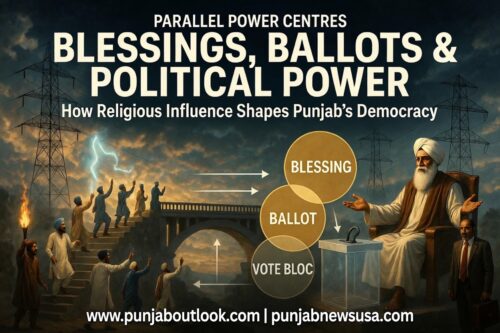
 Editor’s Note:This editorial is not directed at any particular dera, saint, or religious community. It recognizes that many religious and charitable organizations perform valuable service. Its purpose is to encourage accountability, transparency, critical thinking, and the protection of vulnerable individuals from exploitation by anyone who misuses faith for personal, financial, or political gain. In a democratic society governed by the rule of law, no individual or institution should be above scrutiny, and allegations should be assessed fairly through evidence and due process.-Editor
In a democratic society, every citizen has the constitutional right to follow a religion, support a spiritual organization, and seek guidance from religious leaders. Faith has always played an important role in shaping communities, providing moral direction, social support, and charitable service. However, when religious influence begins to directly affect political decision-making, a complex question emerges: where should the boundary exist between spiritual guidance and political power? Punjab provides one of the most visible examples of this debate, where some large deras and religious organisations have developed influence that extends beyond spiritual activities into social and political spheres.
The relationship between religion and politics is not new. Throughout history, political leaders have sought support from respected community figures because they understand the power of trust and social networks. In Punjab, influential religious figures often have large numbers of followers who listen carefully to their messages. During election periods, visits by politicians to prominent deras frequently become major public events. Leaders from different political parties may seek blessings, attend religious gatherings, or highlight their association with spiritual institutions. While such interactions are part of democratic freedom, they also raise questions about whether political choices should be influenced by religious authority rather than by independent evaluation of policies and candidates.
Elections are ultimately a test of public trust. Citizens must decide who should govern based on issues such as employment, agriculture, education, healthcare, law and order, economic development, corruption, and social welfare. However, when a religious figure openly or indirectly signals support for a particular candidate or political party, followers may feel social pressure to follow that direction. In close elections, even a small shift among dedicated followers can become politically significant. This reality explains why political parties across the spectrum often attempt to maintain relationships with influential deras and community organizations.
The influence of deras in Punjab cannot be understood only through the number of followers they claim. Their strength often comes from a combination of social, economic, and organizational networks. Many deras operate large campuses where thousands of people gather regularly. They may run charitable activities, educational institutions, healthcare services, and community programmes. These activities create a strong connection with ordinary people, especially in rural areas where social institutions play an important role in daily life. The personal relationship between followers and religious organizations can therefore become deeper than their relationship with political institutions.
For many political leaders, this influence represents an opportunity. A public appearance at a dera can communicate a message of acceptance and social connection. A blessing from a respected figure may be portrayed as a sign of goodwill or community support. However, the danger arises when political calculations begin to replace democratic principles. A democracy is strongest when citizens vote freely after considering information, debate, and performance rather than following instructions from any individual, regardless of their religious status.
The issue becomes even more sensitive when allegations emerge that some religious organizations receive political benefits in exchange for electoral support. Such allegations must always be investigated carefully and fairly, because accusations alone cannot establish wrongdoing. However, the possibility of political-religious networks influencing governance is a legitimate subject of public discussion. Transparency is essential. Citizens have the right to know whether decisions are being made in the public interest or whether informal networks of influence are shaping government priorities behind closed doors.
Punjab’s political history demonstrates that religious influence can have both positive and negative consequences. Religious organizations have often played important roles in social reform, humanitarian assistance, and community development. During times of crisis, many religious institutions have provided food, shelter, medical assistance, and emotional support. These contributions represent the best traditions of faith-based service. The concern begins when service becomes a pathway to personal power, when charity becomes a tool for political negotiation, or when spiritual authority becomes a substitute for democratic accountability.
One of the major challenges in dealing with influential religious figures is that criticism is often misunderstood. Questioning the political influence of a religious organization does not mean disrespecting religion. A democratic society must allow respectful discussion about every institution—government departments, corporations, political parties, media organizations, and religious bodies. Accountability should not be considered an attack. In fact, transparency protects honest institutions by separating them from those who misuse public trust.
Another important factor is the changing nature of communication. In the past, influence was limited to physical gatherings and local networks. Today, social media has transformed the landscape completely. A message from a religious figure can reach millions of people within minutes. Videos, speeches, livestreams, and online communities allow organizations to maintain constant contact with followers. This digital influence can be used positively for education, charity, and awareness campaigns. However, it can also amplify misinformation, emotional manipulation, and personality worship if followers are encouraged to accept every statement without verification.
The responsibility does not belong only to religious leaders. Political parties also have a responsibility to maintain ethical boundaries. Seeking votes through development programmes, transparent governance, and public debate strengthens democracy. Seeking votes through symbolic endorsements from powerful individuals weakens the idea of independent citizenship. A mature democracy should encourage citizens to respect religious leaders while still making their own political decisions.
The media also has an important role. Coverage of religious organizations should neither become unconditional promotion nor unfair criticism. Journalists must examine facts, investigate financial structures, report public service achievements, and question allegations responsibly. Sensationalism can damage innocent individuals, while silence can allow genuine problems to continue. Balanced journalism is essential when dealing with institutions that combine faith, money, and influence.
For Punjab, the central question is not whether religious organizations should exist in public life. They always have and will continue to play an important role. The real question is whether any institution—religious, political, or economic—should possess enough influence to operate without transparency and accountability. In a constitutional democracy, respect and scrutiny must exist together.
The teachings that shaped Punjab’s identity emphasize humility, equality, and service. True spiritual leadership does not require political control. A person who genuinely serves humanity does not need fear from questions or accountability. The strength of faith comes from truth, not from power. The strength of democracy comes from informed citizens, not from instructions delivered by influential personalities.
As Punjab moves forward, society must find a balanced path—protecting religious freedom while preventing the misuse of faith for political or personal advantage. The blessing that matters most in a democracy is not the blessing of a powerful individual; it is the collective wisdom of an educated and responsible citizenry.
Disclaimer: This article and accompanying images are for informational and illustrative purposes only. Some visuals may be AI-generated or digitally enhanced and may not depict actual events or persons.Views expressed are based on publicly available information and analysis.