
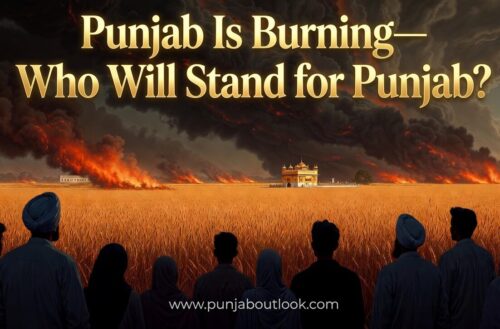
 There is no debate that every citizen of India has the constitutional right to participate in peaceful protests. Students have historically played an important role in defending democratic values, raising their voices against injustice, and shaping public opinion. However, an equally important question arises today: When Punjab itself is facing one of the most difficult periods in its modern history, why does the same level of public mobilisation not occur for Punjab’s own survival?
Punjab is passing through an unprecedented crisis. The state’s debt continues to rise, industries are shifting to neighbouring states, unemployment is forcing educated youth to seek opportunities abroad, drug addiction continues to destroy families, groundwater is depleting rapidly, and law and order remains a matter of public concern. Farmers face uncertainty, small businesses struggle to survive, and thousands of talented young Punjabis no longer see their future in their own homeland.
Yet, when national issues dominate the headlines, thousands of voices can be heard. When Punjab cries for help, the response is often muted.
This is not an argument against participating in national movements. Sikhs have always believed in standing for justice, whether it concerns their own community or society at large. From the freedom struggle to national defence, from humanitarian relief to the farmers’ movement, the Sikh community has repeatedly demonstrated its willingness to sacrifice for larger causes. That proud tradition should continue.
However, justice begins at home as well.
Where are the nationwide student marches demanding a permanent solution to Punjab’s economic decline? Where are the protests over the continuous migration of Punjab’s youth? Where are the campaigns demanding greater industrial investment, protection of Punjab’s river waters, better schools, improved healthcare, and employment opportunities? Why do these issues rarely receive the same urgency?
Punjab has contributed immensely to India’s growth. It has fed the nation through the Green Revolution, protected the country’s borders, strengthened the armed forces, contributed to commerce across the globe, and earned international respect through the hard work of the Punjabi diaspora. Yet today, many Punjabis feel that when Punjab faces adversity, the nation does not always respond with the same intensity that Punjab has shown for national causes.
This growing perception deserves thoughtful discussion, not political slogans.
Student organizations have tremendous power. Universities have often served as the conscience of society. If thousands of students can organize buses to travel hundreds of kilometers to participate in demonstrations in the national capital, surely the same determination can be shown to highlight Punjab’s own challenges. Imagine the impact if similar campaigns focused on saving Punjab’s environment, creating jobs, strengthening higher education, fighting drug abuse, and demanding accountable governance.
Punjab’s problems cannot be solved by governments alone. Political parties come and go. Lasting change requires citizens who remain engaged regardless of who occupies power. The future of Punjab depends not only on elected representatives but also on teachers, students, farmers, entrepreneurs, professionals, religious institutions, and civil society organizations working together.
History teaches us that every generation is judged not merely by the causes it supports elsewhere, but by how it protects its own homeland during difficult times. Future generations will ask whether today’s Punjabis spoke loudly enough when their own state needed them the most.
This editorial is not intended to discourage participation in national democratic movements. Rather, it is a call for balance. Punjab’s youth have the energy, courage, and commitment to contribute to national debates. They also have a moral responsibility to ensure that Punjab’s own voice is never drowned out.
If Punjab’s brightest minds continue to leave, if industries continue to relocate, if debt continues to rise, if drugs continue to destroy families, and if agriculture continues to face uncertainty, then the greatest protest of all should be against the slow decline of Punjab itself.
The Sikh principle of “Sarbat da Bhala”the welfare of all has always inspired service beyond narrow interests. But that noble principle does not require ignoring the suffering of one’s own people. Serving humanity and protecting Punjab are complementary responsibilities, not competing ones.
Punjab does not need sympathy. Punjab needs commitment.The time has come for every student, every intellectual, every social organization, and every citizen to ask one simple question:If we can march for the nation, why can’t we march with the same determination to save Punjab?
Until that question is answered through action rather than words, many Punjabis will continue to wonder whether their homeland has become the forgotten cause in the very land to which it has contributed so much.
Disclaimer: This article and accompanying images are for informational and illustrative purposes only. Some visuals may be AI-generated or digitally enhanced and may not depict actual events or persons.Views expressed are based on publicly available information and analysis.