
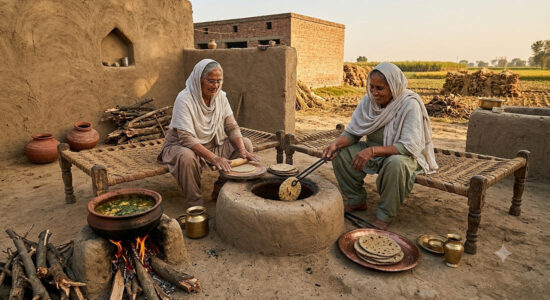
 Butter chicken (ਬਟਰ ਚਿਕਨ) and dal makhani (ਦਾਲ ਮਖਣੀ) feel ancient. Neither is. A look at what Punjabis actually ate before the tandoor (ਤੰਦੂਰ) met the highway dhaba (ਢਾਬਾ), how gur (ਗੁੜ) gave way to sugar, and what science says about why richness became the region’s signature.
Punjab settled its own philosophy of living long before philosophers elsewhere got round to writing theirs down. “Khaadha peeta lahe da, baaki Ahmad Shahe da” (ਖਾਧਾ ਪੀਤਾ ਲਾਹੇ ਦਾ, ਬਾਕੀ ਅਹਿਮਦ ਸ਼ਾਹੇ ਦਾ) — what you have eaten and drunk is truly yours; the rest belongs to Ahmad Shah — is not a throwaway line but a philosophy earned the hard way, forged by a land invaded, plundered and fought over more often than almost any other on the subcontinent, not least by Ahmad Shah Abdali’s repeated eighteenth-century raids. When the granary could be emptied by morning, the only wealth that could never be taken back was what had already passed your lips. It is, in its own idiom, Punjab’s answer to the Epicurean instruction to eat, drink and be merry — not hedonism for its own sake, but a considered response to a landscape where tomorrow’s harvest was never guaranteed. What follows is an attempt to hold that inherited philosophy up to the light: to work out how much of Punjab’s reputation for rich living is genuine appetite for the moment, and how much is a modern industry retrofitted onto an old and rather wiser instinct.
I. BEYOND BUTTER CHICKEN AND THE PATIALA PEG
Set a plate of makhani-laden black dal (ਦਾਲ) and a well-buttered paratha (ਪਰਾਂਠਾ) before most Indians, and “Punjabi food” needs no further explanation. Add a Patiala peg on the side and the stereotype is complete: a region supposedly wedded to richness, in food and drink alike. Archaeological and historical evidence tells a different, more interesting story — one of a largely modest, agrarian diet that only acquired its present reputation for excess quite recently, and for identifiable reasons. The question worth asking is not whether Punjabis enjoy rich food — plainly, many do — but whether that enjoyment reflects something innate to the region, or a specific twentieth-century history of migration, markets and mechanisation that has been mistaken for tradition.
The meat side of that stereotype is also softer than it looks. By the government’s own National Family Health Survey (NFHS-5, 2019–21), Punjab remains a vegetarian-majority state: 70 per cent of Punjabi women and 41 per cent of men report never eating chicken, fish or meat. Only three Indian states clear that vegetarian-majority bar at all — Punjab, Haryana and Rajasthan — and Punjab is, in fact, the least vegetarian of the three. Haryana tops the table, with nearly 80 per cent of women and over 56 per cent of men vegetarian; Rajasthan follows at 75 per cent of women and 63 per cent of men. Punjab’s meat-eating, such as it is, is heavily gendered — a large gap between men and women rather than a uniform regional appetite — which cuts directly against the flattened idea of Punjab as India’s meat-and-drink capital.
II. WHAT DID EARLIER PUNJABIS ACTUALLY EAT?
The archaeological and historical record points toward something considerably plainer than today’s restaurant menu. Early inhabitants of the Indus region are understood to have eaten barley rotis with saag (ਸਾਗ) — greens, lentils and local vegetables — rather than the maize-based makki di roti (ਮੱਕੀ ਦੀ ਰੋਟੀ) or butter-heavy preparations now treated as quintessentially Punjabi. Before the Columbian exchange reshaped Indian agriculture, the everyday diet rested on grains such as jowar (ਜਵਾਰ) and bajra (ਬਾਜਰਾ), pulses, dairy, and a limited range of seasonal vegetables and fruit; meat was consumed sparingly, constrained by both scarcity and religious norms.
Staples were correspondingly humble: mustard greens (sarson, ਸਰ੍ਹੋਂ), bitter gourd, aubergine (baingan, ਬੈਂਗਣ), okra (bhindi, ਭਿੰਡੀ), peas (matar, ਮਟਰ) and river fish, much of it preserved as pickle to survive the lean months. Wheat (kanak, ਕਣਕ) itself, along with the tomatoes, potatoes and chillies now central to North Indian cooking, arrived comparatively late, carried by global trade and colonial-era agriculture. Much of what urban India today calls “authentic Punjabi food” is, on this evidence, historically recent — rooted in the twentieth century, however deeply it now feels lodged in the region’s identity. Sarson da saag (ਸਰ੍ਹੋਂ ਦਾ ਸਾਗ) itself is a partial exception worth noting here: the practice of cooking winter mustard greens is genuinely old, tied to mustard’s place as a November-sown, cold-tolerant crop and referenced in texts as early as the third century BC. What is recent is the polished, five-greens, extra-butter restaurant version — the underlying habit is old agriculture; the ceremony around it is modern branding.
III. FROM GUR TO SUGAR: A SWEETENING REVOLUTION
Punjab’s relationship with sweetness has its own quiet history of displacement, running roughly parallel to the tandoor’s takeover of the everyday table. For most of Indian history, gur (jaggery, ਗੁੜ) and desi shakkar (unrefined granular sugar, ਸ਼ੱਕਰ) were the household norm — sugar crystallisation itself was discovered in India around 350 CE, in the Gupta period, and the country exported unrefined sugar and cane-growing knowledge for over a thousand years afterward. Refined white sugar (khand, ਖੰਡ) remained a minor, luxury product through most of this period.
The shift began under colonial rule. British economic policy — partly shaped by the abolitionist movement’s demand for sugar not grown on slave plantations — built up large-scale industrial refining through the nineteenth and early twentieth centuries, while a cultural preference for “white and refined” foods, imported alongside colonial aesthetics, gave khand a prestige that gur never fully recovered. A second, homegrown wave followed after Independence: the growth of the bakery and beverage industries needed a sugar that dissolved clear rather than cloudy, and that commercial demand finished what colonial policy had begun. Small khandsari and gur-making units gradually gave way to large mills, and refined sugar became the Punjabi kitchen default it is today — gur surviving mainly in specific festive dishes such as gur da halwa (ਗੁੜ ਦਾ ਹਲਵਾ) and pinni (ਪਿੰਨੀ) rather than in everyday tea and cooking.
IV. DAIRY, GHEE AND “RICHNESS”: PRACTICE WITH A PHYSIOLOGICAL LOGIC
Dairy’s centrality to Punjabi diets is real and long-standing, and it is worth taking seriously rather than dismissing as indulgence. Milk (doodh, ਦੁੱਧ), dahi (curd, ਦਹੀਂ), paneer (ਪਨੀਰ), makkhan (butter, ਮੱਖਣ) and ghee (ਘਿਓ) served farming communities as dense, portable sources of energy and protein through physically demanding agricultural work. Traditional makkhan — cultured butter, produced by fermenting milk or cream and churning it — is a genuinely fat-rich product, typically 78 to 81 per cent fat, and contains beneficial compounds such as conjugated linoleic acid alongside its high-melting fats.
Seen this way, dairy-heavy eating was rational, not merely indulgent: it matched calorie-dense food to calorie-demanding work. The difficulty arises when the food survives the lifestyle that justified it. As physical activity declines and portion sizes grow in an increasingly urban, sedentary Punjab, the same richness that once sustained field labour becomes a measurable cardiometabolic risk. An early-morning lassi (ਲੱਸੀ) for someone heading into the fields and a late-night bowl of cream-laden dal for a desk-bound diner in Ludhiana or Delhi are, nutritionally, worlds apart — even though both would be filed under the same cuisine.
V. PARTITION, REFUGEE DHABAS AND THE INVENTION OF “PUNJABI CUISINE”
The pivotal moment in the story is Partition. Displaced Punjabi cooks who resettled in Delhi and other cities built a livelihood around portable tandoors and robust, butter-based gravies, serving filling, affordable food to travellers and labourers along the new highways of refugee India. Butter chicken and dal makhani, now treated as ancient village recipes, emerged from this specific milieu — practical solutions for using leftover tandoori chicken and softening tough dal over long service hours, not centuries-old inheritance.
Chai (tea, ਚਾਹ) travelled a similar road at almost the same moment. Tea itself is a colonial import, marketed hard by the British as cultivation expanded in Assam and Darjeeling through the nineteenth century; Punjab had no indigenous tea tradition before that. What Punjab did was localise it — boiling tea leaves straight into full-fat milk rather than serving milk on the side, producing doodh patti (ਦੁੱਧ ਪੱਤੀ, literally “milk-leaf”), later intensified into the extra-strong, extra-sweet kadak chai (ਕੜਕ ਚਾਹ) that became a fixture of dhaba counters and highway stops. Like butter chicken, it is a colonial-era commodity localised during the same Partition-and-highway period, then retold as timeless tradition.
Over decades, this dhaba repertoire — rich gravies, generous butter and cream, tandoori meats, kadak chai — came to stand in for Punjabi food as a whole, even as everyday home cooking for many families remained considerably simpler. The distinction worth preserving here is between performative cuisine, built for markets and for a portable regional identity, and routine diet, built for daily survival and health. The two have been conflated so thoroughly that most consumers of the first no longer recognise the second.
VI. AMRITSAR: THE CITY THAT EATS, RELISHES
If any one city concentrates this history into a single afternoon, it is Amritsar, routinely called Punjab’s culinary capital. Kesar Da Dhaba, tucked into a narrow lane near the Golden Temple, has served a purely vegetarian menu since 1916, when Lala Kesar Mal opened it for pilgrims and travellers; its dal makhani and ghee-laden lachha paratha (ਲੱਛਾ ਪਰਾਂਠਾ) are now treated as a benchmark rather than merely a meal. A short drive away, Lawrence Road has built its own, distinct identity around breakfast: Kanha (Kanhaiya) Sweets, opposite the old DAV College for Women, draws a daily queue for puri chole (ਪੂਰੀ ਛੋਲੇ) finished in pure desi ghee, tangy aloo sabzi, and gur ka halwa — one of the few everyday settings left where jaggery still outranks refined sugar. Bansal Sweets, barely fifty steps away on the same stretch, is the city’s reference point for pinni and doda burfi (ਬਰਫ਼ੀ), sold by weight to visitors heading straight to the airport.
What connects a century-old vegetarian dhaba to a pair of Lawrence Road sweet shops is not fusion or reinvention but sheer continuity — recipes and counters that have barely changed while the city around them was rebuilt twice over, first after Partition and again as a modern tourist destination. It is worth noting, too, that Amritsar’s most celebrated eating houses are overwhelmingly vegetarian, sweet-and-savoury rather than meat-and-drink — a reminder that the city’s culinary fame rests as much on dal, paneer and ghee as on any protein-and-peg cliché.
VII. ALCOHOL IN PUNJABI SOCIETY: DATA, REFORM AND DUALITIES
The drinking side of the stereotype deserves the same scrutiny. Survey-based research from the late twentieth century found that roughly half of adult Punjabi men reported some alcohol use, with genuinely heavy drinkers forming a small subset and women’s consumption minimal across most samples. More recent studies confirm significant prevalence among men, with whisky the dominant spirit and weekly or daily drinking common in particular groups — figures that keep the underlying stereotype from being pure invention.
Running alongside this, however, is a long counter-tradition. Singh Sabha, Arya Samaj and successive Sikh and Hindu revivalist movements have for well over a century preached sobriety and condemned drink as contrary to religious and family discipline. The honest picture is a genuine tension between practice and ideal, not a region uniformly given to excess: popular culture amplifies the drinking image, survey data confirms real but bounded male consumption, and religious reform pushes hard in the opposite direction.
VIII. FAST FOOD AND THE NEW RICHNESS: SLOW POISON?
The latest chapter in this history is the least examined. Fast food arriving in Punjab did not simply add another cuisine to the menu; it was reverse-engineered to flatter an existing palate already primed for salt, fat and char. Cardiologists in Ludhiana now describe Punjab as having the highest rate of heart disease of any Indian state, attributing it to a combination of sedentary lifestyle and a diet rich in carbohydrates and fat, with high cholesterol, diabetes, hypertension and obesity clustering together as metabolic syndrome at unusually high rates. Recent estimates put nearly 30 per cent of adults in Punjab as overweight or obese, with diabetes prevalence around 12 per cent and hypertension around 26 per cent — figures that sit above the national average.
Calling this “slow poison” would be dramatic, but not wholly unfair as shorthand: the mechanism is exactly that of the dhaba-era shift examined earlier, repeating itself one generation on. Where butter chicken took a Partition-era survival food and made it aspirational, fast food takes an already rich palate and intensifies it further, without the physical labour that once burned it off. The result is less a new disease pattern than an acceleration of the old one — Punjab’s historic taste for dense, high-energy food, now applied to food that is dense and high-energy for entirely artificial rather than agricultural reasons.
IX. A SCIENTIFIC LENS ON “FONDNESS” FOR RICH FOOD AND DRINK
Several strands help explain why the stereotype took the shape it did. Energetic need is the most basic: high energy expenditure in an agrarian economy made calorie-dense food a rational choice, an equation the Green Revolution’s mechanisation and subsequent urbanisation have since overturned without a matching change in diet. Taste conditioning compounds this — sustained exposure to high-fat, high-salt, high-sugar food recalibrates taste thresholds and reward pathways, so that lighter fare starts to seem bland, reinforcing a cultural narrative of “strong” versus “weak” food.
Social signalling plays its part too: feasts built around meat, ghee and alcohol function, in many Punjabi communities, as displays of prosperity and masculinity, particularly in rural and diasporic settings — a cultural performance, not a genetic trait. And the health consequences are well documented in North Indian epidemiology: high saturated-fat intake and heavy alcohol use are both linked to elevated cardiovascular risk, liver disease and metabolic disorders. None of this is fixed. Growing interest in lighter Punjabi cooking and in non-alcoholic social spaces suggests that habits shaped by history and economics can, with the same forces working differently, be reshaped again.
X. FACT AND FICTION, SIDE BY SIDE
Fiction: that Punjabis, as a rule, eat lavish restaurant-style food daily and drink heavily every evening. Fact: everyday diets across income groups are diverse and often simple, shaped strongly by economics, religion and gender; Punjab is, by the government’s own data, a vegetarian-majority state, and its most celebrated food city runs on dal, ghee and sweets as much as on meat. The rich-food, heavy-drink image owes more to a specific post-Partition dhaba culture, a colonial-era sugar and tea economy, and durbar-era legend than to any timeless regional trait. What has genuinely persisted is the underlying logic — dense, high-energy food for hard agricultural labour — even as the labour that justified it has largely disappeared from most Punjabi lives, and as fast food now supplies the same density without any of the original justification.
None of this, in the end, is an argument for policing the Punjabi table with a dietician’s chart and a cholesterol reading. Khaadha peeta lahe da remains, in its own vernacular way, sound philosophy: a plate and a glass genuinely enjoyed today are not undone by tomorrow’s lab report, and no nutrition label has ever written a memory worth keeping. The honest position is not to shame the inheritance but to understand it — to know which parts are old wisdom earned on a hard and often plundered land, which are colonial and industrial accident, and which are simply someone else’s marketing dressed up as memory. Understood that way, and eaten that way, Punjab’s food is not a health warning to be issued but a philosophy to be inherited and enjoyed — heart leading head at the table, exactly as it always has.