
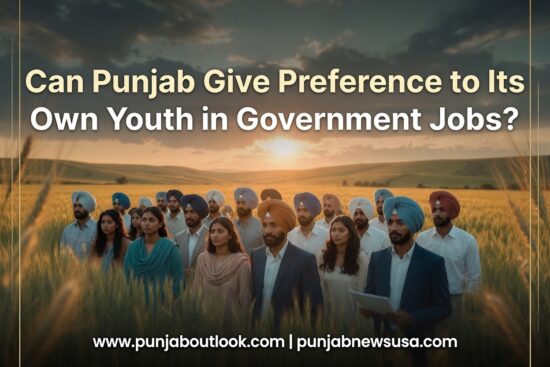
 Editorial Desk-The demand for greater employment opportunities for Punjab’s youth has moved beyond protest marches and political speeches. It has become one of the most significant public policy debates in the state. As unemployment and migration continue to dominate conversations in homes, colleges, and villages, many citizens are asking an important question: Can Punjab legally give preference to its own residents in government jobs?
The answer is more complex than a simple “yes” or “no.” It lies at the intersection of constitutional law, public policy, and the state’s responsibility to provide opportunities for its own people.Across Punjab, thousands of educated young men and women spend years preparing for competitive examinations. Many complete degrees in engineering, education, medicine, agriculture, information technology, law, and business. Yet a significant number remain unemployed or underemployed.
For these young people, the demand for greater local employment is not simply a political slogan. It reflects a desire to build careers in their own state, remain close to their families, and contribute to Punjab’s development instead of seeking opportunities thousands of miles away. Many ask why a state that has contributed so much to India’s food security, armed forces, economy, and industry cannot create enough quality employment for its own youth.
India’s Constitution guarantees equality before the law and equal opportunity in public employment. These principles ensure that every Indian citizen has fundamental rights regardless of the state in which they were born. Because of these constitutional protections, a state generally cannot exclude citizens from other states from government employment solely on the basis of residence unless there is a valid legal basis.
At the same time, the Constitution also allows governments to establish reasonable qualifications for certain posts, including, where legally justified, requirements related to language or other job-related criteria. Some states also have special constitutional or statutory provisions that differ from the general framework.This means that any proposal introduced by Punjab must be carefully designed to comply with constitutional requirements.Legal experts often suggest that instead of pursuing blanket restrictions, Punjab could focus on measures that are more likely to withstand legal scrutiny while benefiting local youth.
Possible approaches include:
Filling long-pending vacancies without unnecessary delay.
Expanding recruitment in education, healthcare, agriculture, policing, and public administration.
Strengthening Punjabi language requirements where they are directly relevant to the duties of the post and legally permissible.
Increasing investment in vocational education and technical training.
Encouraging industries receiving state incentives to create more opportunities for qualified local residents, consistent with applicable laws.
Such measures seek to strengthen employment within Punjab without undermining constitutional principles.The public discussion is not only about legal rules. It reflects deeper concerns about Punjab’s future.Every year, many talented young Punjabis leave the state and often the country—in search of better opportunities. Families invest enormous financial resources in overseas education because they believe stable careers are difficult to secure at home.Supporters of employment reform argue that if Punjab offered more opportunities, many young people would choose to stay, contribute to the local economy, and build businesses and families within the state.Most economists agree that employment protection alone cannot solve Punjab’s challenges.
The state also needs:
Modern industrial growth.
Expansion of manufacturing.
Greater investment in technology.
Support for start-ups and entrepreneurship.
Diversification beyond traditional agriculture.
Faster infrastructure development.
Transparent and timely recruitment to public-sector posts.
These reforms can create sustainable employment while making Punjab more competitive.Punjab has every reason to seek better opportunities for its young people. At the same time, any policy adopted by the state must respect the constitutional rights enjoyed by all Indian citizens.The challenge for policymakers is to design solutions that encourage local employment, reduce migration, and strengthen Punjab’s economy while remaining firmly within the framework of the Constitution.
The debate over local employment is likely to remain central to Punjab’s political and economic future.Young people are not asking for special treatment. Many are simply asking for a fair chance to build successful lives in the land where they were born, educated, and raised.Whether that goal is achieved through faster recruitment, stronger industrial development, improved education, or carefully designed employment policies, one fact is clear: Punjab cannot afford to lose another generation of talent.The future prosperity of the state depends on creating opportunities that allow its youth to dream, work, and succeed without feeling compelled to leave their homeland.
Disclaimer: This article and accompanying images are for informational and illustrative purposes only. Some visuals may be AI-generated or digitally enhanced and may not depict actual events or persons. Views expressed are based on publicly available information and analysis.