
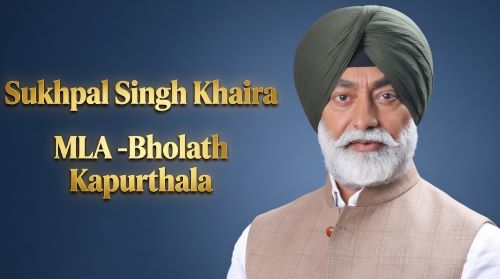
 Every successful political career begins with grassroots work, and Sukhpal Singh Khaira’s journey is no exception. Before entering the Punjab Legislative Assembly, he began his public life as a member of the Panchayat in his native village of Ramgarh in Kapurthala district. This early experience gave him direct exposure to rural administration and the day-to-day concerns of farmers, labourers, and village communities.
Khaira comes from a politically respected family. His father, Sukhjinder Singh Khaira, was a senior Shiromani Akali Dal leader and served as Punjab’s Education Minister. Although he inherited political exposure from his family, Sukhpal Singh Khaira chose to chart his own course and initially joined the Indian National Congress through its Youth Congress organization rather than following his father’s political path.
In 1997, he was appointed Vice-President of the Punjab Youth Congress, marking the beginning of his rise within the state Congress organization. During the following years, he served in several party positions, including Secretary of the Punjab Pradesh Congress Committee and President of the District Congress Committee in Kapurthala. These organizational responsibilities helped him build a network across Punjab and sharpen his political skills.
Khaira contested the Bholath Assembly constituency more than once before tasting electoral success. Although he was unsuccessful in his early attempts, he remained active in public life and continued strengthening his base among the people. His perseverance paid off in 2007 when he was elected as MLA from Bholath, defeating seasoned opponents and establishing himself as an important Congress leader in Punjab.
After losing the 2012 Assembly election, Khaira did not withdraw from politics. Instead, he continued to raise public issues and remained active in opposition politics. In 2015, dissatisfied with developments within the Congress, he joined the Aam Aadmi Party during its rapid expansion in Punjab. His move attracted considerable political attention because he was regarded as one of the state’s most vocal opposition leaders.
The 2017 Punjab Assembly election proved to be another milestone in his career. Khaira was elected once again from Bholath and was subsequently chosen as the Leader of the Opposition in the Punjab Legislative Assembly. In this role, he frequently questioned the government on matters relating to governance, agriculture, law and order, corruption, financial management, and the rights of Punjab. His speeches often became central to debates both inside and outside the Assembly.
Political differences within the Aam Aadmi Party eventually led to his removal as Leader of the Opposition in 2018. Later, he left the party and launched the Punjab Ekta Party, presenting it as a platform focused on Punjab’s regional interests. Although the party had a relatively short life, it reflected Khaira’s willingness to pursue an independent political path when he believed his principles differed from those of his party leadership.
In 2021, Khaira returned to the Indian National Congress, describing the move as an effort to strengthen the opposition against the ruling government. He resigned his Assembly seat before rejoining the Congress and successfully contested the 2022 Assembly election from Bholath, beginning his third term as an MLA. His victory demonstrated that he continued to enjoy significant support among voters despite several political realignments.
Today, Sukhpal Singh Khaira remains one of Punjab’s most recognizable legislators. Admirers view him as a fearless campaigner who consistently raises public issues, while critics question aspects of his political strategy and confrontational style. Regardless of differing opinions, few would dispute that he has remained an influential participant in Punjab’s political discourse for nearly three decades, with a career marked by resilience, debate, and active legislative engagement.
Building a Political Identity Through Persistence and Public Engagement
In politics, achievements are not measured only by the offices a leader holds but also by the ability to remain relevant, influence public debate, and maintain the confidence of the electorate over time. Sukhpal Singh Khaira’s political journey reflects these qualities. Through victories, defeats, party changes, and public campaigns, he has remained one of Punjab’s most recognized political personalities for nearly three decades.
One of Khaira’s significant achievements is his repeated election from the Bholath Assembly constituency. Winning elections in different political circumstances and under different party banners demonstrates that a substantial section of voters has continued to place confidence in his leadership. Electoral success over multiple terms requires sustained grassroots engagement, continuous public contact, and the ability to respond to local concerns.
His appointment as Leader of the Opposition in the Punjab Legislative Assembly after the 2017 Assembly elections marked one of the most important milestones of his career. The position placed him at the center of legislative debates and gave him responsibility for presenting the opposition’s viewpoint on government policies. During this period, he emerged as one of the state’s most visible opposition voices, regularly participating in debates on governance, public finance, agriculture, law and order, and administrative accountability.
Khaira has earned recognition for his command over legislative procedures and his ability to present detailed arguments during Assembly discussions. Many of his speeches have attracted significant media attention because they combined political criticism with references to official records, public policy, and constitutional issues. His familiarity with legislative rules has enabled him to effectively question governments through debates, motions, and formal interventions.
Another important aspect of his public career has been his accessibility. Unlike many politicians who become less visible between elections, Khaira has remained active throughout the year by meeting citizens, addressing public gatherings, participating in press conferences, and responding quickly to major political developments. This consistent engagement has strengthened his image as a leader who remains connected with public concerns beyond the election cycle.
Khaira has also developed a reputation for taking independent political positions, even when doing so has involved personal or political risks. Throughout his career, he has demonstrated a willingness to disagree with party leadership when he believed important principles or public interests were involved. While such decisions have occasionally resulted in political isolation or organizational conflicts, they have also reinforced his image as a politician prepared to defend his convictions.
Over the years, he has spoken extensively on issues relating to Punjab’s economy, agriculture, unemployment, education, healthcare, environmental challenges, federalism, and democratic institutions. Many of these concerns have remained central to public debate, allowing him to maintain relevance even during periods when his party was not in power.
Another noteworthy achievement has been his ability to communicate effectively with both traditional and digital media. Khaira regularly uses press briefings, interviews, and social media platforms to explain his political positions and respond to current events. In an era where communication plays a vital role in public life, this has helped him remain one of Punjab’s most visible legislators.
His long political career has also enabled him to develop relationships across party lines. Although political disagreements have often been intense, many leaders acknowledge his experience in legislative affairs and his understanding of Punjab’s political landscape. Such recognition reflects the respect that experienced legislators can earn through active participation in democratic institutions.
Public recognition, however, has not come without challenges. Strong political opinions have made Khaira a frequent target of criticism from his opponents. Governments that he has questioned have often rejected his allegations and defended their own policies. These disagreements are an expected part of democratic politics, where opposition leaders and governments regularly contest each other’s positions before the public.
Perhaps Khaira’s greatest political achievement is his ability to remain a relevant voice despite changing political circumstances. Few leaders successfully navigate electoral defeats, party changes, organizational disputes, and shifting political alliances while continuing to win public support and influence debate. His career illustrates resilience, adaptability, and sustained political engagement.
As Punjab continues to confront economic, social, and governance challenges, Sukhpal Singh Khaira remains one of the state’s experienced legislators whose opinions continue to attract public attention. Whether praised by supporters or challenged by critics, his contribution to Punjab’s democratic discourse has established him as a significant figure in contemporary state politics.
Legislative Performance, Public Campaigns, and the Politics of Accountability
A democracy functions effectively only when there is a strong and active opposition capable of questioning the government and holding those in power accountable. Throughout his legislative career, Sukhpal Singh Khaira has projected himself as one of Punjab’s most vocal opposition leaders. Whether serving as Leader of the Opposition or as a senior MLA, he has consistently used the floor of the Punjab Vidhan Sabha and public platforms to raise issues that he believes affect the people of the state.
Khaira has repeatedly focused on the growing financial burden on Punjab. During Assembly debates and public interactions, he has questioned rising public debt, the state’s fiscal management, and the long-term sustainability of government finances. He has argued that development should be accompanied by financial discipline so that future generations are not left with an unsustainable debt burden. His interventions have often sparked wider public discussions about Punjab’s economic direction.
Agriculture has remained another major area of his political engagement. Representing a predominantly rural constituency, Khaira has regularly spoken about the challenges faced by farmers, including increasing cultivation costs, declining profitability, groundwater depletion, crop diversification, and delayed procurement payments. He has urged successive governments to develop long-term agricultural policies that protect both farmers’ livelihoods and Punjab’s natural resources.
The issue of drug abuse has also been central to Khaira’s public campaigns. Over the years, he has repeatedly demanded transparent investigations into narcotics trafficking and has argued that the fight against drugs should target both the supply chain and the networks that enable organized crime. He has maintained that the battle against narcotics requires consistent enforcement, rehabilitation programs, and greater accountability within institutions responsible for law enforcement.
Khaira has frequently raised concerns about corruption and administrative transparency. Through Assembly questions, press conferences, and public statements, he has called for independent investigations into matters that he believes require public scrutiny. Supporters view these efforts as essential to democratic accountability, while political opponents have often rejected his allegations and defended government actions. These exchanges have contributed to some of Punjab’s most closely followed political debates.
Employment opportunities for Punjab’s youth have remained another recurring theme in his public speeches. Khaira has argued that unemployment continues to encourage migration of educated young people to foreign countries, resulting in a loss of skilled human resources. He has advocated policies aimed at attracting investment, strengthening industry, encouraging entrepreneurship, and creating sustainable employment within the state.
Education and healthcare have also figured prominently in his legislative interventions. He has called for improved government schools, better staffing in educational institutions, stronger public healthcare infrastructure, and equitable access to essential services, particularly in rural areas. According to Khaira, long-term investment in education and healthcare is fundamental to Punjab’s social and economic progress.
Khaira has also spoken extensively on issues relating to federalism and Punjab’s constitutional rights. He has participated in debates concerning river waters, Chandigarh, agricultural policies, and the balance of powers between the Union and the states. He has consistently argued that Punjab’s interests should be protected within the framework of the Constitution while maintaining national unity.
One of the defining characteristics of Khaira’s political style is his accessibility to the media. He regularly addresses press conferences, responds to current political developments, and communicates his positions through interviews and public meetings. This active engagement has helped keep him in the public eye and has made him one of Punjab’s most frequently quoted opposition leaders.
Like every experienced politician, Khaira’s legislative record has generated both appreciation and criticism. Admirers describe him as fearless, articulate, and committed to exposing issues of public importance. Critics contend that his confrontational approach sometimes leads to political polarization and prolonged controversies. These contrasting perceptions reflect the nature of competitive democratic politics, where strong advocacy often invites equally strong disagreement.
Despite differing political opinions, Sukhpal Singh Khaira has remained a significant participant in Punjab’s democratic process. His willingness to question governments, challenge policies, and engage in legislative debate has ensured that he continues to occupy an important place in the state’s political landscape. Whether viewed as a determined watchdog or a combative opposition leader, his role has undeniably contributed to shaping public discussion on governance, accountability, and Punjab’s future.