
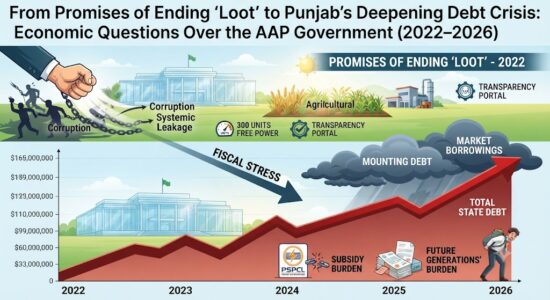
 When the Aam Aadmi Party came to power in Punjab in March 2022, it promised a new era of clean politics, transparency, financial discipline, and relief for ordinary people. The party presented itself as an alternative to traditional political parties and assured Punjabis that corruption and misuse of public money would end.However, after more than four years in power, Punjab’s financial condition has become a major political and economic debate. The opposition has accused the Bhagwant Mann government of pushing the state further into debt, relying heavily on market borrowing, and failing to create a sustainable economic model for Punjab.
2022: A Government With Big Promises and Growing Expectations
The AAP government took charge in March 2022 with promises of improving governance, providing free electricity to eligible households, creating employment opportunities, controlling corruption, and strengthening Punjab’s economy.One of its major decisions was the implementation of free electricity up to 300 units per month for eligible consumers. While the scheme provided relief to many households, questions were raised about its long-term financial impact on Punjab State Power Corporation Limited (PSPCL) and the state treasury.
Punjab was already facing a serious debt burden before 2022. The state had accumulated liabilities due to years of fiscal pressure, declining industrial growth, agricultural challenges, and increasing government expenditure. The new government inherited these challenges but was expected to bring reforms to improve the financial health of the state.
2023: Borrowing Becomes a Major Concern
During 2023, concerns grew over Punjab’s increasing dependence on loans. Critics argued that instead of reducing financial pressure, the government was continuing the pattern of borrowing to meet expenses.Economists and opposition leaders repeatedly questioned whether Punjab was moving toward a situation where a large portion of future revenues would be used only for repayment of debt and interest.The debate intensified around government spending priorities, subsidies, and administrative expenses. The opposition alleged that the government was focusing more on publicity and political branding rather than long-term economic reforms.
2024: Rising Debt and Questions Over Economic Management
By 2024, Punjab’s debt situation became one of the biggest political issues in the state. Opposition parties claimed that the state’s total debt had increased substantially and warned that future generations would face the consequences.The government defended its borrowing decisions, arguing that loans were necessary for development, infrastructure, welfare schemes, and fulfilling public commitments.However, critics questioned whether Punjab was creating enough new revenue sources to repay these loans. They argued that without industrial expansion, employment generation, agricultural reforms, and investment growth, borrowing alone could not solve Punjab’s economic problems.
2025: Financial Stress Reaches Power Sector
Punjab’s power sector became another major area of concern. PSPCL, the backbone of Punjab’s electricity system, faced financial challenges due to rising costs, subsidy burden, and operational pressures.Questions were raised about whether the state government was providing timely financial support to the power corporation and whether the current subsidy model was sustainable.The opposition alleged that even Punjab’s own institutions were being forced to seek loans because of financial pressure, creating a cycle where one government department depended on borrowing to manage daily operations.
2026: Fresh Borrowings and Political Battle Over Punjab’s Future
In 2026, the debate over Punjab’s economic direction intensified after allegations that the state government was planning additional market borrowing of around ₹13,000 crore.This came amid claims that Punjab’s power supplier PSPCL was also seeking financial assistance, reportedly including a demand for a ₹10,000 crore loan.Opposition leaders argued that Punjab was heading toward a dangerous financial situation where borrowing was becoming a routine method of governance rather than a temporary solution.They accused the AAP leadership of failing to control expenditure and claimed that decisions affecting Punjab were influenced by the Delhi leadership of the party. The phrase “Punjab becoming an ATM” for political interests became a major part of opposition criticism.
The Bigger Economic Question: Where Is Punjab Heading?
The central question facing Punjab is not only how much money the government is borrowing, but whether those loans are creating assets, jobs, industries, and future income opportunities.Punjab’s economy requires structural reforms:
revival of agriculture with sustainable income models;
expansion of industry and manufacturing;
creation of employment opportunities for youth;
strengthening of government revenue;
reduction of unnecessary expenditure;
transparent financial management.Borrowing can be useful when it creates long-term economic growth. But continuous borrowing without increasing income can create a serious burden for future generations.
Punjab Needs Economic Responsibility Beyond Political Slogans
The political debate over Punjab’s economy has become sharper as the state moves closer to the 2027 Assembly elections. The AAP government argues that it is implementing welfare measures and development projects, while the opposition claims that Punjab’s financial position has deteriorated.Ultimately, the people of Punjab will judge whether the government’s economic policies have improved their lives or increased the burden of debt.The future of Punjab cannot depend only on loans and political promises. It requires responsible financial management, investment, employment generation, and a clear economic roadmap that protects the interests of coming generations.
Disclaimer: This article and accompanying images are for informational and illustrative purposes only. Some visuals may be AI-generated or digitally enhanced and may not depict actual events or persons.Views expressed are based on publicly available information and analysis.