
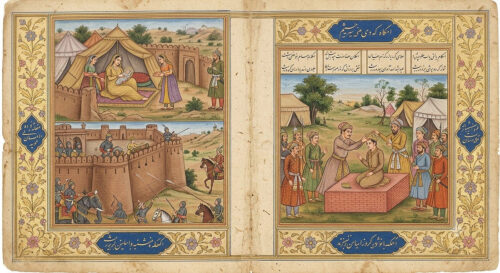
 Ask most Indians to picture Akbar the Great, and they picture K. Asif’s Mughal-e-Azam — a commanding emperor secure on his throne. That image tells us almost nothing about the boy who became him: born in a borrowed fort, held hostage by his own uncle, and crowned on a brick platform because there was no throne to sit on.
Born in Exile, Not in a Palace
Akbar was not born to comfort. In 1540, his father, Emperor Humayun, was decisively defeated by the Afghan chieftain Sher Shah Suri and driven out of India entirely — the young Mughal Empire, barely a generation old, simply ceased to hold any territory. Humayun fled westward with a shrinking band of loyalists, his wife Hamida Banu Begum among them. On 15 October 1542, sheltering at Amarkot in Sindh under the protection of a local Rajput chief, Rana Prasad, Hamida gave birth to a son. There was no empire for that child to inherit — only a fugitive father, a mother in hiding, and the goodwill of a Hindu host in someone else’s fort. That child was Akbar.
The Amarkot Debt — Repaid, Then Complicated
Akbar did not forget where he was born. As emperor, he maintained a benevolent hand toward Rana Prasad’s Sodha Rajput descendants at Amarkot: when his own regent’s family later sought a marriage alliance with the Rana’s household, the Sodhas were treated as honoured kin rather than mere subjects, and the family retained local standing and territory in the Tharparkar region for generations. But the relationship was not simply one of favour repaid — after Rana Prasad’s successor, Rana Megraj, died, governorship of the Amarkot fort itself passed out of direct Sodha hands to the son of Mirza Jani Beg, the Mughal-aligned ruler installed over Sindh. Gratitude, in other words, did not override the practical politics of empire — the Sodhas kept their honour and their region, but not always the fort where Akbar was born.

A Childhood Spent as a Hostage
Humayun soon left for Persia to seek Safavid military help, and infant Akbar was left behind — in the custody of his father’s own brothers, Kamran Mirza and Askari Mirza, who were themselves waging war against Humayun for control of Kabul and Qandahar. This was not a sheltered royal nursery. Akbar was, at different points, a captive inside a besieged fortress and a bargaining chip in his uncles’ war against his own father. In the most chilling episode, Kamran Mirza had the toddler Akbar placed on the ramparts of Kabul during Humayun’s siege of the city, exposing the child to his own father’s artillery to force Humayun to hold his fire. Humayun finally recovered custody of his son in 1545, but Akbar’s formative years had already been shaped by imprisonment, danger, and family betrayal.
Coronation on a Brick Platform
Humayun eventually reclaimed Delhi from the fractured Sur dynasty in 1555, restoring Mughal rule after a fifteen-year interruption. He did not enjoy it long. In January 1556, he died after a fall down the stone stairs of his library in Delhi. At the time, his thirteen-year-old son was in Punjab with his guardian and regent, Bairam Khan, campaigning against a Suri claimant. On hearing of his father’s death, the boy was crowned emperor at Kalanaur — in present-day Gurdaspur district, Punjab — on 14 February 1556. There was no jewelled throne room waiting for him. Contemporary accounts describe a hastily constructed brick platform serving as his coronation seat, out on campaign, far from any capital.
Delhi Slips Away — to a Hindu King
The new reign’s fragility was immediately tested. With the Mughal court distracted by the succession, an extraordinary rival emerged: Hemu, a trader from Rewari who had risen through sheer ability to become commander-in-chief for one of the Sur claimants. Undefeated in some twenty-two prior engagements, Hemu marched on Agra and then Delhi, crushing the modest Mughal garrison at the Battle of Delhi in October 1556. He took the city, crowned himself with the title Vikramaditya, and briefly ruled Delhi as an independent Hindu king — a genuine possibility, for a few weeks, that the newly restored Mughal dynasty might end before its teenage emperor had even properly begun his reign.
Panipat, Again
Bairam Khan chose to fight rather than retreat, marching the young Akbar’s army toward Delhi. The two forces met at the Second Battle of Panipat in November 1556 — the same ground where Akbar’s grandfather Babur had founded the empire three decades earlier. Hemu was winning the battle when a stray arrow struck him in the eye; he fell unconscious, and his army collapsed without him. He was captured and executed, and Delhi returned to Mughal hands.
The Regent’s Own Controversial End
Bairam Khan ruled as regent for four years, but by 1560 the teenage Akbar — encouraged by rival court factions, including his foster-mother Maham Anga — moved to end the regency and rule in his own right. Bairam Khan was eased out, and after a brief, half-hearted rebellion in Punjab that collapsed for lack of support, he submitted to Akbar in person and was pardoned. Given the choice between staying at court stripped of power or departing on pilgrimage to Mecca, he chose the latter. Travelling through Gujarat toward the coast, he stopped near Patan, where on 31 January 1561 he was ambushed and killed by a band of Afghans led by Mubarak Khan Lohani, avenging his father’s death in an earlier battle against Bairam Khan. The killing has never been entirely free of suspicion — a personal revenge killing, certainly, but one that conveniently removed a recently sidelined power-broker just as he was leaving the empire he had helped build for his own protégé. Akbar, for his part, brought Bairam Khan’s widow and young son, Abdul Rahim, to Agra and married the widow, Salima Sultan Begum — his own first cousin, and a woman better known in her own right as an educated poet (”Makhfi”) and later a trusted court diplomat than as a mother, since the marriage produced no children. Abdul Rahim, born of Bairam Khan’s earlier wife, grew up under Akbar to become one of his own most trusted nobles.
The Distance Between the Boy and the Legend
Before he was “the Great,” Akbar was a refugee’s son, a hostage on a besieged rampart, a boy crowned on brick because no throne existed, and a teenage king who watched his capital fall to another ruler within months of his own coronation — and whose own guardian would die in ambiguous, violent circumstances soon after. The historical record gives us a far more precarious, far more human story than the marble certainty of the screen.