
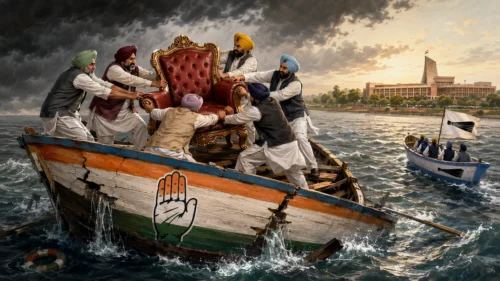
 The AAP government faced questions over law and order, drugs and governance. The Akali Dal remained fractured, while the BJP carried a rural trust deficit. Congress had won seven of Punjab’s 13 Lok Sabha seats in 2024 and possessed an organisation spread across the state. Congress had every chance to form the government in 2027. Today, it is struggling to keep itself afloat.
What went wrong? Congress became too confident too early. Its leaders treated a favourable situation as a guaranteed victory. The contest stopped being about defeating AAP and became a contest over who would control the party, distribute tickets and occupy the Chief Minister’s chair.
Optimism produced ambition. Ambition became greed for the top post. That greed created competition among leaders aplenty.
Punjab Congress has a state president, a Leader of the Opposition, a former Chief Minister, former Deputy Chief Ministers, MPs and regional heavyweights. But when too many leaders prepare for the same chair, strength becomes weakness.The party started dividing the spoils before it had won the battle. The warning signs were visible in the municipal elections. AAP won 958 wards, while Congress managed only 397. Instead of forcing an organisational review, the setback produced more factional warfare.
The crisis did not begin in July. In January, the high command ruled out a leadership change. In March, Rahul Gandhi told Punjab leaders to become team players or sit on the reserve bench. His warning had little effect.After the civic-poll setback, a May meeting with the high command reportedly became stormy.
Then came Congress strategist Sunil Kanugolu’s assessment. Its figures are not public, but its reported message was clear: Congress could win only through unity. At the latest Delhi meeting, Kanugolu reportedly indicated a decline in Malwa after Amarinder Singh Raja Warring was retained as PPCC president.If Congress trusts surveys while selecting candidates and planning campaigns, it cannot simply ignore them when they raise questions about its leadership.
The July 1 arrangement retained Warring, made Charanjit Singh Channi Campaign Committee chairman and gave Sukhjinder Singh Randhawa the Core Committee. It created several power centres without one accepted command: power-sharing without shared purpose.Channi’s supporters organised shows of strength at Morinda and Mohali. At one meeting with Punjab in-charge Bhupesh Baghel, around 90 leaders, including at least 12 sitting MLAs, reportedly supported a leadership change. Randhawa said the party did not need a “compromised president”.
For the anti-Warring camp, removing Warring became non-negotiable.The high command took the opposite position. Baghel said organisational appointments could not be changed whenever someone applied pressure, describing the party as not a “gudda-guddi ka khel”. Rahul Gandhi’s continued support for Warring made his retention equally non-negotiable.Two non-negotiable positions cannot produce unity. They produce paralysis.
The latest Delhi meeting exposed the deterioration. KC Venugopal reportedly expressed strong annoyance with Warring, Channi and Randhawa for washing the party’s dirty linen in public. Even this sharp reprimand failed to produce a settlement.Channi reportedly offered to resign as Campaign Committee chairman if Warring continued. Randhawa and Rana Gurjeet Singh questioned why survey reports were being ignored. The meeting remained inconclusive.
Congress now proposes a Unity Bus Yatra. But placing rival leaders in one bus cannot create unity if every passenger wants to grab the steering wheel.The high command’s hesitation is understandable. In Madhya Pradesh, the Kamal Nath-Jyotiraditya Scindia conflict ended with Scindia and 22 MLAs leaving and the Congress government collapsing. In Assam, it lost Himanta Biswa Sarma, who became the BJP Chief Minister.Delhi does not want another split. But Congress can remain united on paper while being hollowed out by mistrust, parallel commands and silent sabotage.Warring cannot be blamed for everything. Channi and Randhawa cannot demand unity while building competing power centres. Nor can every disagreement become a contest over the next Chief Minister.The problem is larger than one individual. Punjab Congress has an abundance of leaders but no accepted leadership.
Meanwhile, AAP is enjoying the spectacle. Bhagwant Mann can point towards Congress and say that every leader there wants to become Chief Minister. This allows AAP to avoid questions about its own record and argue that Congress cannot provide a stable government because it cannot govern itself.The damage is greater because the BJP’s 18.56 per cent vote from the 2024 Lok Sabha election may come under pressure. The Ram Mandir donation controversy and the youth-led Cockroach agitation over examination leaks have placed the BJP on the defensive nationally, with consequences in Punjab too.
The BJP’s entire vote is not transferable. But its floating urban, trading, Hindu and anti-incumbency voters may move towards AAP or Congress, generally favouring the party most likely to form the government.
Six months ago, Congress appeared to be the natural beneficiary of any BJP decline. Today, its infighting makes AAP look more coherent and therefore more likely to win.
Congress is not merely losing its existing support. It is surrendering the opportunity to inherit a part of the BJP’s nearly 19 per cent vote. In a close election, even a movement of a few percentage points could become decisive.
What happens now?
The high command will probably retain Warring because removing him under pressure would reward rebellion. Channi and Randhawa are also unlikely to leave because their influence remains tied to Congress.
The greater danger is a cold civil war. Leaders will stay but operate through separate camps. Every rally will become a headcount, every survey a weapon. Unity will be performed in public while sabotage continues in private.
Congress must decide now. If Warring is to remain, he must be given clear authority and every camp must face the same discipline. If the party’s internal evidence shows that his continuation is causing serious electoral damage, the change should be made now, not in panic on the eve of the election. Each day delay is causing more damage.
But it is still not late. If all things are put in right place, Congress still has strong chance to harness power. It has the strongest cadre, strongest baseline vote bank. In a five cornered contest, it just has to keep its core vote bank intact and not allow it to shift.
The worst option is the present one: retaining Warring formally while allowing every senior leader to run a parallel command.
Six months ago, Congress had every chance to form the next Punjab government. Its leaders mistook that opportunity for an accomplished victory and began fighting over the Chief Minister’s chair.
But it is still not late!!