
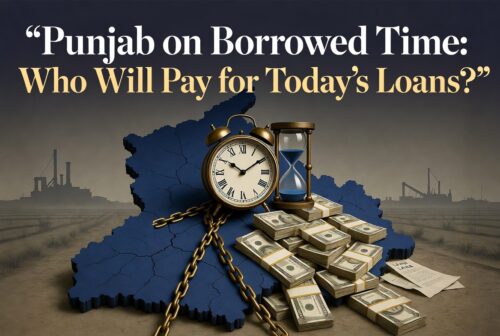
 Punjab’s debt story is no longer just about numbers buried inside a Budget document. It is becoming a question of political accountability, economic survival and intergenerational justice. Every fresh loan announced by the state government may be presented as a routine financial transaction, but behind the borrowing is a much larger question: is Punjab borrowing to build its future, or borrowing to pay for its past?
The distinction matters because Punjab is entering a period in which an increasingly large portion of its financial resources is already committed before a new rupee is spent. The government has projected gross borrowings of about ₹1.32 lakh crore for 2026–27. That figure alone is striking. But the more revealing number is the nearly ₹93,726 crore that the state expects to repay during the same year. Punjab is therefore operating within a cycle in which enormous sums are raised while enormous sums are simultaneously required to meet earlier obligations.
This is not necessarily evidence of financial mismanagement. States routinely refinance maturing debt. But it does expose the central vulnerability of Punjab’s finances: the state has become heavily dependent on the continuous management of debt. The question is whether this borrowing cycle is gradually becoming self-perpetuating.
Consider the broader picture. Punjab’s outstanding liabilities are projected to remain around 45 per cent of GSDP in 2026–27. The government can point to the fact that this ratio is below the levels recorded during the pandemic years. That is a legitimate defence. But a lower ratio does not erase the underlying burden. The projected outstanding debt is still enormous, potentially reaching around ₹4.5 lakh crore. Behind that figure are future interest payments, future repayments and future Budgets that will have to accommodate obligations created today.And this is where the arithmetic becomes uncomfortable.
Punjab is not simply dealing with old debt. It continues to run a revenue deficit. The 2026–27 Budget estimates a revenue deficit of around ₹21,955 crore. That means the state’s regular revenue remains insufficient to meet its regular expenditure. In other words, even before the government considers major new infrastructure projects, it has a structural gap in its day-to-day finances.That should be the biggest warning sign.
A government can reasonably borrow for a bridge, a highway, an irrigation project or an industrial corridor because such assets can contribute to economic growth for years. But borrowing to meet a recurring revenue gap is fundamentally different. It does not create an asset capable of generating a future return. It simply pushes the financial problem forward.Punjab therefore faces a difficult question that cannot be answered through political slogans: how much of its borrowing is creating new economic capacity, and how much is merely keeping the existing system running?The government needs to answer this question publicly and in detail.
Every rupee borrowed should have a destination. Citizens should know how much of the borrowing programme is being spent on capital projects, how much is being used to refinance existing liabilities, how much is required for short-term cash management and how much ultimately supports recurring expenditure. Without such information, the public is being asked to judge Punjab’s financial health from a headline borrowing number that tells only part of the story.
The political debate has so far remained trapped between two extremes. The government says it inherited a massive debt burden and is keeping borrowing within permissible limits. The opposition points to fresh loans and warns that Punjab is being pushed towards bankruptcy. Both sides are simplifying a complicated fiscal reality.Punjab did inherit a serious debt problem. Successive governments contributed to the accumulation of liabilities, while structural pressures such as pensions, salaries, subsidies, interest payments and weak revenue growth have been building for years. It would therefore be inaccurate to blame the entire debt burden on one administration.But inheritance is not immunity.
A government cannot keep pointing backwards indefinitely. Once in office, it becomes responsible for changing the trajectory. The relevant question is not who signed the old loan documents. It is whether the government in power today is doing enough to ensure that Punjab will need fewer loans tomorrow.That is where the scrutiny must intensify.
The government’s argument that borrowing is being used for development is reasonable in principle. Punjab urgently needs infrastructure. Its roads, cities, irrigation systems, industrial infrastructure, health facilities and public services require investment. Development cannot be achieved without expenditure, and expenditure cannot always be financed entirely from current revenue.But development spending should produce something tangible.
A loan that creates a productive asset is fundamentally different from a loan that disappears into recurring expenditure. The first can strengthen future growth; the second can leave behind nothing except another repayment obligation.This distinction is especially important because Punjab’s economy needs a new growth engine. Agriculture remains enormously important, but the state cannot expect agricultural activity alone to generate the revenue required to service a debt burden of this magnitude. Punjab needs stronger manufacturing, food processing, logistics, services, technology, tourism and other sectors that can create jobs and expand the tax base.Without faster economic growth, debt reduction becomes extremely difficult.
But there is another side to the growth argument. The government cannot simply assume that economic growth will automatically solve the debt problem. If growth falls short of expectations while salaries, pensions, subsidies and interest payments continue to rise, the debt ratio could come under renewed pressure.That is why fiscal reform cannot wait for growth to rescue the Budget.
Punjab’s subsidy structure requires particularly close examination. Subsidies may be politically popular and socially necessary, but they have a recurring fiscal cost. Electricity subsidies, agricultural support and welfare programmes can consume resources year after year. The question is not whether the poor or farmers should receive support. The question is whether the support is properly targeted and whether the state can afford it over the long term.
A government that refuses to discuss the cost of subsidies is not having an honest conversation about fiscal sustainability.There is also a less visible part of Punjab’s debt story: contingent liabilities. State guarantees for public-sector entities may not immediately appear as direct government debt, but they can become a taxpayer liability if the entities concerned cannot meet their obligations. The same is true of financially stressed state-owned corporations and utilities.This is why Punjab needs a full balance-sheet approach to debt.
The public should be told not only how much the government owes directly, but also what it guarantees, what its public-sector entities owe, what the annual interest bill is, when major loans mature and how much future revenue is already committed.Without this information, the state’s financial position cannot be properly understood.The most important question may therefore be hidden behind the headline debt number: what is the cost of carrying the debt?
A ₹4.5 lakh crore liability is not simply a static figure. It generates interest costs and repayment obligations year after year. Those payments compete directly with spending on schools, hospitals, roads, irrigation and employment programmes. The higher the debt-servicing burden becomes, the less freedom the government has to respond to new economic or social challenges.This is how fiscal stress develops—not necessarily through a dramatic collapse, but through the slow disappearance of choices.A government discovers that next year’s revenue is already committed. Then the following year’s revenue becomes committed. Eventually, the Budget becomes less about deciding what the government wants to do and more about managing what it is already obliged to pay.Punjab must avoid reaching that point.
The state’s borrowing limits should therefore not become the benchmark for success. The fact that borrowing remains within a legally permitted ceiling does not mean borrowing is automatically sustainable. A responsible government should aim much higher than merely staying below the maximum allowed limit.The benchmark should be whether debt is falling relative to the state’s capacity to generate revenue and whether borrowing is producing sufficient economic returns.There is also a political cost to ignoring this issue. Debt allows governments to spend today while shifting part of the financial burden into the future. That can make difficult decisions politically easier. The benefits are immediate; the costs are delayed.But delayed costs are still costs.
Punjab’s younger generation will eventually inherit the consequences of today’s borrowing decisions. They will pay taxes in an economy that may have to devote a significant share of its revenues to servicing old liabilities. If today’s borrowing produces world-class infrastructure, productive industries and better economic opportunities, that burden may be justified. If the money merely finances recurring expenditure, the next generation could inherit debt without inheriting corresponding assets.That is the real test of responsible borrowing.
The government should therefore publish a detailed five-year debt and fiscal consolidation roadmap. It should specify how much debt it expects to carry each year, how it plans to reduce the revenue deficit, what proportion of borrowing will finance capital expenditure, how subsidy costs will be managed, how revenue will be increased and when the state expects to achieve a sustainable fiscal position.Such a roadmap would also force governments to move beyond annual political accounting.
Because Punjab’s debt problem will not be solved in one Budget.Nor will it be solved by blaming the previous government.Nor will it be solved by announcing another loan and calling it development.It requires several years of disciplined policy.The state needs to increase its own revenues, expand the productive economy, improve tax compliance, rationalise subsidies, reform financially weak public-sector entities and protect capital expenditure. At the same time, it must prevent recurring expenditure from growing faster than its revenue base.
Most importantly, Punjab must change the culture of borrowing from “How much can we raise?” to “What return will this borrowing generate?”That is the question that should accompany every new loan announcement.A ₹1,000-crore loan should not merely produce a press release. It should come with a project, a timeline, a cost-benefit assessment and a clear explanation of how the investment will strengthen Punjab’s economy.
The same principle should apply to borrowing running into tens of thousands of crores.Punjab cannot afford to treat debt as an accounting entry. Debt is a claim on the future.And that future is already becoming expensive.The state is not bankrupt. Claims of imminent financial collapse should not be exaggerated for political effect. Punjab still has a substantial economy, significant productive potential and the ability to raise revenue and attract investment. But neither should the government underestimate the warning signals.
A debt burden approaching half of GSDP, a continuing revenue deficit, massive annual repayment obligations and persistent dependence on borrowing represent a serious fiscal challenge.The danger is not that Punjab will suddenly run out of money tomorrow morning.The danger is that, year after year, the state will have less and less money left after paying for yesterday.That is why Punjab’s borrowing plans deserve scrutiny far beyond the politics of the latest loan.
The real investigation should begin with three simple questions:Where is the borrowed money going?What assets or economic returns will it create?And who will ultimately pay for it?Until those questions are answered transparently, Punjab’s debt story remains incomplete.The state may be borrowing to build its future. It may also be borrowing to postpone its past.The numbers suggest that policymakers have very little time left to ensure that it is the former not the latter.
Disclaimer: This article and accompanying images are for informational and illustrative purposes only. Some visuals may be AI-generated or digitally enhanced and may not depict actual events or persons.Views expressed are based on publicly available information and analysis.