
 There was a time when Sikh leadership possessed the political strength, unity and moral authority to tell the Union government that no major decision affecting Punjab or the Sikh community could simply be taken without taking Sikh leadership into confidence. There was a time when Sikh leaders sitting across the negotiating table with New Delhi were not merely requesting favours, appointments or financial packages. They were representing a political community with clearly defined demands and were prepared to make it clear that Punjab’s interests could not be ignored.
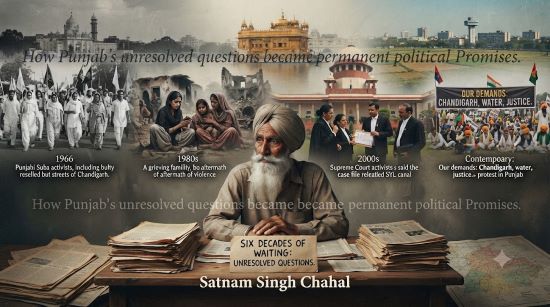
Sadly, that political confidence and collective bargaining strength appears to have weakened considerably over the decades. Since the reorganisation of Punjab in 1966, nearly six decades have passed, governments have changed, political parties have risen and fallen, and countless leaders have occupied positions of power, but many of the fundamental political, constitutional, territorial, economic and religious questions concerning Punjab and the Sikh community remain unresolved. The tragedy is that issues which should have been settled through political negotiations decades ago continue to return in every generation as election promises, protest slogans and government resolutions.
The reorganisation of Punjab on November 1, 1966, which followed the long struggle for Punjabi Suba, was supposed to provide a new beginning. Instead, it created a new political geography that left several contentious questions unresolved. Chandigarh became a Union Territory and the shared capital of Punjab and Haryana. The question of Punjabi-speaking areas that remained outside Punjab continued to generate resentment. The territorial question was never fully settled, and Chandigarh gradually became one of the most enduring symbols of Punjab’s unfinished political settlement.
The 1970s brought another major development. The Anandpur Sahib Resolution of 1973 placed greater state autonomy, Centre-State relations, economic rights and the political and cultural interests of Punjab at the centre of Sikh political discourse. Whatever interpretation different political parties may place on the resolution today, there is no denying that it represented an attempt to articulate Punjab’s concerns within the federal structure of India. The questions it raised about Centre-State relations and the distribution of constitutional powers, however, never disappeared. Instead, they became part of the larger political confrontation between Punjab and New Delhi.
By the early 1980s, Punjab had entered a dangerous period of political confrontation. The Dharam Yudh Morcha transformed the nature of the struggle, while the deteriorating law-and-order situation and rise of militancy pushed Punjab towards one of the darkest chapters in its modern history. Operation Blue Star in June 1984, the assassination of Prime Minister Indira Gandhi later that year and the horrific anti-Sikh violence that followed left deep wounds. Four decades later, questions of justice, accountability, rehabilitation and the treatment of victims continue to influence the political consciousness of Punjab and the Sikh community.
The 1985 Rajiv Gandhi-Sant Harchand Singh Longowal Accord was perhaps one of the most important opportunities to resolve Punjab’s major political disputes through negotiation. The agreement dealt with several contentious matters, including Chandigarh, territorial claims, river waters, Centre-State relations and other grievances. It represented a political recognition that Punjab’s problems could not be solved through confrontation alone. Unfortunately, implementation became controversial and incomplete, and the assassination of Sant Longowal only weeks after the agreement dealt another devastating blow to the possibility of sustained political reconciliation. An important opportunity was lost.
The following decades saw the restoration of peace and democratic politics in Punjab, but peace did not automatically bring resolution. Many families continued to seek justice for the violence of the 1980s and 1990s. Questions concerning Sikh prisoners, rehabilitation and accountability remained sensitive. At the same time, Chandigarh and the territorial question remained unresolved, while the river-water dispute continued to dominate relations between Punjab, Haryana and the Union government.
The river-water issue is perhaps the clearest example of how an unresolved question can survive for generations. Punjab’s position has repeatedly been that its water resources and agricultural economy must be protected, while Haryana has maintained its claims to its share of the waters. The Sutlej-Yamuna Link canal became a symbol of this larger dispute. In 2004, the Punjab government enacted the Punjab Termination of Agreements Act, leading to a constitutional dispute that eventually reached the Supreme Court. Years later, the matter remains politically sensitive. What should have been resolved through political federalism became a prolonged legal and inter-state confrontation.
The SYL controversy again came to the forefront in 2016 when the Supreme Court dealt with the Presidential Reference concerning the Punjab legislation. Instead of disappearing with the passage of time, the dispute became further entrenched. The lesson is obvious: when political leadership fails to find a durable settlement, unresolved questions eventually move from the negotiating table to courtrooms, commissions and administrative institutions.
The same pattern continues today. In the 2020s, Punjab is still debating Chandigarh, river waters, the BBMB, federal relations and the rights and interests of the state. Farmers and political organisations continue to protest over water and other Punjab-related issues. Governments change, but the underlying disputes remain remarkably familiar. The language of the political debate may change, but the questions remain almost the same.
The issue of Sikh prisoners is another matter that continues to demand attention. Sikh organisations, including the SGPC, have repeatedly raised the demand for the release of prisoners who have completed their sentences. This issue cannot simply be treated as another political slogan. It involves questions of justice, constitutional principles, rehabilitation and equal application of law. If an individual has completed the sentence imposed by a court, the circumstances surrounding continued incarceration deserve transparent and accountable examination.
But while it is easy to place the entire responsibility on New Delhi, Punjab’s own political leadership must also accept responsibility. Over the last six decades, different political parties have raised Punjab’s issues when they were in opposition and often adopted different priorities when they came to power. Leaders have promised to fight for Chandigarh, water, federalism, Punjabi-speaking areas, Sikh prisoners and other concerns, but Punjab has rarely maintained a permanent, united and bipartisan negotiating position that survives a change of government.
This is perhaps Punjab’s greatest strategic weakness. The Union government knows that Punjab’s political position can change whenever the government changes in Chandigarh. One party raises an issue today, another raises a different interpretation tomorrow, and the same question becomes part of political competition. Instead of presenting one permanent Punjab position to New Delhi, political parties frequently compete with one another over who can claim to be the greater defender of Punjab.
That fragmentation has weakened Punjab’s bargaining power.
There was a time when Sikh leadership could mobilise large sections of society around a political demand and negotiate with New Delhi from a position of collective strength. Today, the Sikh political landscape is divided among political parties, religious organisations, factions, farmer organisations, civil society groups and individual leaders. Democratic diversity is not itself a problem. The problem arises when there is no common institutional mechanism through which the community and Punjab can establish a long-term position on issues of fundamental importance.
Punjab does not need every political party to agree on everything. It does not require political opponents to stop criticising one another. But there must be certain fundamental issues on which political competition ends and collective interest begins. Chandigarh should not become merely an election issue. Punjab’s water should not become a five-year political slogan. Punjabi language and culture should not be remembered only when elections approach. Questions of justice should not be revived only on anniversaries. These issues require permanent institutional commitment.
The history of Punjab since 1966 therefore tells a painful story. In 1966, Punjabi Suba was created, but Chandigarh and territorial questions remained. In 1973, the Anandpur Sahib Resolution articulated demands for greater state autonomy and federalism. In 1982, the Dharam Yudh Morcha intensified political confrontation. In 1984, Punjab and the Sikh community suffered an unprecedented political and humanitarian tragedy. In 1985, the Rajiv-Longowal Accord offered a possible political settlement, but its promise was never fully realised.
The history of Punjab since 1966 therefore tells a painful story. In 1966, Punjabi Suba was created, but Chandigarh and territorial questions remained. In 1973, the Anandpur Sahib Resolution articulated demands for greater state autonomy and federalism. In 1982, the Dharam Yudh Morcha intensified political confrontation. In 1984, Punjab and the Sikh community suffered an unprecedented political and humanitarian tragedy. In 1985, the Rajiv-Longowal Accord offered a possible political settlement, but its promise was never fully realised. In the following decades, peace returned but many questions remained. In 2004, the water dispute entered another major constitutional phase. In 2016, the SYL controversy again returned to the centre of national attention. In the 2020s, Chandigarh, water, BBMB, Sikh prisoners and federal concerns continue to dominate political debate.
Nearly six decades later, the question must therefore be asked: how many more generations must wait?
A young person born at the time of Punjabi Suba in 1966 would now be approaching 60. Someone who experienced the events of 1984 as a young adult could now be a senior citizen. Yet many of the political questions that shaped their youth are still being discussed by their children and grandchildren.
This is not simply a failure of one government, one political party or one generation. It is a failure of political strategy over decades.
Punjab needs to stop passing the same political file from one government to another. The state needs a comprehensive and permanent Punjab agenda, developed through consultation among political parties, the SGPC, farmers, constitutional experts, economists, academics, legal experts, civil society and the Punjabi diaspora. Such an agenda should clearly identify which issues require constitutional reform, which require legislation, which require inter-state negotiations and which can be resolved through administrative decisions.
Most importantly, Punjab needs to establish a principle that its fundamental interests must not change with the government of the day. Whether the government in Chandigarh is led by Congress, SAD, AAP, BJP or any future political formation, the core interests of Punjab must remain consistent.
This does not mean creating one political party or demanding blind political unity. It means creating a common minimum position on matters that affect Punjab’s long-term future.
The Sikh community also needs institutions capable of thinking beyond elections. Religious institutions should not become tools of short-term political battles, and political parties should not be allowed to use religious institutions merely for electoral advantage. Punjab needs leadership that can think 20, 30 and 50 years ahead rather than only until the next election.
The most important lesson of the last six decades is that Punjab cannot expect others to protect its interests if its own political leadership remains divided. It is convenient to blame New Delhi for every unresolved issue, but Punjab must also ask what it has done to build permanent political institutions capable of negotiating with the Union government.
The real question today is not whether Punjab can repeat the demands of 1966, 1973 or 1985. The real question is whether today’s leadership has the courage, unity, political maturity and institutional vision to finally resolve them.
Nearly six decades have passed since Punjabi Suba.
Generations have come and gone.
Governments have changed.
Political parties have changed.
Leaders have changed.
But the questions remain.
Punjab cannot afford another six decades of waiting. It needs a new political strategy, a new negotiating framework and, above all, leadership capable of restoring the collective bargaining strength that Sikh leadership once possessed.
The time has come to move from resolutions to results, from slogans to settlements, and from political fragmentation to collective strength.
Punjab deserves nothing less.