
America has always presented itself to the world as a nation where people of different races, religions, nationalities and cultures can live together under one Constitution and one promise of equal protection. Yet the years from 2020 to 2026 have exposed a disturbing contradiction between that promise and the reality experienced by thousands of Americans. Hate has not disappeared. It has entered neighborhoods, schools, workplaces, houses of worship, public transportation, political debates and social media. And when hatred crosses the line from prejudice into threats, intimidation or violence, it becomes more than an ugly opinion—it becomes a direct threat to American democracy.
The Federal Bureau of Investigation’s hate-crime statistics tell a disturbing story. In 2020, the country was already dealing with thousands of reported bias-motivated crimes. The COVID-19 pandemic then created a particularly dangerous environment for Asian Americans, as political rhetoric and misinformation contributed to harassment and hostility against people who were blamed for a virus that knew no nationality or race. The message from that period should never be forgotten: when political or social fear is directed at an entire community, innocent people can suddenly become targets simply because of their appearance or ancestry.
Then came the “Stop Asian Hate” movement. Asian Americans, including elderly people and women, reported verbal abuse, intimidation and physical attacks. Some victims were targeted while walking on the street. Others were attacked in businesses or public places. The common thread was often the same—the attacker believed that the victim’s race or appearance made that person an acceptable target. A country that allows an elderly American to fear leaving home because of the color of his skin has a problem far deeper than statistics can describe.
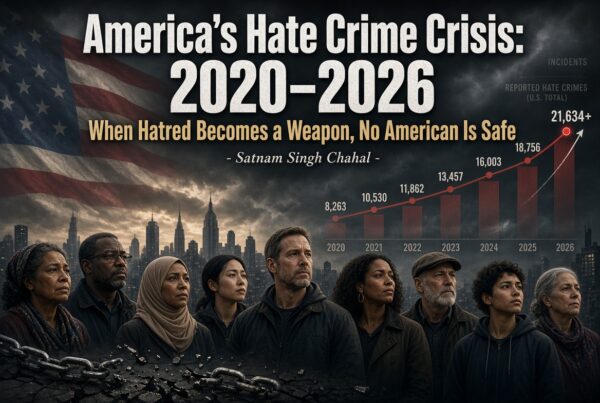
The problem was not limited to Asian Americans. The FBI’s subsequent reporting showed that race, ethnicity, ancestry, religion, sexual orientation and other forms of identity continued to be involved in thousands of reported hate crimes. By 2022 and 2023, hate crimes remained at extraordinarily high levels. In 2023, law-enforcement agencies reported 11,862 hate-crime incidents involving 13,829 related offenses. These numbers should shake the conscience of a nation that claims to believe in equality.
Religion became one of the most troubling dimensions of the crisis. Jewish Americans faced significant antisemitic incidents. Muslim Americans continued to experience anti-Muslim hostility. Sikh Americans faced anti-Sikh incidents. Other religious communities also experienced attacks and intimidation. The problem is not that one community has a monopoly on suffering. The problem is that America is witnessing a growing pattern in which people are sometimes judged, threatened or attacked because of the religious identity they were born into or freely chose.
For Sikh Americans, this danger has a particularly painful dimension. A Sikh can often be identified immediately because of the turban and beard. Those visible articles of faith should represent dignity, devotion and religious freedom. But ignorance can turn visibility into vulnerability. A person who knows nothing about Sikhism may make assumptions based entirely on appearance. In the worst cases, that ignorance can lead to harassment or violence.
A turban is not a political statement. A beard is not evidence of extremism. The Sikh kirpan is not a symbol of criminality. These are connected to Sikh religious identity and practice. Yet Sikhs have repeatedly had to explain who they are in a country that should not require any citizen to justify his or her right to exist openly as a member of a faith.
The FBI recognizes anti-Sikh bias as a category of religious hate crime. That recognition matters, but statistics alone cannot protect anyone. A Sikh family does not become safer simply because an anti-Sikh incident is recorded in a federal database. Safety requires education, prevention, community engagement, trained police officers, serious investigations and meaningful prosecution when crimes occur.
The danger is not merely physical. Hate crimes create psychological walls around communities. When one Sikh is attacked, other Sikh families wonder whether they could be next. When one Muslim woman is threatened, other Muslim women become more cautious. When one Jewish family receives a threat, other Jewish families worry about their children. When an Asian American is assaulted, thousands of others may feel less secure walking through the same neighborhood. Hate therefore does not stop with the victim. It sends fear through an entire community.
The years 2023 and 2024 also demonstrated how international conflicts can spill into American communities. Americans have every right to protest wars, criticize foreign governments and debate international policy. But an American citizen cannot be held responsible for the actions of a foreign government simply because of religion, ancestry or nationality. An American Jew is not the government of Israel. An American Muslim is not a foreign terrorist organization. An American Sikh is not responsible for the actions of any political group. An American Hindu is not responsible for the policies of the Indian government. Americans must be judged as individuals.
This principle is especially important for immigrant communities. The United States has been built by generations of immigrants who arrived with different languages, religions and traditions. Many came with little more than hope. They worked, paid taxes, opened businesses, educated their children and contributed to the American economy and civic life. Yet immigrants can still be treated as permanent outsiders. Being told to “go back” to a country someone has never lived in is not merely an insult. It is a reminder that prejudice can survive even after generations of citizenship.
The 2024 FBI data showed that hate crime remained a major national concern. Law-enforcement agencies reported 11,679 hate-crime incidents involving 13,683 related offenses. Although that represented a modest decline from the previous year, it was nowhere near a level that should allow America to declare victory. A decline in reported incidents in one year does not mean hatred has disappeared. It does not erase the fear created by previous attacks, and it certainly does not guarantee that the following year will be safer.
There is another problem that must be confronted: underreporting. The official FBI numbers cannot capture every incident of hatred in America. Victims may be afraid to report. Some may not trust the police. Immigrant families may fear contact with authorities. Others may believe that reporting will not make a difference. Some victims may not even know that an incident qualifies as a hate crime. Therefore, the official statistics should be understood as a record of reported and captured incidents—not a perfect measurement of the amount of hatred in American society.
Social media has made the situation even more dangerous. Hatred that once remained inside a small circle can now reach millions of people within minutes. Conspiracy theories can spread across communities. Racial insults can become viral entertainment. Religious hatred can be packaged as political commentary. Threats can be delivered directly to victims. And people who would never say certain things publicly can hide behind anonymous accounts.
America must defend freedom of speech, but freedom of speech should never be confused with freedom to commit violence. Political disagreement is protected. Religious debate is protected. Criticism of governments is protected. Peaceful protest is protected. But credible threats, stalking, intimidation, assault and violence are crimes, regardless of the political or religious justification offered by the perpetrator.
The greatest danger may be the normalization of hate. A society rarely moves from tolerance to violence overnight. The process often begins with words. First comes the joke. Then the stereotype. Then the accusation. Then the dehumanization. Then the threat. And eventually, in some cases, violence. When society laughs at the early stages, it should not be surprised when the later stages become more dangerous.
This is why political leaders have a special responsibility. They cannot condemn hate only when the victim belongs to their political camp. Hate must be condemned regardless of whether the victim is Republican or Democrat, conservative or liberal, Sikh or Muslim, Jewish or Hindu, Black or White, Asian or Latino, immigrant or native-born. Selective outrage is not leadership. It is political convenience.
America also needs better hate-crime education and law-enforcement training. Police officers should understand the religious and cultural communities they serve. They should know what Sikh articles of faith represent. They should understand Islamic and Jewish religious practices. They should know why some immigrant victims may hesitate to report crimes. They should recognize that a hate crime can traumatize an entire community, not just the person named in a police report.
Schools have an equally important responsibility. Children who learn nothing about the people around them can easily become victims of stereotypes. Teaching students about Sikhism, Islam, Judaism, Hinduism and other faiths does not weaken American identity. It strengthens it. Knowledge destroys the ignorance upon which hatred depends.
The North American Punjabi Association believes that the fight against hate must never become a competition between communities. The Sikh community does not need another community to lose so that Sikhs can win. We need an America where nobody has to win or lose based on identity. An attack on a Sikh is an attack on religious freedom. An attack on an Asian American is an attack on equality. An attack on a Muslim is an attack on religious liberty. An attack on a Jewish American is an attack on the right to live without fear. An attack on any minority is ultimately an attack on the American principle itself.
The United States must also recognize that the years 2025 and 2026 should not be used for careless statistics. As of 2026, the latest complete nationwide FBI hate-crime dataset available is for 2024. Responsible journalists and organizations should therefore avoid presenting unverified 2025 or 2026 numbers as official national FBI totals. But the absence of a finalized national number does not mean the problem has disappeared. Communities continue to report threats, bias and fear, and law-enforcement agencies continue to investigate hate-related offenses.
America does not need to wait for the next annual report to decide whether hatred is dangerous. It already knows the answer.The real question is whether America has the courage to act before another victim becomes another statistic.The country needs a national commitment to preventing hate crimes, improving reporting, strengthening community-police relations, educating young people and prosecuting criminal acts without political favoritism. It also needs political leaders who understand that the safety of minorities is not a minority issue. It is an American issue.
The true test of American democracy is not how comfortably the majority lives. The true test is whether a Sikh father can walk down the street wearing his turban without fearing attack. Whether a Muslim woman can wear her hijab without being threatened. Whether a Jewish family can enter a synagogue without wondering whether someone is waiting outside with hatred in his heart. Whether an Asian American can speak his native language in public without being told to leave. Whether a Black child can grow up believing that the law will protect him. Whether an immigrant can proudly say, “This is my country too.”
Those are not extraordinary demands. They are the minimum requirements of a democratic society.America’s promise was never that everyone would look alike, worship alike or think alike. Its promise was that people who are different could still live together under the protection of the same law.That promise is now being tested.The United States can either allow hatred to become normalized, or it can draw a firm line and say that identity will never be a license for violence.
The turban must be safe.
The hijab must be safe.
The yarmulke must be safe.
The cross must be safe.
Every skin color must be safe.
Every name must be safe.
Every religion must be safe.
And every American regardless of race, religion, ancestry or background—must be able to walk down an American street without wondering whether being different could make them the next target.America does not need less diversity. America needs less hatred.Because when hatred decides who belongs, democracy itself becomes the victim.
Disclaimer: This article and accompanying images are for informational and illustrative purposes only. Some visuals may be AI-generated or digitally enhanced and may not depict actual events or persons.Views expressed are based on publicly available information and analysis